
Security teams have spent years hardening endpoints, identities, networks, cloud workloads, and data. Now there is a new layer sitting inside security operations- AI
- It summarizes incidents.
- It enriches alerts.
- It writes KQL queries.
- It triages phishing.
- It helps analysts make sense of security signals, ticketing systems, threat intelligence, identity data, cloud telemetry, and endpoint activity.
In more mature environments, AI is no longer just assisting. It is starting to recommend and trigger response actions.
That is a good thing.
Alert volumes are not coming down. Attackers are already using AI. SOC teams need speed, scale, and consistency. Microsoft reported that analysts using its Security Copilot Phishing Triage Agent achieved up to 6.5 times as many true positives per analyst minute and a 77% improvement in verdict accuracy compared with a control group. But there is a risk in how many organizations are getting there.
AI is being added to the SOC faster than the AI layer is being secured.
One 2026 survey of more than 900 executives and technical practitioners found that 80.9% of technical teams had moved beyond AI-agent planning into testing or production, but only 14.4% reported full security approval for their entire agent fleet. The same research reported that 88% of organizations had confirmed or suspected AI-agent security incidents in the past year. We have seen this pattern before. Business value moves first. Controls catch up later.
The difference this time is that the technology being deployed is not just another analytics tool. It is a reasoning layer with access to sensitive security data, privileged workflows, and in some cases, automation hooks.
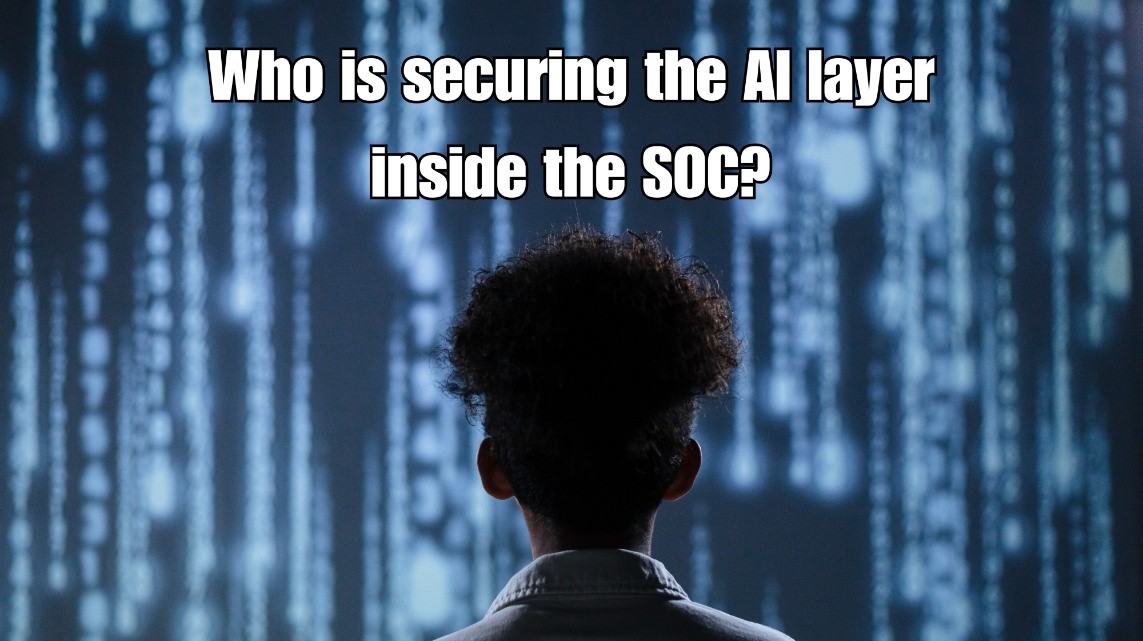
So the question is not whether the SOC should use AI. The better question is:
What We Mean by the AI Layer
The AI layer is more than the model. In an enterprise SOC, it includes prompts, instructions, retrieved context, embeddings, agent memory, plugins, connectors, tool calls, service identities, approval workflows, logs, and policies that decide what AI can see and what AI can do.
That layer now sits between analyst intent and security action. If managed well, it becomes a force multiplier for the SOC. If left unmanaged, it becomes a new privileged attack surface inside the very team responsible for defense.
Why the AI Layer Creates New SOC Risk
The SOC is a special case because the data its AI reads is partly written by the people you are defending against. Logs, phishing emails, suspicious attachments, command lines, URLs, user agents, DNS names, attempted usernames, and ticket comments are not clean business documents. They are evidence. Many of them may be attacker-controlled. In a traditional SOC, that evidence is something an analyst reads. In an AI-assisted SOC, that same evidence becomes model context.
That changes the risk.
Recent research on prompt injection against LLM-augmented security operations tested attacks hidden inside adversarial log content. The study found that attacker-controlled log fields could manipulate LLM-assisted SOC tasks, with summarization showing particularly high exposure: context manipulation reached 96% injection success without defenses and 38% even with constrained output.
That matters because summarization is exactly where many SOCs start using AI.
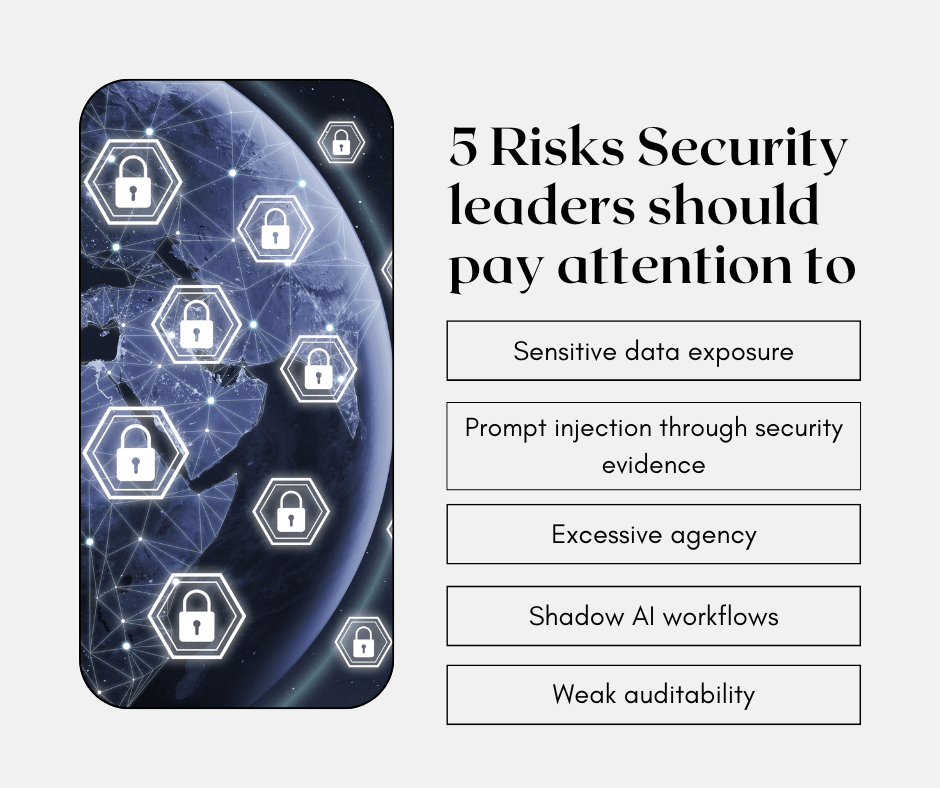
1. Sensitive data exposure
Prompts and retrieved context can include incident details, usernames, hostnames, IPs, email content, endpoint telemetry, identity signals, business context, and sometimes regulated data.
Without governance, that data can move into vendor logs, shadow tools, unmanaged stores, or places where DLP and retention policies were never designed to look.
2. Prompt injection through security evidence
Prompt injection in the SOC does not need to look like a chatbot trick. It can be buried in a log line, phishing email, attachment text, URL, ticket comment, or command-line argument.
The attacker does not need to compromise the model. They only need to influence the evidence the model is asked to summarize, classify, or act on.
3. Excessive agency
AI agents may run queries, enrich cases, open or close incidents, call APIs, trigger SOAR workflows, isolate hosts, disable accounts, or recommend control changes.
If the agent has more access than the task requires, the blast radius grows.
4. Shadow AI workflows
Analysts are practical. If the approved workflow is slow, they will use the tool that gives them an answer.
That may be Security Copilot, Microsoft 365 Copilot, an embedded AI feature, a custom script, a browser-based AI tool, or something a power user built quickly.
Some of that productivity is valuable. Some of it is invisible data movement and unaudited decision-making.
5. Weak auditability
If an AI assistant summarizes an incident incorrectly, who catches it?
If an agent closes an alert, can the team reconstruct why?
If it recommends containment, can you see the prompt, retrieved evidence, model response, user approval, tool call, and final action?
In regulated environments, that evidence trail is not optional. It is what makes AI acceptable to the business.
Standards Help, but They Must Become Operational
AI security is not starting from a blank page. Frameworks such as NIST AI RMF, ISO/IEC 42001, ISO/IEC 23894, OWASP LLM Top 10, and MITRE ATLAS help define risk, governance, and adversarial threat models for AI-enabled systems. But for a SOC, these frameworks only become useful when they show up in the operating model. That means inventory, ownership, risk classification, access boundaries, agent identity, prompt and tool-call telemetry, AI red teaming, incident response, and governance evidence.
It is one thing to say “govern AI.”
It is another to understand how analysts actually use Microsoft Defender, Sentinel, Entra ID, Purview, Security Copilot, SOAR, threat intelligence, case management, and custom automation at 2 a.m. during an active incident.
What CISOs Can Do Now
The goal is not to slow down AI adoption in the SOC. The goal is to make it safe enough, governed enough, and measurable enough to scale.
Here are five practical steps.
1. Build an AI usage inventory
Map every place AI touches SOC work: Security Copilot, Microsoft 365 Copilot, AI features inside Defender, Sentinel, Purview, Entra-related workflows, custom agents, automation scripts, RAG pipelines, plugins, connectors, and informal analyst tools. Capture what each tool can see, what it can do, who owns it, and where its logs go.
2. Classify AI use cases by risk
Not every AI use case needs the same control depth. Summarizing a case is different from closing one. Writing a KQL query is different from executing remediation. Classify use cases by data sensitivity, autonomy, tool access, user exposure, regulatory impact, and business consequence.
3. Govern AI agents like privileged identities
Agents need owners, identities, scoped access, permission reviews, version control, lifecycle rules, and deactivation paths. Where possible, separate the component that reasons from the component that acts. Use least privilege and avoid shared service accounts that make accountability difficult.
4. Make AI activity observable
Prompt logging alone is not enough. The SOC needs the full transaction: user prompt, system instruction version, retrieved evidence, model response, policy decision, tool call, user approval, and final action. This telemetry should support detection engineering, compliance, insider risk, and incident response.
5. Red-team the AI layer through real SOC workflows
Do not only test prompts in a lab. Test hostile emails, adversarial log lines, poisoned retrieval entries, malicious attachment text, manipulated ticket comments, crafted command-line telemetry, and unsafe tool outputs.
The question is not simply, “Can the model be jailbroken?”
The better question is: Can adversarial evidence change a SOC decision or action?
The Business Outcome: Faster SOC, Lower Risk, Stronger Trust
Securing the AI layer is not only a technical hygiene exercise. It is what allows the SOC to use AI for real business outcomes:
- Faster triage without losing control of sensitive data
- Better analyst productivity without creating shadow workflows
- More consistent investigations without blind trust in model output
- Safer automation without giving agents excessive privilege
- Better auditability for regulators, customers, and executives
- Higher confidence that AI-SOC investments are reducing risk, not moving it somewhere less visible
That is the positive story. AI can make the SOC more effective. But only if the AI layer is designed, governed, instrumented, and tested like the production security infrastructure it has become.
The Bottom Line
Somewhere in your organization, someone owns endpoint security. Someone owns identity. Someone owns cloud posture. Someone owns data protection.
Now ask a harder question:
Who owns the security of the AI inside your security stack?
In many companies, the answer is still split between the SOC leader who adopted the tool, the platform team that integrated it, the governance team still classifying it, and a vendor whose internal controls may not be fully visible.
That gap matters. The AI layer is now part of production security infrastructure. It has access to sensitive data, privileged workflows, analyst decisions, and response actions. It also has a unique attack surface because the evidence it reads can be influenced by adversaries.
CISOs who assign ownership, inventory the layer, govern agent access, instrument AI activity, and test it through real SOC workflows will not slow down AI adoption.
They will make AI adoption credible at enterprise scale.
At YASH Technologies, this is the direction we support through AI Autonomous SOC and Security Services for AI — helping organizations modernize security operations with AI while securing the AI systems, agents, prompts, workflows, and governance layers behind them.

Shivaram Jeyasekaran
Director – Cybersecurity Services, YASH Technologies
A distinguished cybersecurity leader with over 23 years of experience transforming enterprise security landscapes across global organizations. He is recognized for architecting and scaling robust cybersecurity programs that align with business objectives while maintaining cutting-edge defense capabilities. Shivaram has spearheaded numerous large-scale cybersecurity consulting engagements in his illustrious career, helping organizations navigate complex security challenges while balancing innovation with risk management. His approach combines strategic vision with practical implementation, ensuring organizations stay resilient in the face of evolving cyber threats.
More From Author.
Related Posts.

Beyond MTTD and MTTR: How to Prove the Business Value of an AI-Enabled SOC
Shivaram Jeyasekaran

Your SOC Has Enough Alerts. Does It Deliver the Answers the Business Needs?
Shivaram Jeyasekaran



The Future of Security Operations Is Decision Intelligence-Augmented
Senthilvel Kumar

The Microsoft Security Shift CISOs Can’t Ignore
Mahipal Kirupanithy Senthilvel Kumar Shivaram Jeyasekaran


AI vs AI: Why Traditional SOCs Are Losing the 2026 Threat Race
Senthilvel Kumar Vikash Kumar

Mythos Moves in Hours. Your MTTD Starts Too Late
Shivendra Sharma