

AI vs AI: Why Traditional SOCs Are Losing the 2026 Threat Race
Publish Date: June 18, 2026A few months ago, Google’s Mandiant team published findings on a threat cluster that had quietly compromised seventeen enterprise networks using an autonomous agentic framework. No single human attacker drove it — the system planned, adapted, and adjusted its approach based on what it observed in each environment, in real time, without waiting for instructions.

The attacker’s playbook has changed
For years, security teams built their defenses around a predictable enemy. Malware followed fixed scripts, phishing emails had patterns, and intrusions left signatures that detection tools could learn and flag. That predictability is gone.
CrowdStrike’s 2026 Global Threat Report found a 340% jump in AI-assisted intrusion attempts compared to just two years earlier, with AI tools now behind roughly 38% of credential-harvesting campaigns worldwide. Researchers have also documented malware that rewrites its own code mid-execution, generating new obfuscation techniques on the fly to slip past tools still looking for yesterday’s signature.
The unsettling part isn’t just that attacks are faster. It’s that they’re adaptive. An AI-driven intrusion can probe your defenses, notice what triggers an alert, and quietly change course before a human analyst even sees the activity. Some researchers now call this “AI vs AI” — because increasingly, that’s what’s happening on the wire.
Why human-speed SOCs can’t keep up
Here’s the number that should concern every security leader: the average enterprise still takes 197 minutes — well over three hours — to detect a breach. Agentic attackers are learning to exploit exactly that gap.
Most SOCs are still built around a familiar rhythm — alerts queue up, analysts triage them by hand, and response follows once someone has reviewed the evidence. That rhythm worked when attackers moved at human speed too. It doesn’t work against a system that can re-plan its attack the moment it senses resistance, and that’s why agentic intrusions are so hard to catch in progress — not because security teams lack skill, but because the architecture beneath them was never designed for adversaries that learn.
What “fighting AI with AI” actually means
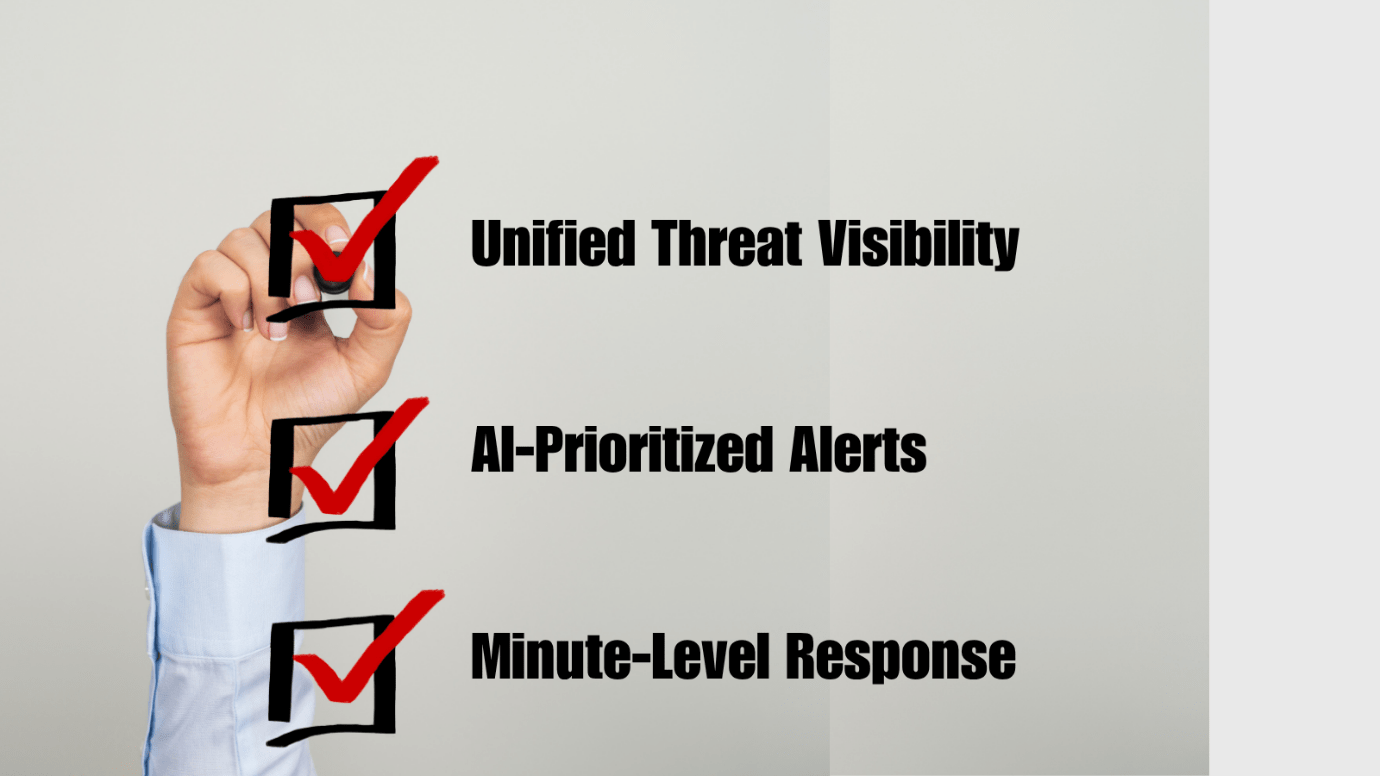
The instinct might be to add more tools, more dashboards, more alerts. But more noise isn’t the answer — most teams are already drowning in it. The shift that matters is architectural, and it comes down to three changes.
- First, stop monitoring surfaces in isolation. Today’s attacks rarely stay confined to one layer — they move across endpoint, cloud, identity, and SaaS in sequence. Detection has to correlate signals across all of them at once, or the attacker simply steps around whichever surface you’re watching most closely.
- Second, let AI do the sorting AI created the need for. The volume of alerts a modern environment generates was never meant to be triaged by hand. The goal is fewer, sharper alerts — with the noise filtered out before an analyst ever sees a queue.
- Third, design for response in minutes, not review cycles. If an attacker can re-plan the moment it senses resistance, a SOC that waits for a human to read, decide, and act has already lost the race.
None of this removes the human from the loop. It changes what the human is doing — moving from sifting through noise to making judgment calls on the threats that actually warrant attention. That’s a more valuable use of a skilled analyst’s time, not a smaller one.
The real question for security leaders
Agentic attacks aren’t a future risk to plan for someday. They’re active now, documented across industries, and growing quickly. The gap between attackers and defenders is real, but it isn’t insurmountable — the organizations closing it are rethinking their SOC’s architecture around correlation, AI-assisted triage, and faster response, rather than just adding headcount to an old model.
So the question worth asking isn’t whether your organization will eventually face an AI-driven attack. It’s whether your SOC, as it’s built today, would even notice — and if the answer isn’t a confident yes, that’s the conversation worth having this quarter.

Senthilvel Kumar
Vice President – Cyber Security Services
Senthil is a cyber security Practice Head and VP at YASH offering advisory on cyber security solutions to CxO's, CISO, Board Level Executives for building a robust security modernization programme covering on-prem and Cloud.

Vikash Kumar
Sr. Manager - Cybersecurity
Vikash serves as a Senior Manager at YASH Technologies, where he drives service delivery for the NAM accounts and supports Endpoint Detection and Response (EDR) services across the organization’s portfolio.
More From Author.
Related Posts.

Beyond MTTD and MTTR: How to Prove the Business Value of an AI-Enabled SOC
Shivaram Jeyasekaran

Your SOC Has Enough Alerts. Does It Deliver the Answers the Business Needs?
Shivaram Jeyasekaran



The Future of Security Operations Is Decision Intelligence-Augmented
Senthilvel Kumar

The Microsoft Security Shift CISOs Can’t Ignore
Mahipal Kirupanithy Senthilvel Kumar Shivaram Jeyasekaran

Your SOC Is Using AI. But Who Is Securing the AI Layer?
Shivaram Jeyasekaran

Mythos Moves in Hours. Your MTTD Starts Too Late
Shivendra Sharma