

Passkeys, Unified SecOps, AI Agent Governance, and Secure Copilot Adoption
Microsoft security is entering a new phase. For years, many enterprise security improvements were optional. Organizations could enable stronger authentication, modernize their SOC, govern data access, or secure Copilot adoption at their own pace.
That flexibility is changing – Across Microsoft Entra ID, Microsoft Sentinel, AI agents, and Microsoft 365 Copilot, several security shifts are now moving from “recommended” to “required.” For CISOs, this is not just a Microsoft roadmap update. It is a readiness moment.
The question is no longer: Are these capabilities available?
The question is: Is the organization prepared to adopt them securely and on time?
Passkeys are moving from optional to expected
Microsoft is pushing organizations toward phishing-resistant authentication. Beginning September 1, 2026, passkeys will be automatically enabled for users currently enabled for SMS or voice MFA. From February 1, 2027, tenants that have not configured a customer-managed telecom provider will no longer be able to use Microsoft-provided SMS or voice for MFA.
The direction is clear. Passwords and phishable MFA methods are no longer enough.
For CISOs, the challenge is not only technical. It is operational. How many users still rely on SMS or voice MFA? Which groups need passkeys first? How will frontline workers, contractors, shared devices, and recovery processes be handled?
The organizations that prepare early will turn this into an identity modernization opportunity. The ones that wait may face user disruption, helpdesk pressure, and rushed exceptions.
Sentinel is moving into the Defender portal
Microsoft Sentinel is also moving into a unified security operations model. After March 31, 2027, Microsoft Sentinel will no longer be supported in the Azure portal and will be available only in the Microsoft Defender portal.
This should not be treated as a simple portal change. For SOC teams, it affects how analysts view incidents, investigate alerts, manage workflows, align permissions, and coordinate response across Microsoft Sentinel and Defender XDR.
It is a chance to reduce tool switching and improve SOC productivity. But it also requires careful planning around access, automation, reporting, escalation processes, and analyst readiness.
A good migration plan should not begin with the easiest workspace. It should test real SOC complexity: identity, endpoint, email, cloud, and incident workflows together.
AI agents need governance
AI agents are becoming part of enterprise workflows. They can read data, trigger actions, call APIs, and support business processes. But many organizations still do not have a clear view of which agents exist, who owns them, or what access they have.
Microsoft Entra Agent ID is now generally available and extends identity and access management to AI agents, helping organizations authenticate, authorize, govern, and protect agent identities at enterprise scale.
This matters because unmanaged agents can become a new identity risk. Every agent should have an owner, defined permissions, lifecycle controls, access reviews, and monitoring. If an AI agent behaves unexpectedly, security teams should be able to answer three questions quickly: Which agent was it? What did it access? Who is accountable?
Copilot needs a secure data foundation
Microsoft 365 Copilot does not create most data exposure problems. It often reveals the ones that already exist.
If sensitive files are overshared in SharePoint or Teams, Copilot may surface them to users who already have access. That makes permission hygiene, sensitivity labels, DLP, audit logging, and restricted discovery critical before broad adoption.
Microsoft now provides controls such as Copilot security dashboards, Restricted Content Discovery, Purview data security capabilities, and Copilot audit logs to help organizations manage oversharing and AI interaction risks.
The safest approach is phased adoption: assess oversharing, remediate high-risk sites, apply guardrails, monitor usage, and then scale.
What CISOs should do now?
These four shifts point to one larger message: Microsoft security is becoming more unified, identity-driven, AI-enabled, and governance-led.
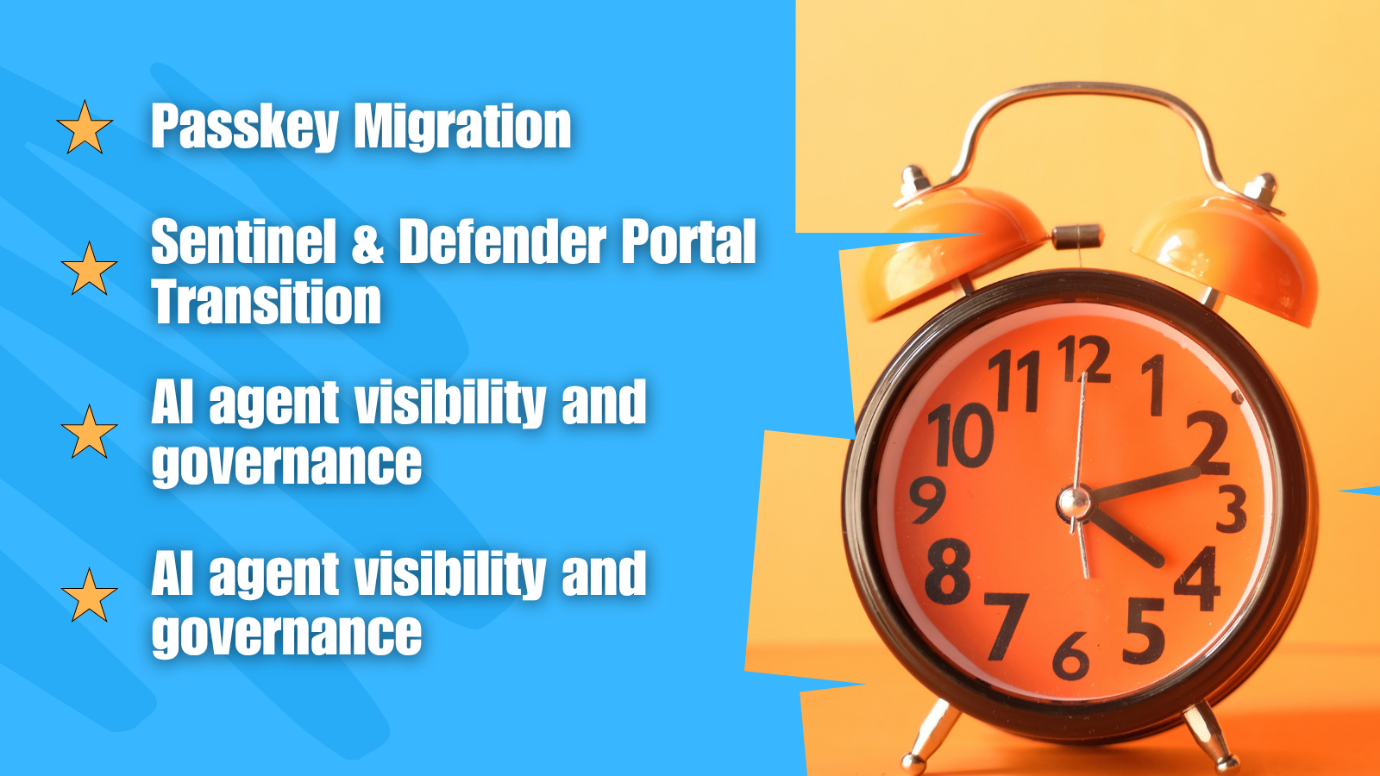
CISOs should use the next two quarters to assess readiness across four areas:
None of this is just a tool update. It affects users, SOC operations, data governance, identity risk, and board-level cyber resilience.
The organizations that act early will enter 2027 with stronger controls and fewer surprises.
The ones that delay may still get there — but under more pressure, with less time, and higher risk.
YASH can help organizations assess their Microsoft Security readiness across passkeys, Unified SecOps, AI agent governance, and secure Copilot adoption.
If your team is planning for these Microsoft security shifts, now is the right time to review gaps, define priorities, and build a practical readiness roadmap.
Connect with YASH to schedule a Microsoft Security Readiness Discussion

Senthilvel Kumar
Vice President – Cyber Security Services
Senthil is a cyber security Practice Head and VP at YASH offering advisory on cyber security solutions to CxO's, CISO, Board Level Executives for building a robust security modernization programme covering on-prem and Cloud.

Shivaram Jeyasekaran
Director – Cybersecurity Services, YASH Technologies
A distinguished cybersecurity leader with over 23 years of experience transforming enterprise security landscapes across global organizations. He is recognized for architecting and scaling robust cybersecurity programs that align with business objectives while maintaining cutting-edge defense capabilities. Shivaram has spearheaded numerous large-scale cybersecurity consulting engagements in his illustrious career, helping organizations navigate complex security challenges while balancing innovation with risk management. His approach combines strategic vision with practical implementation, ensuring organizations stay resilient in the face of evolving cyber threats.

More From Author.
Related Posts.

Beyond MTTD and MTTR: How to Prove the Business Value of an AI-Enabled SOC
Shivaram Jeyasekaran

Your SOC Has Enough Alerts. Does It Deliver the Answers the Business Needs?
Shivaram Jeyasekaran



The Future of Security Operations Is Decision Intelligence-Augmented
Senthilvel Kumar

Your SOC Is Using AI. But Who Is Securing the AI Layer?
Shivaram Jeyasekaran

AI vs AI: Why Traditional SOCs Are Losing the 2026 Threat Race
Senthilvel Kumar Vikash Kumar

Mythos Moves in Hours. Your MTTD Starts Too Late
Shivendra Sharma