
From Process to Intelligence: How Agentic AI is Redefining HR Operations
Publish Date: March 13, 2026For years, HR teams have quietly powered organizations behind the scenes—processing payroll, managing compliance, handling employee queries, and maintaining workforce records. Yet despite its importance, HR has often been perceived as a transactional function rather than a strategic driver of business value.
However, this perception is rapidly changing. As enterprises navigate workforce complexity, hybrid work models, and accelerating skill demands, HR operations are undergoing a profound transformation. Artificial Intelligence, particularly the emergence of Agentic AI, is enabling HR teams to move beyond administrative efficiency toward intelligent workforce orchestration.
At YASH Technologies, we see this shift redefining the very role of HR. What was once a back-office function is now becoming a strategic engine for talent, productivity, and organizational agility.
From Generative AI to Agentic AI
The first wave of AI adoption in HR was driven by Generative AI, which automated content-heavy tasks such as drafting job descriptions, summarizing policies, and assisting with employee communication. While valuable, these tools largely functioned as assistants.
Today, organizations are entering the next phase of AI maturity with Agentic AI—autonomous systems capable of executing complex workflows across multiple enterprise platforms with minimal human intervention.
Unlike traditional automation, Agentic AI systems can understand context, trigger actions, and manage multi-step processes across systems such as SAP, Oracle Cloud, and collaboration platforms.
Imagine an AI agent that does more than identify potential candidates. It can:
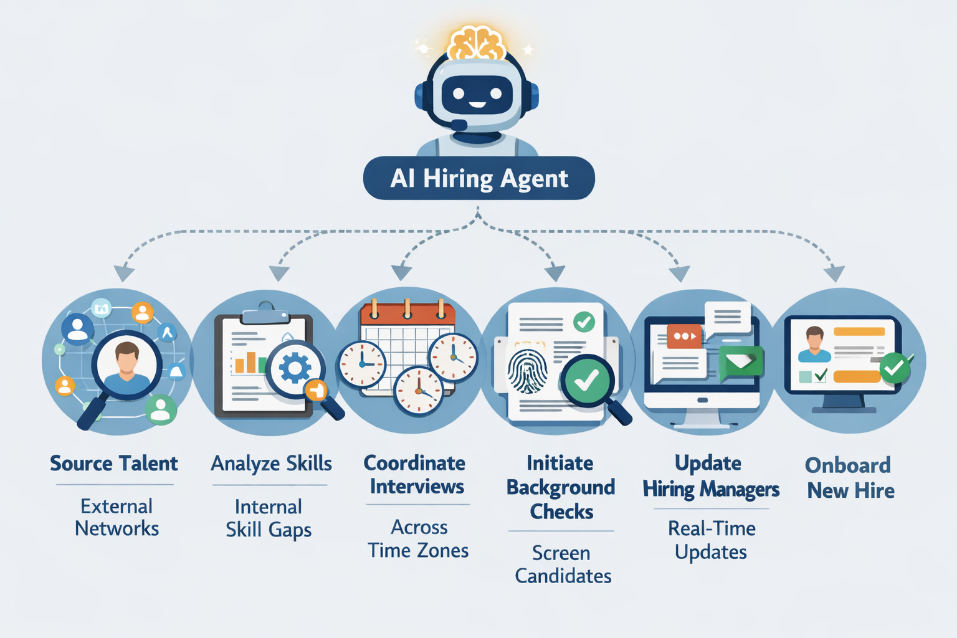
This shift moves HR operations from reactive administration to intelligent orchestration.
Transforming the Talent Lifecycle
AI-led HR operations are transforming every stage of the employee journey—from recruitment to engagement and continuous development.
In recruitment, organizations are moving beyond traditional Applicant Tracking Systems toward intelligent talent ecosystems. AI-powered skill modeling allows companies to identify candidates with adjacent capabilities and long-term potential rather than relying solely on past job titles.
- Once a candidate joins, AI-driven onboarding systems deliver personalized learning journeys, role-specific documentation, and contextual guidance from day one. This significantly reduces onboarding friction and accelerates employee productivity.
- Payroll and compliance, traditionally among the most complex HR functions, are also being redefined. AI systems can now interpret global labor regulations, automatically apply tax policies, and flag anomalies before payroll cycles close. For enterprises operating across multiple geographies, this capability ensures greater accuracy while minimizing compliance risks.
- Employee engagement is also evolving. Annual surveys are giving way to continuous listening models, where AI analyzes sentiment signals across digital workplace platforms. By identifying patterns related to disengagement or burnout, HR teams can intervene earlier with targeted support.
Perhaps most significantly, AI is enabling the emergence of skills-first organizations. As technological change accelerates, job roles evolve faster than ever. AI-powered learning platforms continuously assess employee capabilities and recommend personalized upskilling paths aligned with future business needs.
Insight: The Productivity Multiplier
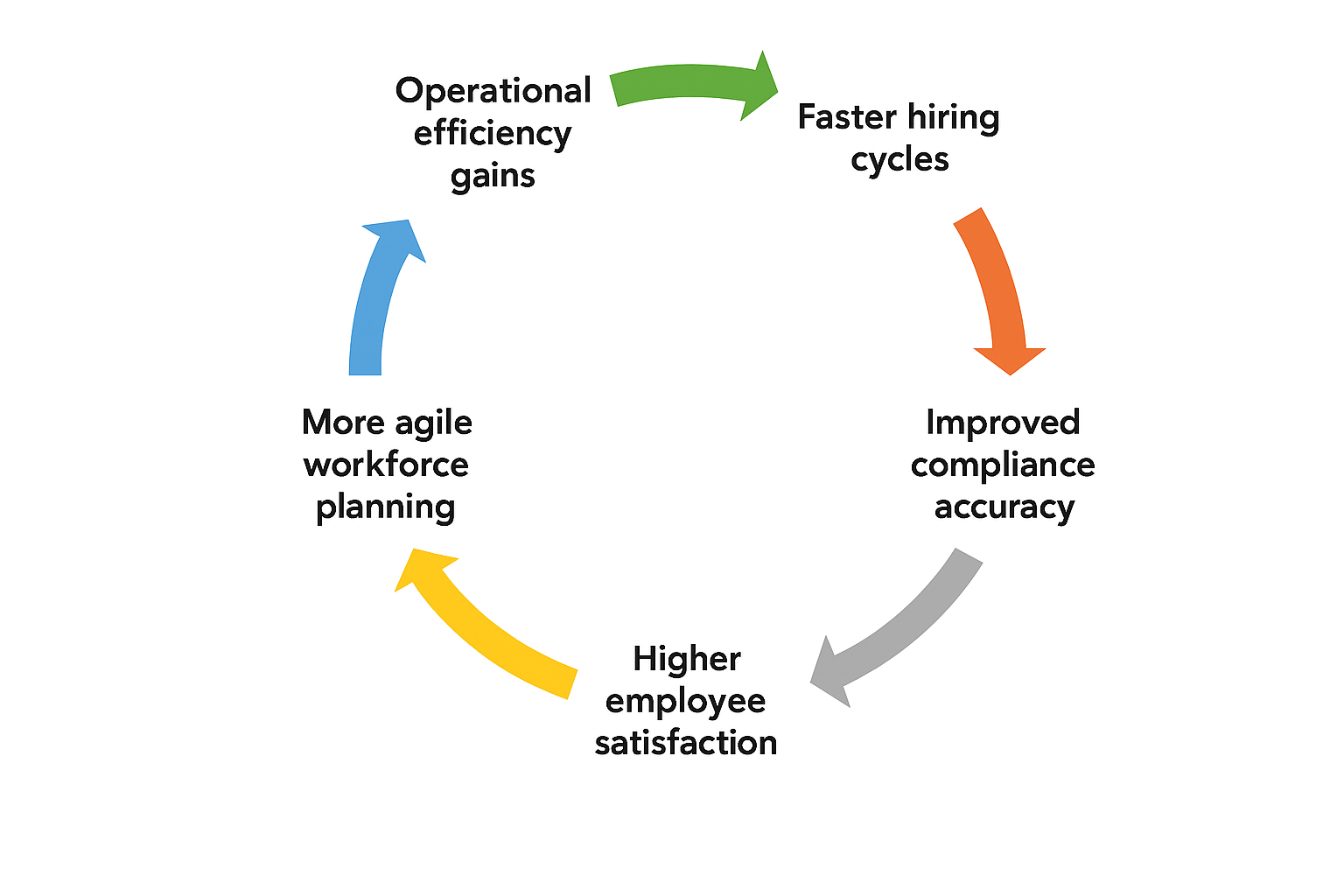
Forward-looking organizations are discovering that AI in HR operations is not just about reducing manual work—it is a productivity multiplier.
By automating high-volume operational tasks, HR professionals can focus on strategic priorities such as leadership development, workforce planning, and organizational culture. In many enterprises, this shift is already delivering measurable outcomes:
The YASH Perspective: Intelligence with Empathy
At YASH Technologies, our perspective on AI in HR operations is rooted in the concept of augmented intelligence. While AI excels at analyzing large volumes of data, identifying patterns, and automating complex workflows, the most important aspects of HR—leadership, empathy, culture building, and strategic decision-making—remain inherently human.
The goal is not to replace HR professionals, but to empower them. When AI handles operational complexity, HR leaders can focus on what truly matters: nurturing talent, guiding workforce transformation, and shaping organizational culture.
However, realizing this vision requires a strong digital foundation. Fragmented HR systems often limit the effectiveness of AI initiatives. Establishing a unified data ecosystem and a single source of truth across the HCM stack is critical for enabling AI-driven insights and intelligent automation.
The Future of HR Operations
The next generation of HR will not be defined by paperwork or administrative workflows. Instead, it will function as an intelligent workforce command center, where humans and AI agents collaborate seamlessly.
Routine operational tasks will fade into the background as autonomous systems manage processes and surface actionable insights. HR leaders will spend less time managing transactions and more time shaping workforce strategy.
Organizations that embrace this transformation will gain not only operational efficiency but also new levels of innovation, agility, and growth. To explore how AI-driven HR operations can create measurable business impact for your organization, connect with the experts at info@yash.com

Related Posts.
The Compliance Revolution: Why AI is the New North Star for Product Stewardship
Prasanna Lakshmi Rayudu



SAP Infrastructure in the NY–NJ Pharma Corridor
Akhilesh Sodhani Parvez Ali
NeoLoad for SAP: Best Practices for Performance & Volume Testing
M. Sreekanth Vishvambhar Rushi
Accelerating Time-to-Value: Why Businesses Choose SAP Cloud ERP
Jacinto Arauz Paola Siri

How Australian HR Leaders Can Build High-Value, High-Trust People Systems in 2026
Saratchandra Panganamamula
The AI-First ERP: Future-Proofing Your Business with SAP Cloud ERP – Public
Paola Constanza Siri