


The “Chink in the Armor”: Why Your SAP SoD Framework is the Ultimate Strategic Guardrail
Publish Date: July 23, 2026In the high-stakes world of enterprise resource planning, breaches rarely announce themselves with a siren. More often, they whisper. They happen through a tiny chink in the armor—a single user with just enough “over-permissioned” access to bypass a control.
Consider this: According to the ACFE 2024 Report to the Nations, organizations lose an estimated 5% of revenue to fraud each year [1], with a lack of internal controls (like SoD) being the primary contributing factor in nearly one-third of cases.
All it takes is one individual to expose your organization to massive financial loss or regulatory wrath—segregation of Duties (SoD) in SAP addresses this challenge head-on. By dividing user access, SoD ensures no single person possesses end-to-end control over critical business cycles. It’s not just a compliance checkbox; it’s a strategic defense against fraud, theft, and data misuse.
The Modern SAP Minefield: Why SoD is Getting Harder
Building a robust SoD framework was simpler when everything lived behind a local firewall. Today, the landscape is shifting under our feet for four primary reasons:
- S/4HANA Complexity: Moving from ECC to S/4HANA isn’t just a technical upgrade; it’s a security overhaul. Fiori-based roles and embedded analytics introduce new permission layers. If you “lift and shift” legacy roles, you’re likely migrating hidden risks into your brand-new environment.
- The Cloud Explosion: As we plug in SAP Ariba, SuccessFactors, and Concur, we create “silos of risk.” These systems often have separate permission models that don’t talk to your core ERP, allowing users to accumulate dangerous cross-system access.
- Invisible Third-Party Gaps: Integrating non-SAP procurement or banking tools creates access paths that can bypass native SAP checks. Without a holistic view, these violations remain invisible until an auditor raises a red flag—or a breach occurs.
- Fragmented Identity: Using Azure AD or Okta for authentication adds flexibility but can fragment governance. Unless SoD checks span across every identity source, your enforcement will be inconsistent at best.
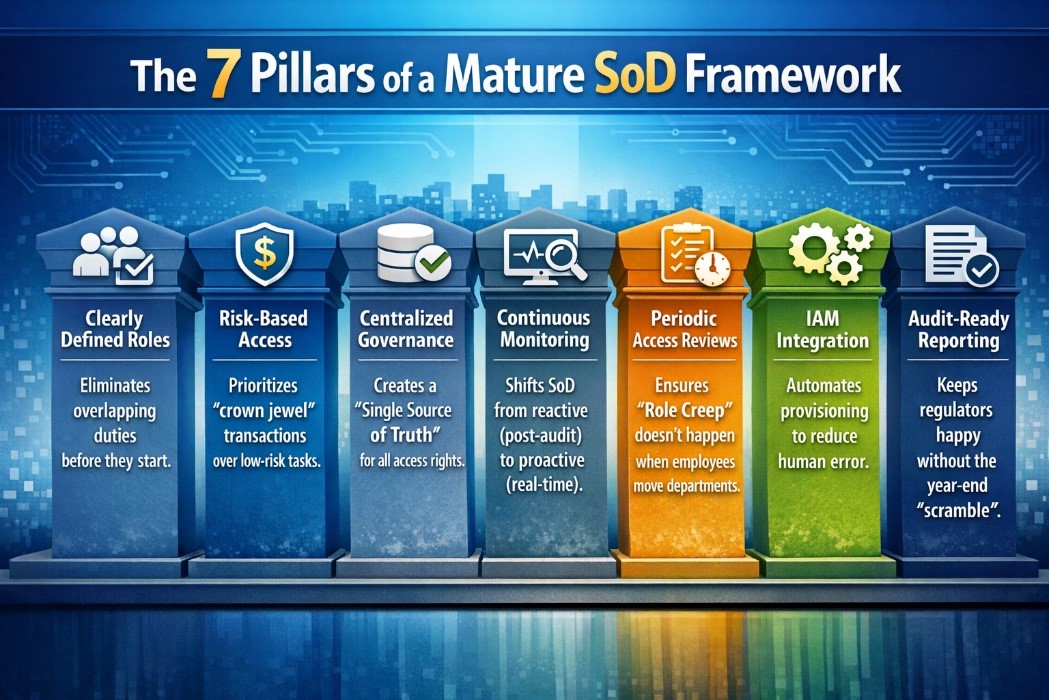
Seven Pillars of a Mature SoD Framework
A framework that actually works—rather than just looking good on paper—requires a blend of policy and technology.
Ten Steps to Building Your SAP SoD Fortress
How do you turn these elements into a functioning program? Follow this roadmap:
- Establish Governance: Form a steering committee with IT, Audit, and Business owners. If nobody “owns” the risk, nobody fixes it.
- Identify Critical Processes: Map out where the money moves—finance, procurement, and HR are your high-stakes zones.
- Catalog Roles: Break down what every role actually does. Identify where a single role can both initiate and approve a transaction.
- Develop a Risk Matrix: Create a standard rule set that defines incompatible duties (e.g., “Vendor Setup” vs. “Payment Processing”).
- Select Your Tech: Don’t do this manually. Tools like SAP GRC Access Control or SAP Cloud IAG are non-negotiable for modern enterprises.
- Redesign & Cleanse: Apply the Principle of Least Privilege. Remove conflicts and, where unavoidable, implement compensating controls such as transaction logging.
- Embed in the Lifecycle: Automate SoD checks so that no new user gets conflicting access by default during onboarding.
- Quarterly Reviews: Business owners should validate their team’s access at least twice a year.
- Monitor & Remediate: Use real-time dashboards to track violations and trends.
- Continuous Improvement: Audit your own framework. As your business changes, your SoD rules must evolve with it.
Leveraging the Right Tools: The SAP Advantage
Managing SoD at scale requires more than a spreadsheet and a prayer.
- SAP GRC Access Control: The gold standard for automating role analysis and risk reporting. To take this further, YASH Technologies enhances GRC implementations with predictive analytics and custom rule sets to align controls with specific business goals.
- SAP Cloud Identity Access Governance (IAG): Your bridge for hybrid landscapes, extending SoD into Ariba and S/4HANA Cloud.
- SAP Fiori Apps: These provide intuitive dashboards for managers, making it easier for non-technical leaders to spot and stop risks.
- Third-Party Integration: For multi-vendor environments, tools like SailPoint or Saviynt can be integrated with SAP GRC to centralize identity across the entire enterprise.
For organizations looking to accelerate this journey and proactively close SoD control gaps, YASH Technologies’ SAP GRC solutions provide advanced capabilities for automated SoD analysis, real-time risk monitoring, and streamlined remediation workflows. To learn more, connect with our SAP experts at info@yash.com.

More From Author.
Related Posts.


Outgrowing Your ERP? How Australian Businesses Can Go Live in 8–10 Weeks
Jai Prakash Nethala


The SAP GROW Story: What Changed, What Stayed, and What It Means for Growing Businesses
Jacinto Arauz Jai Prakash Nethala
Connecting AI Agents to SAP S/4HANA via MCP
Shrina Neema


From Silos to Smart Systems: Why MEA Healthcare Needs Connected Intelligence
Murali Krishna Chilla



YASH F1 Package for SAP GROW Fast: Empowering Midmarket Businesses with Agile Cloud ERP
Jacinto Arauz Jai Prakash Nethala