

For a time, companies thought that planning and doing things were the same. In a world that is constantly evolving, doing things without thinking ahead is a problem. It is time to stop paying a lot for planning methods and start using platforms built for the AI age.
Section 1: The Innovation Plateau. Why Things Cannot Stay the Same
For a time, demand planning has been a key part of supply chain management. Companies have used tools like SAP Integrated Business Planning (IBP). Kinaxis RapidResponse* to predict demand, manage inventory, and make sales and operations plans. These tools have worked well for what they were made for. The world has changed, and there are no longer enough.
The SAP IBP Way: But at What Cost?
SAP IBP is a great piece of engineering. It can process a lot of data quickly. Has a lot of statistical models? For companies that already use SAP, it is a choice.
From a business perspective, there are significant limitations. SAP IBP is mostly a statistical tool. It has some machine learning and deep learning features. They are not fully integrated and often need extra tools. This creates a planning environment that’s expensive, complicated, and relies on human planners to make sense of the data.
The Kinaxis Approach: Fast, But Without Context
Kinaxis excels at enabling companies to model supply chain impacts simultaneously. Their scenario management is great for reacting to changes.
But with its Halo ML platform, Kinaxis has the same problem as SAP: it lacks a mature AI fully integrated into the decision-making process. Planners still have to interpret the data, which takes a lot of time and is prone to errors.
The Cost of Old Methods
The reason to move away from these platforms is clear:
- The Cost Barrier: SAP IBP and Kinaxis are expensive, with licenses ranging from half a million to several million dollars and implementation times ranging from 6 to 18 months. For companies, even big ones, that want to save money, this is hard to justify.
- The Flexibility Problem: Both platforms are rigid and hard to change. Adapting to market realities requires significant IT work and takes months, in a world where agility is key; this is a major problem.
- The “Human Middleware” Issue: Companies are paying a lot for tools that still need their expensive assets. Their people. To act as intermediaries, manually reconciling spreadsheets and guessing at numbers without meaningful AI help.
The market is demanding a change: from rules-based systems to flexible intelligence-native platforms that turn data directly into decisions.
Section 2: The Intelligence Advantage. How Modern AI Changes Forecasting
Old tools were made for another world. Today’s demand environment is volatile, complex, and ambiguous. Modern AI and machine learning do not just look at the past; they learn, adapt, and explain.
YASH Smart Demand Planning is part of this class of technology, using a tiered hierarchy of intelligence to drive business value.
1. Statistical Models: The Foundation
We do not get rid of the past; we build on it. Models such as ARIMA, SARIMA, and Holt-Winters are still the basis for identifying patterns. In YASH Smart Demand Planning, they provide a baseline for predictable demand.
2. Machine Learning: The Contextual Engine
If statistical models look at the “what,” machine learning models understand the “why.” By using algorithms such as XGBoost, LightGBM, and Random Forests, the platform operates like a top-tier demand analyst, considering pricing, promotions, competitor activity, and macroeconomic conditions. This captures the complexity of the world that simple statistics miss.
3. Deep Learning: Seeing What Is Not Obvious
For the complex challenges, LSTM (Long Short-Term Memory) and GRU networks detect patterns that no human analyst could spot. This brings a level of precision previously available only to tech companies.
4. Ensemble Methods: The Wisdom of the Crowd
No single algorithm is always right. YASH Smart Demand Planning uses an Ensemble Approach that combines Prophet, XGBoost, and SARIMA. This creates a forecast that is more accurate and resilient than any single model.
5. Data Integrity: Intelligent Outlier Detection
Even the best AI fails on data. We use four methods to detect anomalies, ensuring that the AI is trained on accurate data.
Section 3: YASH Smart Demand Planning. Turning Intelligence into Action
For a long time, demand planning has been a “numbers game.” YASH Smart Demand Planning transforms it into a decision engine*. It doesn’t just generate a forecast; it explains its challenges and assumptions and drives alignment across the organization.
Control: The Planner as Conductor
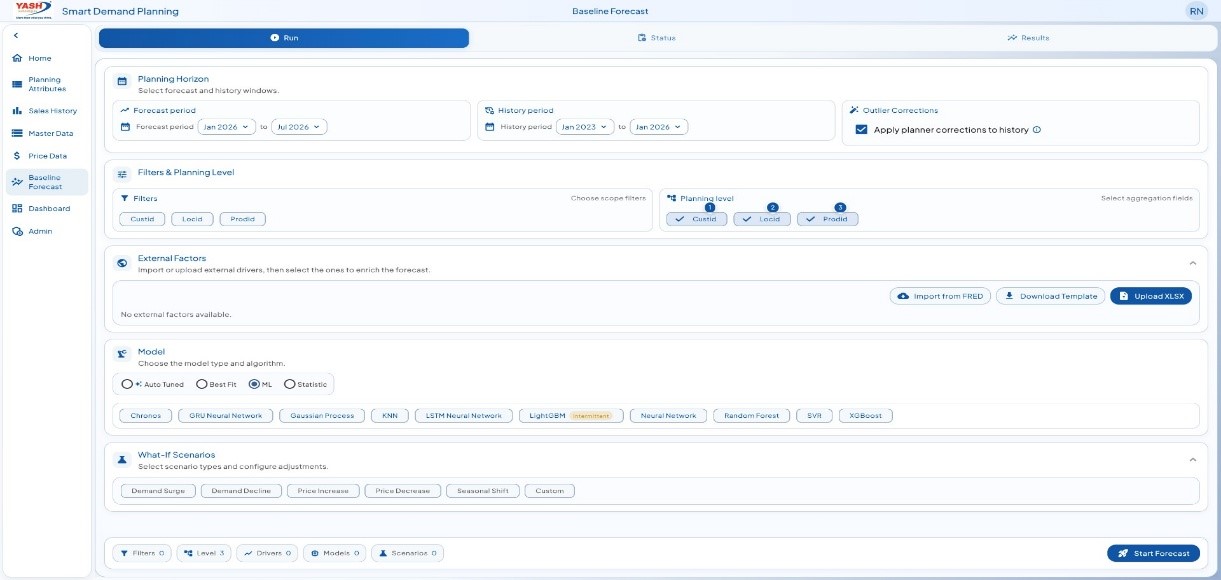
Unlike black-box solutions, YASH puts the power back in the hands of the business. Leaders define the parameters. Can select history windows, apply filters, and layer in external factors instantly.
Accuracy Meets Accountability
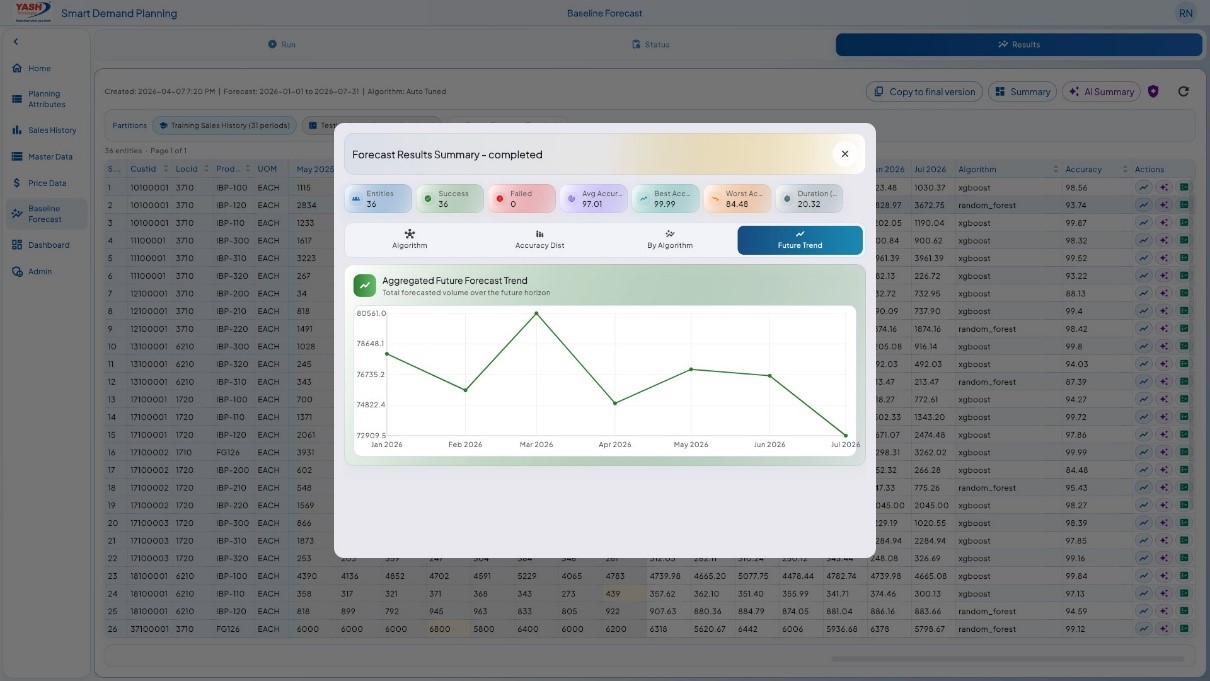
Results are presented as insights. Planners see sales versus forecast values alongside an accuracy score. With the platform delivering accuracy above 95%, teams can identify high-confidence areas and those needing intervention.
The Generative AI Breakthrough: From Data to Narrative
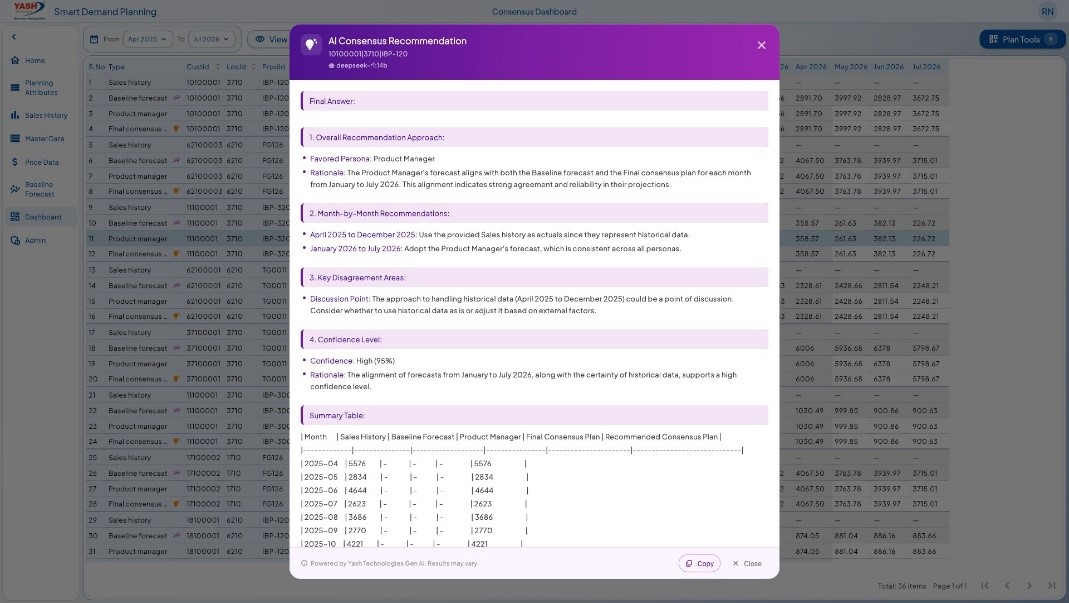
This is where YASH Smart Demand Planning redefines the industry. We have moved beyond dashboards to Narrative Intelligence. The platform synthesizes baseline forecasts, product manager inputs, and market data into a plain-language recommendation. It identifies the favored strategy, explains the rationale, and flags areas of disagreement. It turns data into a strategy memo.
Closing the Loop: The AI Narrative
Understanding why a number deviated from the plan is often more valuable than the number itself. The AI Consensus Plan Narrative provides a written audit of the variance. It quantifies the business implications. Recommends follow-up actions.
This eliminates the “blame game”. Replaces it with evidence-based leadership.
Closing Thought
The question for companies is no longer if they should adopt AI but how quickly they can switch to platforms designed for the intelligence era.
YASH Smart Demand Planning offers enterprise-grade forecasting, AI, and consensus alignment that old tools cannot match at a fraction of the cost and deployment time.
Stop planning for the past. Start predicting for the future.
Connect with us at www.yash.com

More From Author.
Related Posts.




Why Unused SAP Data Costs More Than You Think
Bhavani Sankar Rajasekharuni

How to Carve Out Your SAP System Efficiently Using Archiving
Yellaiah Gattaiah Devasani


Why SAP Archiving Projects Fail Before They Start
Yellaiah Gattaiah Devasani


Predictive Maintenance Is Only as Good as the System Behind It
Firdosh Kotwal Hari Mantravadi