


Why trusted asset master data is the foundation of intelligent asset operations, and how SAP Business AI can help build it
Before enterprises make physical assets intelligent, they must make asset data trustworthy.
Asset-intensive organizations are investing in IoT, Asset Performance Management (APM), mobility, digital twins, and AI agents. The return on all of it depends on a question that rarely reaches the steering committee: Can we trust the digital identity of every physical asset we own?
Oil and gas companies, utilities, miners, and manufacturers are not short of asset data. It spans ERP and enterprise asset management (EAM) platforms, engineering tools, GIS, SCADA/DCS, historians, MES, OEM documentation, and condition monitoring. The hard part is proving that all of those systems describe the same physical asset.
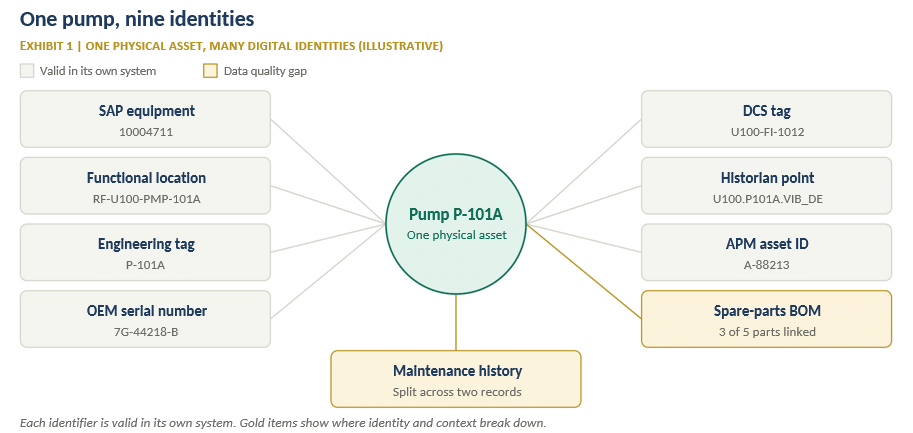
One pump, nine identities
Take a single centrifugal pump, P-101A. In SAP S/4HANA Asset Management, it is anchored by an equipment record and a functional location. However, the same pump also carries an engineering tag, an OEM serial number, a DCS tag, a historian point, and an APM ID. Each identifier is correct in its own system. Together, they are not one trusted asset.
EXHIBIT 1 | ONE PHYSICAL ASSET, MANY DIGITAL IDENTITIES (ILLUSTRATIVE)
Unless these identities are connected, reconciled, and governed, the organization has no single trusted version of this pump, only several partial versions of the truth. Multiply that across hundreds of thousands of assets. ISO 55013:2024 now provides dedicated guidance on managing data as an asset-management resource (ISO, 2024).
AI does not make poor data disappear. It amplifies it.
McKinsey reports that only 7% of companies have fully scaled AI across their organizations and that more than two-thirds of high-performing companies say data is their primary obstacle to enabling AI. It also finds that AI often amplifies both the risk of poor data quality and the complexity of fixing it (McKinsey & Company, 2026).
Other research points the same way. In a Gartner survey of 248 data management leaders in Q3 2024, 63% said they lack, or are unsure whether they have, the right data management practices for AI; Gartner predicts that through 2026, organizations will abandon 60% of AI projects unsupported by AI-ready data (Gartner, 2025). In manufacturing, nearly 70% of companies name data quality, contextualization, and validation as the most significant obstacles to AI implementation (Deloitte, 2025).
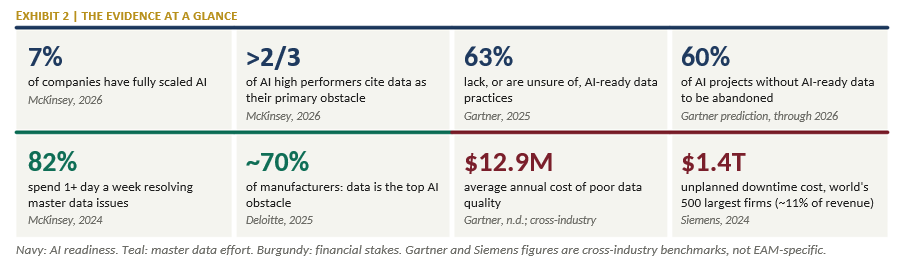
The master data burden predates AI. In McKinsey’s survey of some 80 large organizations, 80% report data silos in at least some divisions, 82% spend one or more days a week resolving master data quality issues, and 66% still rely on manual review (McKinsey & Company, 2024). McKinsey’s QuantumBlack estimates that 30% of enterprise time is spent on non-value-adding work due to poor data quality and availability (QuantumBlack, 2025), and Gartner puts the average annual cost of poor data quality at US$12.9 million (Gartner, n.d.).
The challenge looks different in every industry.
The shape of the problem changes from one industry to the next, but the root cause is the same: several systems, each holding part of the asset’s identity.
EXHIBIT 3 | ASSET MASTER DATA CHALLENGES BY INDUSTRY
| Industry | Master data challenge | Reference |
|---|---|---|
| Oil and gas | Inconsistent taxonomy, criticality, and failure codes across refineries, pipelines, and terminals | ISO 14224 |
| Power utilities | The same transformer or breaker is held in EAM, GIS, network models, SCADA, and inspection systems. | IEC 61968-4 |
| Mining | Component genealogy: engines and wheel motors rebuilt and moved between haul trucks | ISO 55013 |
| Manufacturing | ERP, MES, PLC/SCADA, and historian systems use different IDs for one production asset | ISA-95 |
Utilities show how quickly this drift happens. GIS, asset management, SCADA, ERP, and engineering tools each work on their own but drift apart over time, leaving outdated transformer ratings and planning models that miss approved projects (Utility Dive, 2026); one analysis described much of the US grid as “well engineered but poorly described” (Issues in Science and Technology, 2026). Standards exist to reduce this friction, from ISO 14224 for reliability and maintenance data (ISO, 2016) and IEC 61968-4 for asset record exchange (IEC, 2019) to ISA-95 for enterprise control integration (ISA, 2025).
How poor master data becomes a business problem
Poor master data rarely announces itself. An incorrect hierarchy hides the correct technical object; an incomplete bill of materials (BOM) obscures the correct spare; duplicates split maintenance history. Each gap adds friction, and the friction compounds into cost, delay, and risk.
EXHIBIT 4 | FROM POOR ASSET DATA TO BUSINESS IMPACT
Poor asset data → Incomplete context → Search and verification → Wrong parts or scope → Fragmented history → Weaker reliability decisions → Lower trust in AI
| Impact area | What it looks like |
|---|---|
| Operating cost | Rework, overtime, contractors, expedited freight, emergency buys |
| Financial | Duplicate MRO inventory, premature replacement, and misdirected capital |
| Production and delivery | Longer outages, missed shipments, penalties, lost throughput |
| Quality | Wrong-spec parts, off-spec product, unreliable root-cause analysis |
| Safety and compliance | Wrong criticality on safety-critical assets, weak audit trails |
The stakes are large. Siemens estimates that unplanned downtime costs the world’s 500 largest companies about US$1.4 trillion a year, roughly 11% of revenue, up from US$864 billion (8%) in 2019–20, with an idle automotive line costing up to US$2.3 million an hour (Siemens, 2024).
ABB’s survey of more than 3,200 maintenance leaders found that two-thirds face unplanned downtime at least monthly, at about US$125,000 an hour (ABB, 2023, as reported in ISM, 2024). McKinsey found that mature reliability-centered organizations spend 70–85% of technician hours on preventive work, versus a 51% survey average (McKinsey & Company, 2023), and vendor research estimates that 5–7% of maintenance, repair, and operations (MRO) purchases are duplicates caused by poor material master data (Verdantis, 2026).
A note on credibility: none of this research attributes a specific share of downtime to master data, and neither do I. Master data does not cause every failure; it determines how quickly and accurately an organization diagnoses, plans, sources parts, and learns from each one.
My observation: the shift from data cleansing to data trust
Most organizations still treat EAM data quality as a project: extract, profile, clean, upload, repeat. However, asset data never stops changing. Equipment is commissioned, components are moved, engineering changes are released, and OEM documentation is updated. The day a cleansing project closes, quality starts to decay.
McKinsey notes that manual monitoring cannot keep pace with AI-era data velocity and that governance built for periodic review fails when data is continuously created and consumed. It recommends defining “good enough” data per use case rather than waiting for perfection (McKinsey & Company, 2026).
EXHIBIT 5 | CLEANSING VS. CONTINUOUS INTELLIGENCE
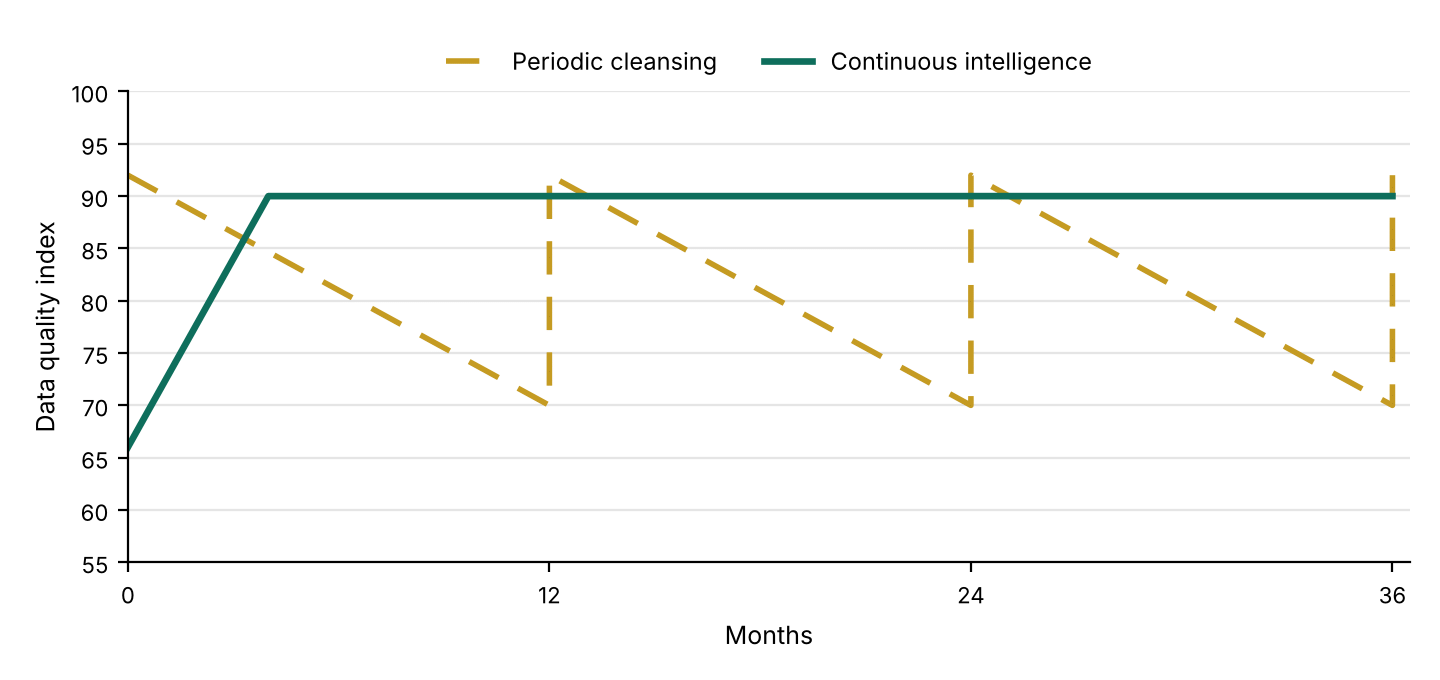
Illustrative pattern, not measured data.
Four further observations stand out:
- Ownership ends when the project ends. Master data health is rarely reported alongside mean time between failures (MTBF), schedule compliance, or wrench time, so decay goes unnoticed.
- The costliest errors live in relationships, not fields. Rules catch a missing manufacturer; they rarely catch a pump under the wrong functional location or a rebuilt engine recorded on two trucks.
- Agents remove the human safety net. Experienced planners silently correct bad data; agents cannot. Moreover, that knowledge is leaving: 73% of maintenance organizations struggle to recruit technicians, and only 55% have formal knowledge-sharing systems (McKinsey & Company, 2023).
- Master data is becoming AI infrastructure: the context layer every maintenance agent reads from, best governed with criticality-tiered quality thresholds.
The need: AI tools that monitor and improve master data continuously
The same technology that depends on trusted data can help create it. An AI-enabled EAM Master Data Intelligence capability continuously monitors the master data landscape rather than waiting for the next cleansing project. AI does the investigative work; accountable people approve changes.
EXHIBIT 6 | MASTER DATA INTELLIGENCE OPERATING LOOP AND AI USE CASES
| Step | Role | Who |
|---|---|---|
| 1. Sense | Read all systems | AI agent |
| 2. Detect | Flag anomalies | AI agent |
| 3. Reason | Weigh evidence | AI agent |
| 4. Recommend | Fix + confidence | AI agent |
| 5. Approve | An engineer or data steward decides | Human accountable |
| 6. Act | Update via MDG | Governed execution |
| 7. Learn | Refine the rules, then loop back to Sense | Governed execution |
| Find: detect what is wrong. | Fix: correct and enrich | Keep: prevent decay |
|---|---|---|
| Duplicate asset detection Cross-system entity resolution Hierarchy anomaly detection Component genealogy agent |
Classification intelligence (ISO 14224) Document intelligence from OEM manuals, with provenance BOM intelligence |
Continuous quality and drift monitor Master data change copilot Point-of-entry validation at commissioning |
Where SAP fits: Joule, SAP Business AI, and agentic AI on a trusted SAP S/4HANA EAM core
The AI conversation in asset management has moved from copilots that answer questions to agents that do the work. SAP’s portfolio now spans Joule, embedded where planners, technicians, and reliability engineers work; Joule Agents, orchestrated by the Asset & Service Assistant; and Industry AI, which packages agents into autonomous asset management scenarios. All of it sits on SAP S/4HANA Asset Management as the system of record. SAP Business AI, therefore, plays two roles: it consumes asset master data to make decisions, and it can increasingly improve that data by capturing, enriching, and validating it at the source.
EXHIBIT 7 | SAP BUSINESS AI ACROSS THE EAM LANDSCAPE
Human approval and governance apply at every layer. GA = generally available. Availability as described by SAP at the time of writing; validate scope per customer release and landscape.
| Layer | Components | Status |
|---|---|---|
| Industry AI: autonomous asset management | Oil and gas and energy first; expanding to manufacturing, mining, and utilities; RWE offshore wind showcase | Announced May 2026 |
| Joule Agents via the Asset & Service Assistant | Alert processing, request initiation, dispatcher, technician briefing, planning alignment, master data, and RCA | GA / early access / planned 2026 |
| Joule Copilot is embedded in EAM apps. | S/4HANA Asset Management, Service and Asset Manager, Asset Performance Management, Digital Manufacturing | Available |
| Trusted asset core: identity and context | S/4HANA EAM master data, MDG EAM extension, SAP Business Network Asset Collaboration (BNAC), SAP Knowledge Graph | Available |
Human approval and governance apply at every layer. GA = generally available. Availability as described by SAP at the time of writing; validate scope per customer release and landscape.
Joule, embedded across EAM.
With SAP S/4HANA (2025). Private Edition, Joule is embedded in Asset Management, allowing users to review maintenance jobs, record time confirmations, and create maintenance events in natural language (SAP Community, 2026c). SAP reports that asking Joule to assign notifications and orders saves about 16 steps, and that maintenance-plan recommendations save around 26 (ASUG, 2026). In SAP Service and Asset Manager (SSAM), technicians can describe completed work by voice, and the app generates job completion and notification details, now including activity codes for notifications (SAP Community, 2026d). Joule is also available within SAP APM (SAP SE, n.d.-b).
Joule Agents and the Asset & Service Assistant
The Asset & Service Assistant turns asset signals and requests into prioritized work packages for reliability engineers, planners, schedulers, dispatchers, and technicians. It then uses actual work outcomes to refine maintenance strategies, health scores, and risk-based prioritization. Its agents include Alert Processing, Maintenance Request Initiation, Dispatcher, Technician Briefing, and Maintenance Planning Alignment. SAP also describes capabilities that act directly on master data: extracting and consolidating equipment information, proposing validated values and updating records; summarizing master data, costs, failure trends, and history on demand; and analyzing failure patterns to support root cause analysis (RCA) (SAP SE, 2026a).
Industry AI and the trusted foundation
At Sapphire 2026, SAP showcased autonomous asset management with RWE. In this scenario, agents analyze thousands of past incidents, identify the likely root cause, and generate prefilled work orders with proven fixes from other sites. At the same time, the SAP Knowledge Graph provides agents with a structured map of business entities and relationships (SAP News Center, 2026b). SAP says the scenario will focus first on oil, gas, and energy, then expand to industrial manufacturing, mill products, and mining, travel and transportation, and utilities (SAP SE, 2026b).
Underneath, the SAP Master Data Governance (MDG) EAM extension provides a standard asset data model, validation rules, and governed workflows (SAP SE, n.d.-a). MDG’s machine-learning rule mining proposes new data quality rules (SAP Community, 2025), while its generative AI-assisted changes currently cover business partner, material, finance, and custom objects (SAP Community, 2026a), so EAM object coverage should be validated.
EXHIBIT 8 | HOW SAP BUSINESS AI ADDRESSES THE MASTER DATA PROBLEM
| Master data challenge | SAP Business AI capability | Human control |
|---|---|---|
| Uncoded, incomplete maintenance history | SSAM AI-assisted job completion; Joule in S/4HANA EAM | The technician reviews the generated details |
| Missing OEM attributes and specifications | Equipment-information agent capability; BNAC OEM data exchange | Engineer approves proposed values |
| Inconsistent records, no quality rules | MDG rule mining; governed change requests | Data steward approves rules and changes |
| Fragmented context behind decisions | Master data summary capability; SAP Knowledge Graph | Planner validates context before acting |
| Slow, manual reliability analysis | Failure-pattern and RCA agent capabilities; APM | Reliability engineer confirms root cause |
EXHIBIT 9 | SAP BUSINESS AI ACROSS ASSET-INTENSIVE INDUSTRIES
| Industry | Master data challenge | How Joule and SAP agents can help (illustrative) | Status |
|---|---|---|---|
| Oil and gas | Inconsistent classes and failure codes across sites | Autonomous asset management starts here; learning “proven fixes from other sites” requires harmonized failure coding (ISO 14224). SSAM coded completions standardize history; Fieldglass gate-pass time capture was planned for June 2026 for contractor-heavy sites. | Initial focus |
| Power utilities | EAM, GIS, SCADA, and OEM records drift apart | BNAC flows OEM bulletins and configuration updates into equipment records, and commissioning packages enrich equipment masters, so the Alert Processing Agent reasons over as-installed data. | BNAC available; autonomous asset management expanding |
| Mining | Component genealogy across haul trucks | Failure-pattern and RCA capabilities require complete installation/removal history; voice capture in SSAM reduces the effort of recording component changes at remote sites. Serialization discipline remains a prerequisite. | Planned expansion |
| Manufacturing | Different IDs across ERP, MES, and controls | SAP Digital Manufacturing distills complex manufacturing issues into clear descriptions. With the Maintenance Request Initiation Agent, issues become well-described notifications when resources map to the right technical objects. | Planned expansion |
Illustrative applications of SAP-described capabilities; not SAP claims of industry-specific functionality.
A reality check. SAP executives have acknowledged that industry scenarios are still maturing: some were developed with only one or two customers, and services are expected to close the last-mile gap (SAPinsider, 2026). Availability also varies, spanning general availability, early access, and planned releases. As SAP’s CEO put it, for mission-critical processes, “‘almost right’ just isn’t good enough” (SAP News Center, 2026b). Every agent above reasons about the identity, hierarchy, BOM, and history maintained in SAP S/4HANA Asset Management.
The takeaway
As maintenance agents become more capable, master data quality becomes more important, not less. Trusted master data is what turns SAP Business AI from impressive into dependable.
Fragmented asset data → Trusted asset identity → Connected context → Joule and agent-assisted decisions → Intelligent asset operations
More From Author.
Related Posts.



Why Unused SAP Data Costs More Than You Think
Bhavani Sankar Rajasekharuni

How to Carve Out Your SAP System Efficiently Using Archiving
Yellaiah Gattaiah Devasani


Why SAP Archiving Projects Fail Before They Start
Yellaiah Gattaiah Devasani



Predictive Maintenance Is Only as Good as the System Behind It
Firdosh Kotwal Hari Mantravadi