


The Data You Can’t See: Shadow Data, AI Projects, and Your Hidden Risk
Publish Date: December 29, 2025A Question Worth Asking
In my two decades of working with organizations on data governance, one thing stands out: most breaches aren’t caused by advanced hackers—they happen because someone discovers data the organization didn’t even realize was there.
Let me share a story that illustrates this problem.
The Forgotten Storage
Last year, I spoke with a CISO of a financial services firm. His organization had strong security controls, regular penetration testing, and millions invested in cybersecurity. Then they suffered a major breach.
The entry point? An unencrypted storage containing customer information from a cloud migration completed 18 months earlier. It was supposed to be temporary. The project lead left the company. Nobody documented it. Nobody monitored it. It just… existed.
The result: 8.4 million customer records exposed, regulatory penalties, remediation costs, and damaged customer trust.
He told me something I’ll never forget: “We secured 99% of our environment. We got breached through the 1% we didn’t know existed.”
This is the shadow data problem.
What Is that 1% ? – the Shadow Data
Shadow data is information that exists in your environment but sits outside your governance, security, and compliance frameworks. It’s not malicious—it’s created through normal business operations:
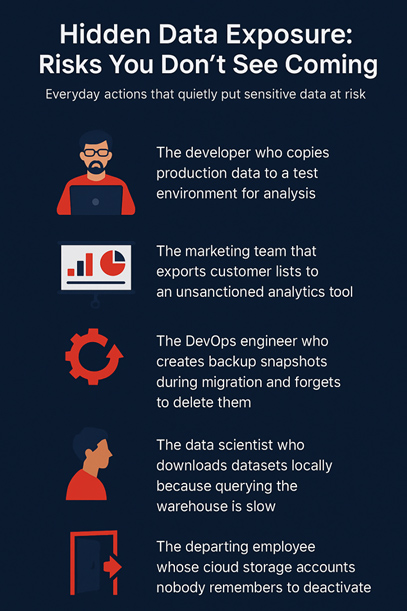
None of these people are trying to create risk. They’re just doing their jobs. But each action creates data fragments that slip through governance cracks.
The uncomfortable reality: Every digital transformation initiative—cloud migration, DevOps sprint, SaaS adoption, AI experiment—creates shadow data. The faster you move digitally, the more shadow data you generate.
The Scale of the Problem
According to recent research, enterprises now use an average of 364 SaaS applications, each potentially storing organizational data. IBM’s 2024 Cost of a Data Breach Report found that 35% of breaches involved shadow data, and these breaches cost 16% more than breaches of managed data.
Think about your organization:
- How many cloud platforms do you use?
- How many active projects create temporary data stores?
- How many development and staging environments exist?
- When did you last inventory all your data repositories?
For most organizations, the honest answer to that last question is: never.
Why This Matters to You
For Security Leaders: Shadow data is an invisible attack surface. You can’t protect what you can’t see. The average data breach now costs $4.88 million globally, and you can’t determine breach scope if you don’t know where all your data lives.
For IT Leaders: Shadow data undermines operations. Teams make decisions on incomplete information. You pay cloud storage costs for redundant data. Your analytics produce unreliable results because nobody knows which dataset is current.
For Business Leaders: Shadow data is execution risk. It delays compliance audits, exposes you to regulatory penalties, and creates liability you can’t quantify. When regulators ask “Where is all personal data stored?”, can you answer confidently?
For Compliance Teams: GDPR, HIPAA, and India’s DPDP Act all require knowing where regulated data exists. You can’t comply with data subject access requests or demonstrate data protection if you’re unaware of shadow repositories.
The YASH Approach: Continuous Data Discovery for Resilient Security
What if instead of discovering data once a year, you discovered it continuously?
What if every new database, backup, or export was automatically detected, classified, and governed the moment it appeared?
What if you had a real-time map showing where all your data lives, who owns it, how sensitive it is, and whether it’s properly protected?
This is what continuous discovery enables. You shift from reactive cleanup to proactive governance.
At YASH Technologies, we’ve built our approach around four phases:
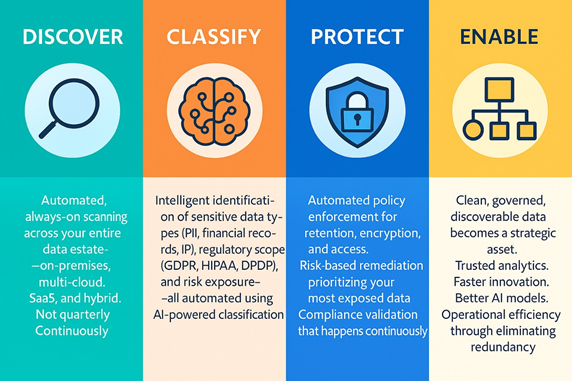
What This Looks Like in Practice
As CISO of a global manufacturing firm, you believed your cybersecurity posture was solid—until our discovery scan exposed hidden vulnerabilities across your sprawling environment, instantly shattering that confidence and raising doubts about unseen risks threatening your operations.
We found:
- Lots of untracked databases containing customer data in development environments
- 2 TB of duplicate customer records in forgotten backups
- 37 unsanctioned SaaS tools storing customer information
- 156 inactive former employee accounts with access to sensitive data
Within 90 days of implementing continuous discovery:
- 40% reduction in redundant data
- 60% improvement in audit readiness
- 90% faster response to data subject access requests
- Zero compliance violations in subsequent reviews
The CISO’s response: “We assumed comprehensive visibility across the environment, yet we were operating in profound blindness.”
Business Benefit
Post-implementation: 98% reduction in unauthorized access incidents, $2.3M in avoided regulatory penalties, and 40% faster innovation because teams now trust the data they’re working with.
Three Questions for Your Team
Before moving on, consider these honestly:
- Could you identify all personal data in your environment within 72 hours if regulators demanded it?
- How much of your cloud storage budget goes to data you don’t use, can’t find, or shouldn’t keep?
- When did you last discover a data store you didn’t know existed—and how many more are hidden?
If you hesitated, you have a shadow data problem.
The Path Forward
Shadow data is not going away, and digital transformation is only creating more of it.
The real question is: will you find it in time through proactive discovery, or only after a breach exposes it for you?
Organizations that win in a data-driven economy are the ones that know exactly which data is truly critical and invest accordingly to protect it.
Seeing, governing, and trusting everything in your data estate is not about spending more everywhere, but about directing budget to the data that matters most to your business.
At YASH Technologies, we’ve built expertise helping enterprises move from blind spots to continuous intelligence. We’ve implemented these solutions across industries, at scale, with measurable results.
The problem is real. The solution is proven. The approach is accessible.

Shivendra Sharma
Technical Architect - Cybersecurity
Shivendra is a cybersecurity solution architect at YASH, focusing on building security strategies and executing solutions for security leaders that connect with their business objectives.
More From Author.
Related Posts.



From Annual Audits to Always-On Assurance: How AI Is Redefining SOC & ISO Compliance
Mahipal Kirupanithy Shivaram Jeyasekaran

Why Third-Party Risk Can No Longer Be Manual: Building an AI-Driven TPRM Program
Mahipal Kirupanithy Shivaram Jeyasekaran

When Ransomware Reprices the Deal: Cyber Risk in Modern M&A
Ankush Arora Shivaram Jeyasekaran

The AWS Security Arsenal: 7 Services Every Cloud Leader Should Master
Mahipal Kirupanithy Shivaram Jeyasekaran
Stop Collecting Security Tools. Start Managing Cyber Risk.
Kaisar Chishti Shivaram Jeyasekaran Val Coucke

Microsoft Sentinel Data Lake: A Game-Changer for Security Operations
Kaisar Chishti Shivaram Jeyasekaran Val Coucke

AI Governance: Board-Level Oversight for Emerging Technology
Shivaram Jeyasekaran

Security Budgeting: Making the Business Case for 2026
Shivaram Jeyasekaran


Securing AI/ML Models: Adversarial Attacks and Defenses
Shivaram Jeyasekaran