


SmartRecruiters and SAP SuccessFactors: Where Hiring Transformation Gets Real
Publish Date: March 30, 2026An ATS demo can look polished in half an hour. Enterprise hiring programs are judged elsewhere, specifically by the quality of the position data.
This means deciding whether recruiters and hiring managers should work in one flow or three, and whether a hire reaches onboarding without having to re-enter the same information twice. That is why the SmartRecruiters discussion in SAP environments has moved beyond feature lists. The more meaningful question is how the platform behaves when it sits alongside Employee Central, third-party recruiting tools, and the controls large organizations already rely on.
In our first blog, we looked at SmartRecruiters from a solution perspective: what the platform includes, where its AI-led capabilities stand out, and why it has become an important part of the evolving SAP talent acquisition conversation.
In this blog, we move to the question that matters far more once enterprise interest becomes serious: how does SmartRecruiters actually work with SAP SuccessFactors in a live HR technology environment?
The integration approach below answers that in a fairly practical way.
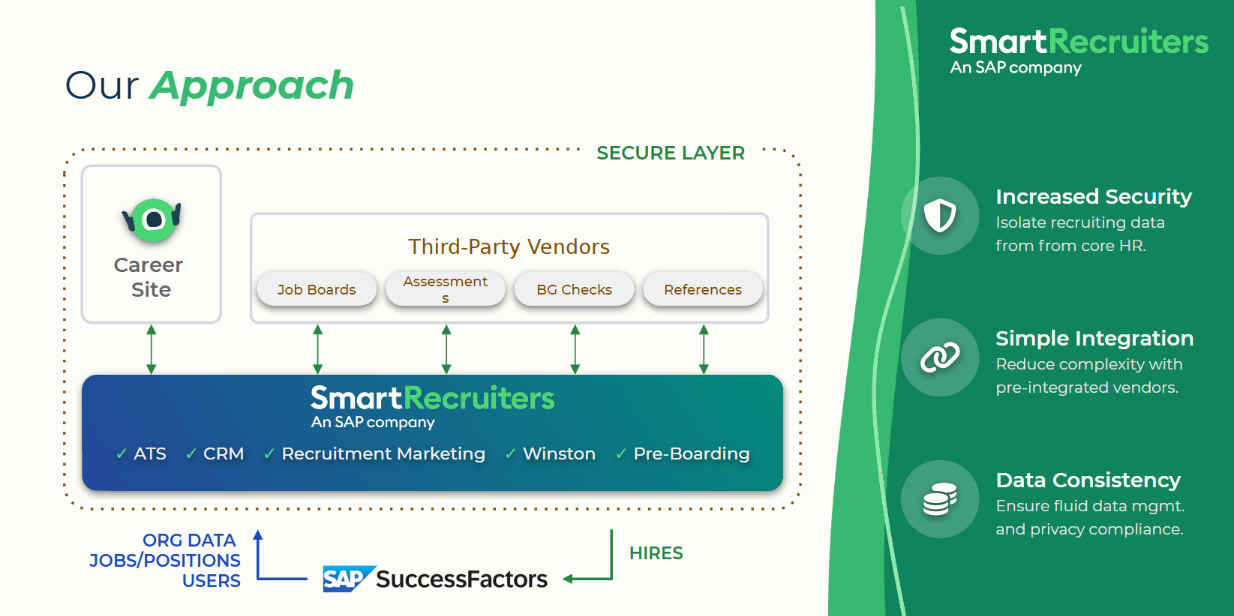
SmartRecruiters aims to serve as a connected recruiting layer, not a standalone hiring application, spanning recruiting tech, work tech, and core HCM/HRIS. It sits between career sites, job boards, assessments, background checks, and references, while staying linked to SAP SuccessFactors for organizational data and hires. Its wide, API-led connectivity across recruiting, collaboration, and core HR gives enterprises a more adaptable architecture where speed, clean master data, traceability, and smoother handoffs can coexist. At YASH, we address that tension directly through three themes:
- stronger security by isolating recruiting data from core HR,
- simpler integration through pre-integrated vendors, and
- tighter data consistency for privacy and governance.
That is the kind of architecture enterprises notice after go-live, not during the sales pitch.
Why the integration layer matters more than the demo
The Phase 1 plan is also telling because it starts with plumbing, which usually decides whether adoption sticks. The foundational layer includes seamless SmartRecruiters instance setup, SSO through IAS login, a unified UX, automatic flow of key user and organizational data from SuccessFactors to SmartRecruiters, and Winston Chat for SuccessFactors recruiting.
There is a useful lesson here from an implementation standpoint: the best recruiting AI in the world does not rescue a fragmented login experience, duplicate user maintenance, or disconnected org structures. Enterprises first need the basics to behave in a predictable way. Once that is in place, AI becomes an accelerator rather than a distraction.
Real-time position sync changes the quality of hiring workflows.
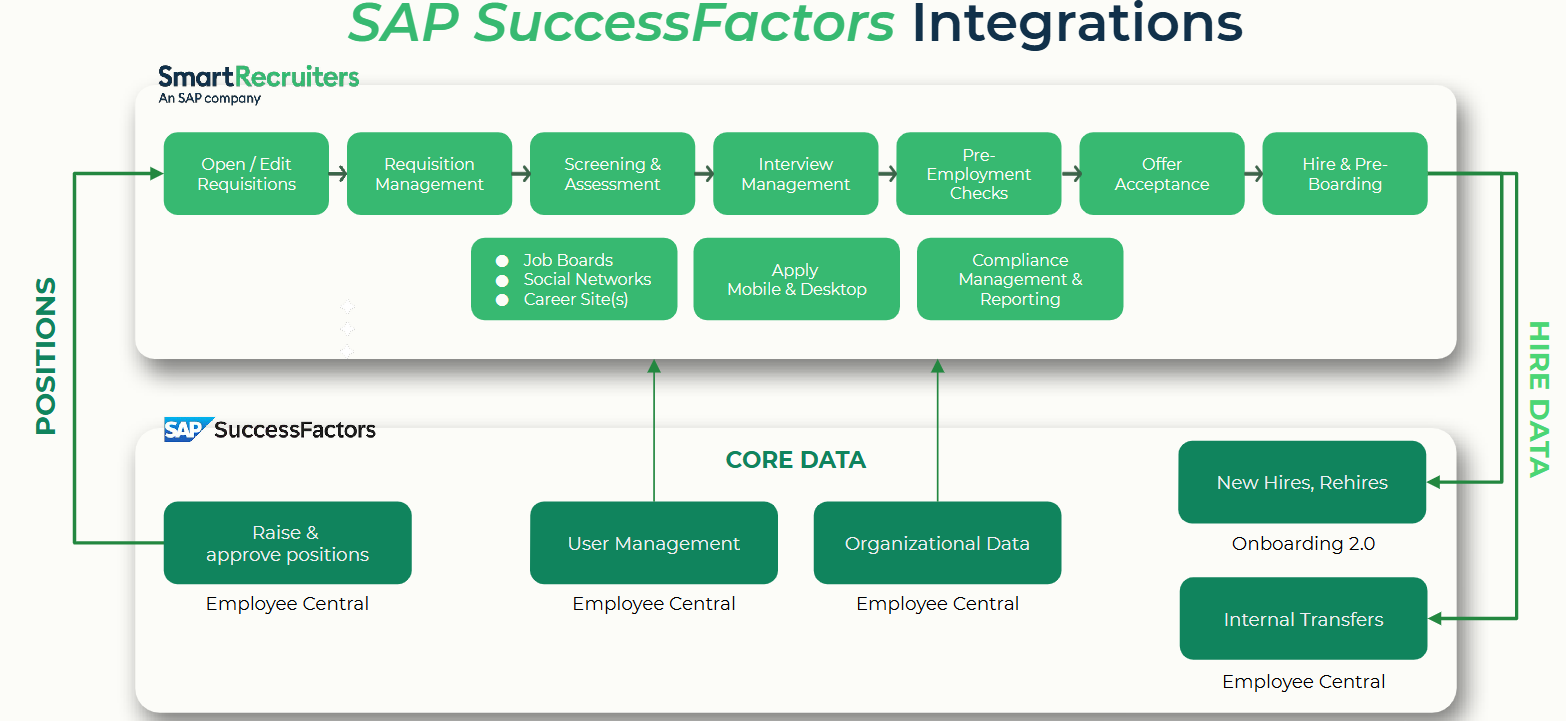
The operational value becomes clearer in the position-data sync. Jobs and positions mastered in SuccessFactors Employee Central are imported into SmartRecruiters in real time, including fields such as position code, company, cost center, department, job code, job title, and location. That shifts requisition management onto position data already established in the core HR system, rather than loosely governed records.
The workflow shown below reflects that sequence: positions originate in Employee Central, then feed into requisition management, screening and assessment, interview management, pre-employment checks, offer acceptance, and hire/pre-boarding.
In practice, that means fewer errors at the very point where recruitment usually begins to drift away from the HR source of truth.
There is another point worth noting in the broader flow. SmartRecruiters is not being treated here as a narrow ATS front end. The process map stretches across job boards, social networks, career sites, mobile and desktop applications, and compliance management and reporting, while SuccessFactors continues to anchor user management, organizational data, new hires, rehires, and internal transfers.
That split is sensible. Recruiting needs elasticity because the market-facing side of hiring is constantly changing. Core HR needs discipline because employee records, permissions, and downstream processes cannot afford improvisation.
Good integration respects both realities instead of forcing one side to behave like the other.
The Point of Hire is where the architecture proves itself.
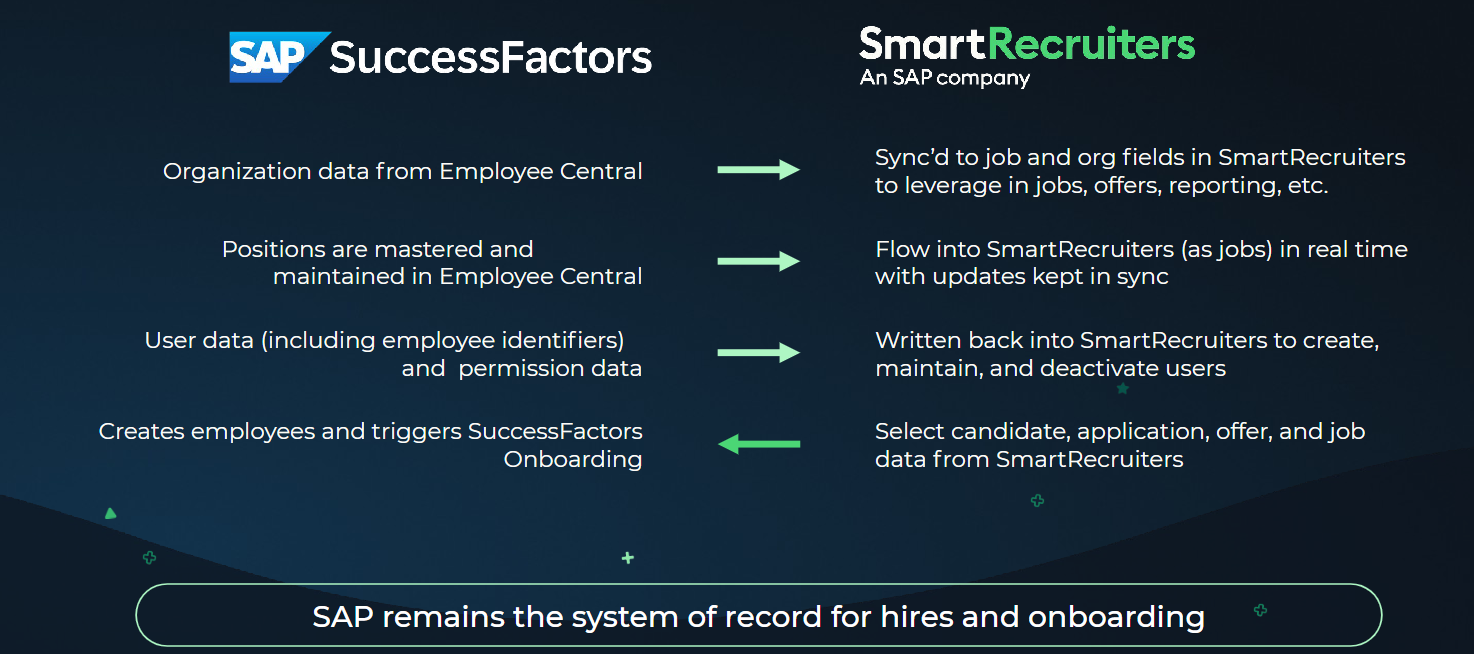
The strongest part of the integration story, though, sits at the point of hire. A real-time change to the onboarding status field in SmartRecruiters triggers the creation of new employees who are fully hired in SuccessFactors with no manual intervention. The data flowing into SuccessFactors is not limited to a basic hire record; it spans candidate user creation, biographical details, employment and job information, personal data, and compensation information, which is why the handoff is operationally meaningful rather than administrative.
The diagram above makes the governance model explicit: organization data from Employee Central syncs into SmartRecruiters for jobs, offers, and reporting; positions flow into SmartRecruiters in real time with updates kept in sync; user and permission data is written back into SmartRecruiters to create, maintain, and deactivate users; and selected candidate, application, offer, and job data returns to SAP to create employees and trigger onboarding. SAP remains the system of record for hires and onboarding.
Turning recruiting-to-HR handoffs into system behavior
From our perspective as implementation partners, the real shift is from adding another recruiting tool to building a durable hiring backbone.
When Employee Central masters positions and structure, SmartRecruiters drives recruiter execution, and hires flow automatically into SuccessFactors. Enterprises get cleaner data, less friction, and fewer workarounds.
That is where hiring transformation becomes an operational reality and where our team at YASH can help your organization make the architecture work in practice.

More From Author.
Related Posts.


SAP Infrastructure in the NY–NJ Pharma Corridor
Akhilesh Sodhani Parvez Ali



NeoLoad for SAP: Best Practices for Performance & Volume Testing
M. Sreekanth Vishvambhar Rushi



Accelerating Time-to-Value: Why Businesses Choose SAP Cloud ERP
Jacinto Arauz Paola Siri

How Australian HR Leaders Can Build High-Value, High-Trust People Systems in 2026
Saratchandra Panganamamula

The AI-First ERP: Future-Proofing Your Business with SAP Cloud ERP – Public
Paola Constanza Siri


SAP Business Data Cloud Essentials: What You Need to Know
Jagadeesh Aradhada