


Business Case First, Architecture Second: Reframing SAP Cloud ERP Decisions in Phase 0
Publish Date: March 5, 2026Did you know that by 2027, 70% of ERP implementations will fail to meet their original business goals [1]? According to Gartner, the culprit isn’t usually the software or the cloud provider—it’s a fundamental lack of alignment between technical architecture and business outcomes at the very start.
Most organizations treat Phase 0 as a technical “pre-flight check” to pick a hyperscaler or define system requirements. But here is the reality: if you are choosing your cloud architecture before you’ve modeled your ROI drivers, you aren’t planning a transformation; you’re just moving your technical debt to someone else’s data center.
At YASH Technologies, we believe it’s time to flip the script. To succeed in the SAP Cloud ERP era, you must put the Business Case First and Architecture Second.
The “Architecture-First” Trap: A Highway to Nowhere
In the rush to meet SAP’s 2027/2030 deadlines, the instinct is to jump straight into the “How.” Questions like “Should we go with AWS or Azure?” or “What is our clean core strategy?” dominate the conversation. While these are vital, they are secondary to the “Why.”
When architecture leads the dance, the project inevitably becomes an IT-driven cost center. Without a value-driven North Star, “Scope Creep” becomes a constant shadow. Why? Because there is no financial framework to say “No” to low-value customizations. An architecture-first approach often results in a “Lift and Shift” mentality—replicating legacy inefficiencies in a faster, more expensive environment. You end up with a high-performance engine in a car that has no steering wheel.
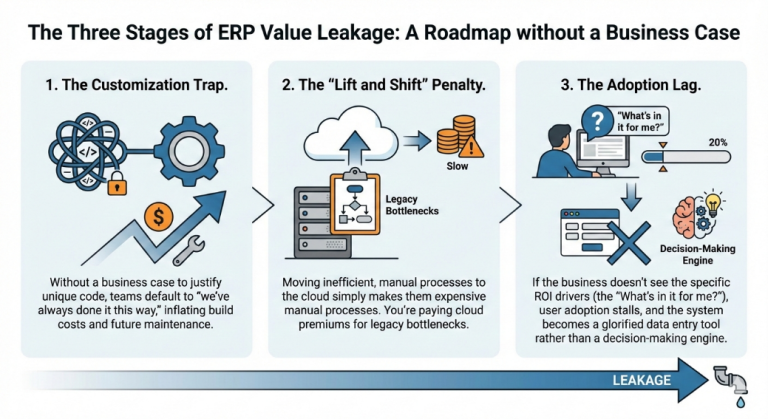
The Silent ROI Killer: Bridging the “Value Leakage” Gap
If you skip the rigorous financial modelling of Phase 0, you aren’t just missing out on potential gains—you are actively inviting Value Leakage. In the ERP world, value leakage is the delta between the “promised” efficiency of SAP Cloud ERP and the “actual” results post-go-live.
The 80/20 Rule of ERP Transformation
A Business-First Phase 0 utilizes the Pareto Principle. In most organizations, 80% of your competitive advantage comes from 20% of your processes. When you lead with architecture, you tend to treat all processes equally—allocating the same resources to “Accounts Payable” as you do to “Predictive Demand Forecasting.”
A strategic Phase 0 flips this. It identifies the 20% of “high-value” processes that drive your NPV and prioritizes them for innovation. The remaining 80% of “commodity” processes are forced into standard SAP Best Practices to keep the core clean and the costs low. By defining these financial boundaries before a single server is provisioned, you ensure your technical architecture serves your balance sheet.
The Three Pillars of a Value-First Phase 0
Reframing Phase 0 means moving away from technical checklists and toward three critical financial and strategic pillars:
1. Dynamic Financial Modelling (NPV & Payback)
A static spreadsheet is not a business case. An actual Phase 0 analysis includes Net Present Value (NPV) and Internal Rate of Return (IRR) calculations that account for the “Risk of Inaction.” What does it cost the business to stay on a legacy system that can’t support real-time supply chain adjustments? This financial transparency builds the C-suite buy-in necessary for long-term success.
2. Industry-Specific ROI Drivers
You don’t buy SAP Cloud ERP for “better IT.” You buy it for business levels. In Phase 0, we identify specific, measurable drivers based on your industry:
- Manufacturing: Reducing inventory carrying costs by 10% through real-time Material Requirements Planning (MRP).
- Retail: Boosting “Available to Promise” (ATP) accuracy to reduce cart abandonment.
- Life Sciences: Streamlining compliance reporting to reduce time-to-market for new products.
3. The “Clean Core” as a Business Mandate
“Clean Core” is often discussed as a technical requirement, but it is actually a financial one. Every customization you add to the core increases the cost of future upgrades. By establishing a Business Case first, you can enforce a “Fit-to-Standard” approach. When a stakeholder asks for a custom modification, the question isn’t “Can we build it?” but “Does this modification provide enough ROI to justify its 10-year maintenance cost?”
How YASH Technologies Redefines Phase 0 with BizNeXT
At YASH, we don’t just “assess” your landscape; we architect your success through our BizNeXT Phase 0 Framework. We treat Phase 0 as a strategic “blueprinting” stage where the goal is clarity, not just configuration.
Our approach focuses on:
- Business Value Case Creation: We help you uncover the hidden ROI in your processes, moving beyond simple TCO (Total Cost of Ownership) to a robust value-realization roadmap.
- Process Harmonization: Before discussing the cloud, we look at your “As-Is” state to identify which manual processes should be eliminated rather than automated.
- Stakeholder Alignment: We bridge the gap between the CFO’s office and the CIO’s team, ensuring every dollar spent on architecture is tied to a specific, measurable business outcome.
If the “Business Case First, Architecture Second” approach resonates with your organizational goals, you can contact us at julie.copple@Yash.com to take the first step toward a value-driven transformation.

Julie Copple
Business Development Manager
Julie Copple has over 15 years’ experience in the technology industry working with C-Level executives to help them achieve their digital transformation goals.
More From Author.
Related Posts.

SAP Infrastructure in the NY–NJ Pharma Corridor
Akhilesh Sodhani Parvez Ali



NeoLoad for SAP: Best Practices for Performance & Volume Testing
M. Sreekanth Vishvambhar Rushi


Accelerating Time-to-Value: Why Businesses Choose SAP Cloud ERP
Jacinto Arauz Paola Siri

How Australian HR Leaders Can Build High-Value, High-Trust People Systems in 2026
Saratchandra Panganamamula

The AI-First ERP: Future-Proofing Your Business with SAP Cloud ERP – Public
Paola Constanza Siri


SAP Business Data Cloud Essentials: What You Need to Know
Jagadeesh Aradhada


FHIR and Interoperability: Beyond Compliance to Innovation
Damian Bonadonna