


April — 1H Release Readiness & Adoption: Preparing for the SAP SuccessFactors 1H 2025 Shift
Publish Date: April 6, 2026April doesn’t announce itself loudly—but in enterprise IT, it carries weight. It’s the month where strategy stops being theoretical and starts being tested in the real world. Months of planning, building, and aligning now face a simple question: are we truly ready?
With the SAP SuccessFactors 1H 2025 preview scheduled for April 14 and production rollout set between May 16–18, organizations are entering a critical window. This release brings significant AI-driven enhancements across Employee Central, Learning, Talent Management, and Time Management, reshaping how organizations manage workforce data, learning journeys, talent decisions, and time processes.
At YASH Technologies, we’ve seen that the difference between a smooth release and a disruptive one rarely lies in the technology alone. It lies in how well the organization prepares for the entire change experience.
Stability First: Designing for Business Continuity
Before any release moves forward, one principle must remain non-negotiable: the business must continue to run—without compromise.
This is where business continuity planning becomes foundational. It is not simply about having a fallback, but about deeply understanding operational dependencies and preparing for controlled recovery if needed. In the context of SAP SuccessFactors 1H 2025, where AI-driven workflows and data dependencies are expanding, continuity planning becomes even more critical to avoid disruptions in core HR operations.
Organizations that approach this rigorously typically:
- Define critical processes and map system dependencies end-to-end
- Establish rollback strategies that are tested—not theoretical
- Align disaster recovery plans with release windows and peak business cycles
- Conduct scenario-based simulations to validate resilience
Continuity planning shifts the mindset from reacting to issues to being prepared for them—reducing uncertainty at the most critical moment.
Alignment as a Lever for Adoption
Even the most technically successful release can struggle if stakeholders are not aligned.
Readiness requires more than approvals—it requires a shared understanding across business leaders, IT teams, and end users. Everyone involved must be clear on what is changing, why it matters, and how it impacts their role. This becomes particularly important for the 1H 2025 release, where AI-enabled features may change how decisions are made across talent, learning, and workforce planning.
This alignment becomes especially important when prioritizing features. Not everything can—or should—make it into a release. The most effective organizations focus on delivering what drives measurable value while managing risk exposure. That balance between ambition and discipline often defines the success of the release itself.
Technical Readiness: From Validation to Confidence
As April progresses, technical teams enter a critical phase—ensuring that systems are not just functional but production-ready.
For SAP SuccessFactors 1H 2025, this means validating not only system functionality but also the behavior of AI-driven recommendations, data flows, and integrations across modules. This requires a focused test strategy that goes beyond standard validation. It must reflect real-world conditions, system interdependencies, and performance expectations.
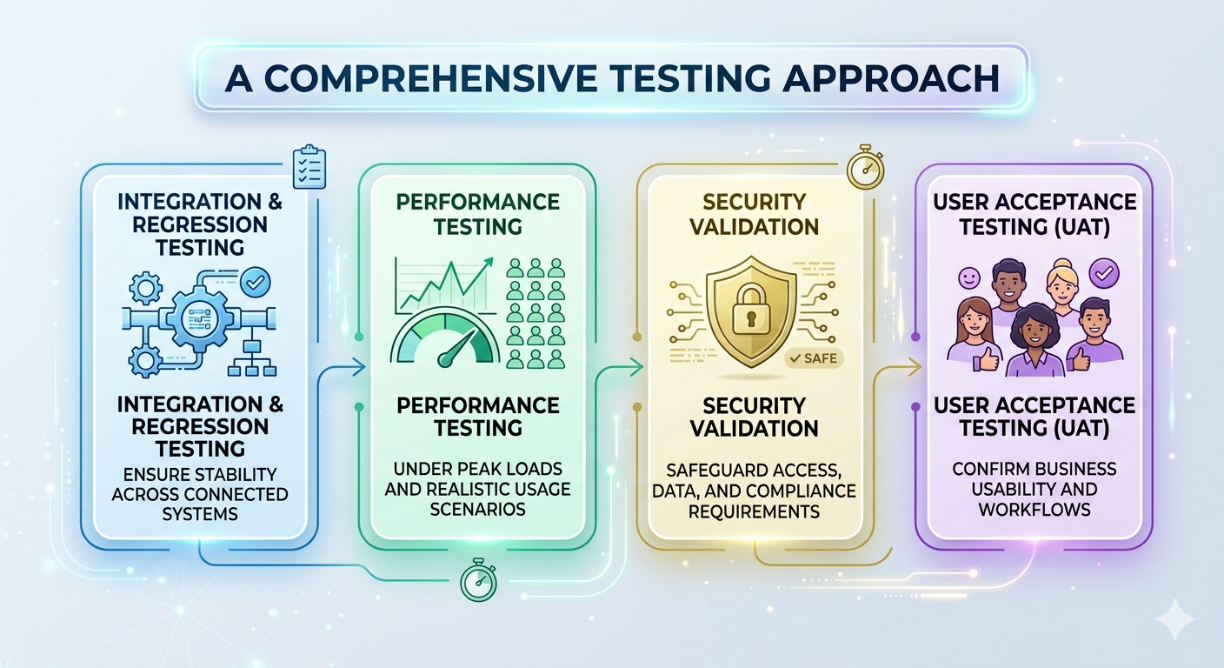
Image generated using AI tools for illustrative purposes.
Equally important is the use of sandbox environments. These controlled spaces allow both IT and business users to experience the system in near-real conditions—identifying gaps early and building confidence ahead of deployment. For the 1H 2025 release, sandbox testing is especially valuable for understanding how new AI capabilities will behave in real-world HR scenarios before the production rollout.
Orchestrating the Release: Sequencing and Control
With the production rollout scheduled for May 16-18, sequencing deployment is essential to ensure controlled adoption of new capabilities without business disruption. Organizations that treat deployment as a controlled progression rather than a one-time switch are better positioned to minimize disruption. Whether through phased rollouts, pilot groups, or staggered activation across regions, the goal remains consistent: reduce risk while maintaining operational stability.
This orchestration also requires clear executive oversight. Leaders play a critical role in assessing readiness, evaluating risk, and making informed go/no-go decisions. Their perspective ensures that releases are aligned not only with technical readiness but also with broader business priorities.
Enabling Change: Communication That Drives Adoption
A well-defined change communication model ensures that users are not just informed, but prepared. Effective communication is timely, role-specific, and continuous. It provides clarity on what is changing, enables users through training and support, and creates feedback loops that allow organizations to respond quickly.
This is particularly relevant for SAP SuccessFactors 1H 2025, where AI-driven changes may alter user interactions and decision-making patterns. When communication is treated as a strategic enabler rather than a final step, user adoption becomes significantly smoother.
After Go-Live: Measuring What Matters
Post-release assessment provides critical insights into system performance, user adoption, and business impact. For this release, evaluation also includes understanding how effectively AI-driven features are being adopted and whether they are delivering expected business insights.
It helps identify gaps, refine processes, and strengthen future release cycles. Organizations that invest in this phase move from reactive fixes to proactive improvement.
A structured release lifecycle—spanning planning, validation, deployment, adoption, and evaluation—ensures that each release contributes to long-term maturity rather than short-term delivery.
The Final Check: Readiness Without Assumptions
In the final days leading up to deployment, discipline becomes essential. A structured readiness checklist ensures that nothing is overlooked and that all moving parts are aligned.
At a minimum, organizations should confirm:
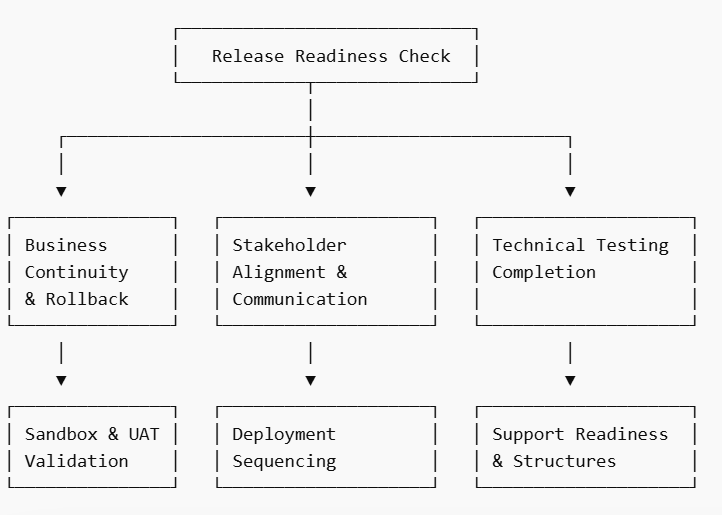
Image generated using AI tools for illustrative purposes.
This final validation is not about caution—it is about confidence.
How YASH Technologies Enables 1H Release Readiness and Adoption
At YASH Technologies, we approach SAP SuccessFactors releases not as isolated upgrade cycles, but as opportunities to strengthen the digital HR ecosystem.
Our role begins well before the preview release—and continues beyond go-live—ensuring that organizations are not just technically prepared, but operationally ready and adoption-focused.
We bring a structured yet flexible approach that combines deep SAP expertise with real-world implementation experience:
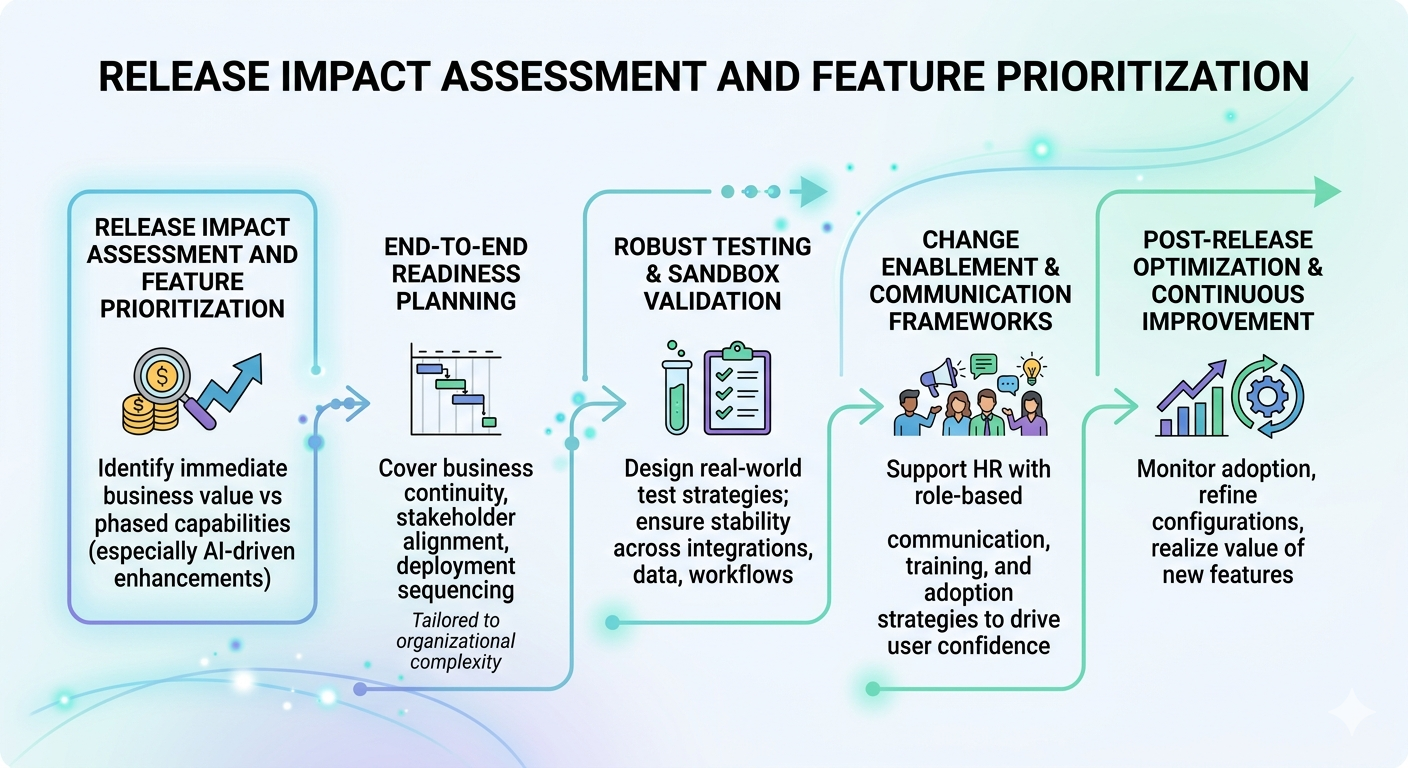
Image generated using AI tools for illustrative purposes.
What differentiates YASH is our ability to connect strategy with execution. Ready to move from go-live to real impact? Connect to our SAP experts at info@yash.com.

More From Author.
Related Posts.

The Compliance Revolution: Why AI is the New North Star for Product Stewardship
Prasanna Lakshmi Rayudu



SAP Infrastructure in the NY–NJ Pharma Corridor
Akhilesh Sodhani Parvez Ali



NeoLoad for SAP: Best Practices for Performance & Volume Testing
M. Sreekanth Vishvambhar Rushi



Accelerating Time-to-Value: Why Businesses Choose SAP Cloud ERP
Jacinto Arauz Paola Siri

How Australian HR Leaders Can Build High-Value, High-Trust People Systems in 2026
Saratchandra Panganamamula

The AI-First ERP: Future-Proofing Your Business with SAP Cloud ERP – Public
Paola Constanza Siri