

Introduction
For many enterprises, the data challenge today is no longer about volume; it is about coherence. SAP landscapes have grown richer and more fragmented simultaneously, with transactional systems, analytical platforms, data lakes, and AI engines evolving in parallel rather than in harmony. Business leaders are asking sharper questions, but data teams are often constrained by duplicated models, inconsistent semantics, and governance frameworks that were never designed for AI-first decision-making.
SAP Business Data Cloud (BDC), is SAP’s most decisive response yet to this reality. Rather than introducing another analytics or data warehousing layer, BDC re-architects how SAP data is unified, governed, enriched, and consumed—across analytics, planning, and AI. It brings together SAP Datasphere, SAP Analytics Cloud, SAP BW/BW4HANA, and deep integrations with SAP Databricks into a single, fully managed SaaS platform that preserves business context while enabling advanced data science and AI at scale.
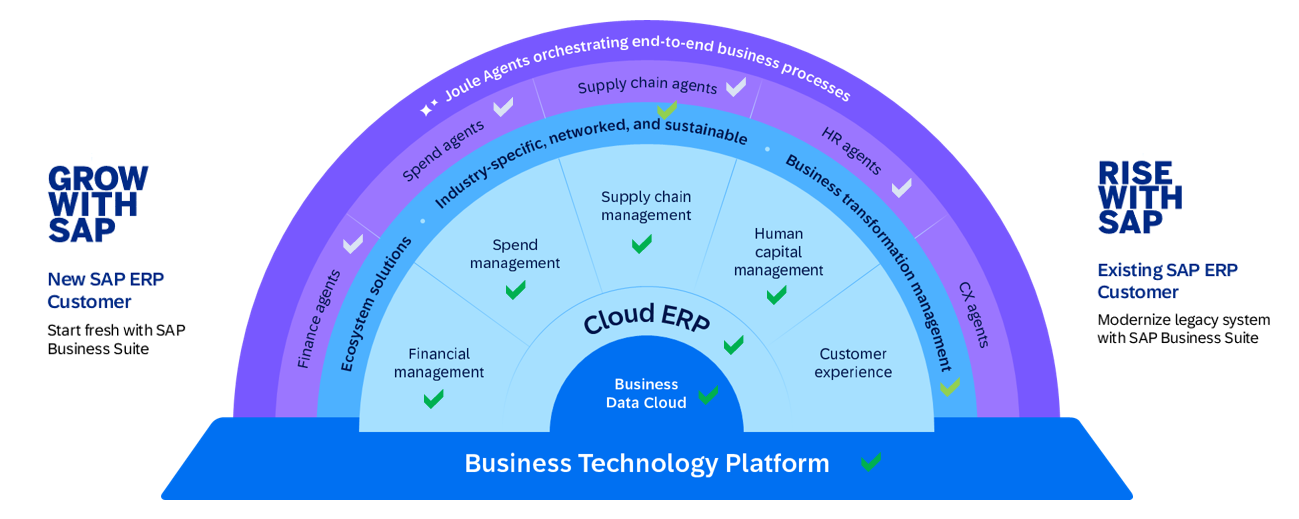
This blog presents a practical, architecture-first view of SAP Business Data Cloud, breaking down its core components, foundational services, and end-to-end data flow. More importantly, it explains why BDC matters: how it reduces analytical friction, enables trusted AI use cases, and creates a future-ready data foundation for organizations navigating SAP modernization.
1. Architecture and Overview of SAP Business Data Cloud
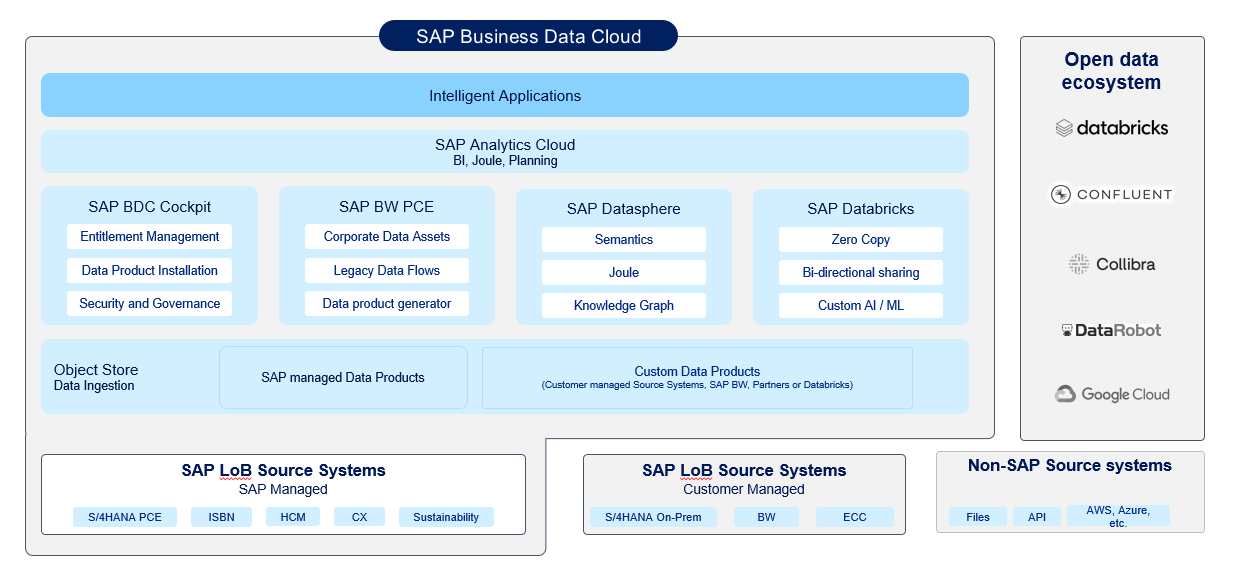
SAP Business Data Cloud (BDC) is built as a modular, cloud-native architecture that integrates multiple SAP and partner technologies into a unified ecosystem. It is designed to centralize data from SAP and non-SAP systems, harmonize it, and make it available for analytics, planning, and AI-driven insights.
1.1 Architectural Layers
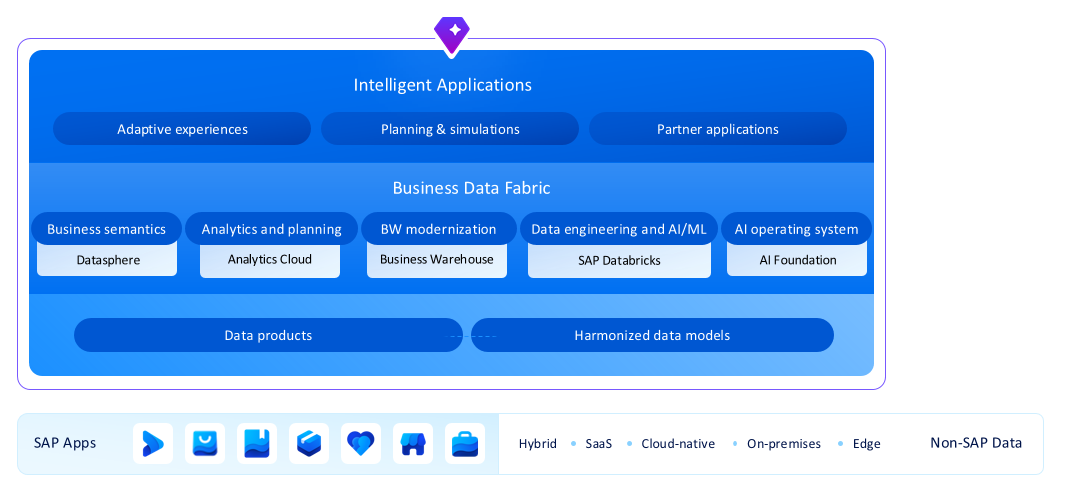
Data Sources Layer
- Includes SAP applications such as S/4HANA, SuccessFactors, Ariba, and Concur, as well as non-SAP systems.
- Data from these systems is accessed and replicated into the BDC environment.
Foundation Services Layer
- The core of BDC is responsible for data harmonization, transformation, and governance.
- It ensures consistency, quality, and compliance across all integrated data.
Data Management and Modeling Layer
- Powered by SAP Datasphere, this layer enables data modeling, semantic enrichment, and federation.
- It allows users to create data products that can be reused across analytics and AI applications.
Analytics and AI Layer
- Combines SAP Analytics Cloud (SAC) for visualization and planning with SAP Databricks for advanced AI/ML capabilities.
- Enables predictive analytics, natural language insights, and intelligent automation.
Consumption Layer
- Provides access to Insight Apps, dashboards, and APIs for business users and developers.
- Integrates with Joule, SAP’s AI assistant, for conversational data exploration.
1.2 Key Architectural Principles
- Cloud-Native and Scalable: Built on SAP HANA Cloud and object storage for elasticity and performance.
- Open and Extensible: Supports integration with third-party systems via APIs and connectors.
- Business Context-Aware: Embeds SAP’s deep business semantics into data models.
- AI-Ready: Seamlessly integrates with Databricks, Snowflake, and GCP for machine learning and generative AI use cases.
2. Key Components of SAP Business Data Cloud
SAP BDC is a suite of interconnected services. Each component plays a specific role in the data lifecycle, from ingestion to insight generation.
2.1 SAP Datasphere
SAP Datasphere is the data management backbone of BDC. It provides a unified data fabric that connects, models, and governs data across hybrid and multi-cloud environments.
Core Capabilities:
- Data Integration: Connects SAP and non-SAP sources using prebuilt connectors and APIs.
- Semantic Modeling: Preserves business context by maintaining metadata and relationships.
- Data Federation: Enables live access to data without duplication.
- Data Marketplace: Offers predefined data products for common business scenarios.
Role in BDC:Datasphere serves as the semantic and modeling layer, ensuring that data remains consistent and business-ready for analytics and AI applications.
2.2 SAP Analytics Cloud (SAC)
SAP Analytics Cloud is the analytics and planning engine within BDC. It provides a unified interface for data visualization, predictive analytics, and enterprise planning.
Key Features:
- Interactive Dashboards: Real-time visualizations powered by in-memory processing.
- Augmented Analytics: AI-driven insights and natural language queries.
- Integrated Planning: Combines analytics with financial and operational planning.
- Insight Apps: Predefined analytical applications built on top of BDC data products.
Role in BDC:SAC transforms harmonized data into actionable insights, enabling decision-makers to visualize trends, simulate scenarios, and plan effectively.
2.3 SAP BW and BW/4HANA
SAP BW (Business Warehouse) and BW/4HANA remain integral to BDC, especially for existing customers. SAP allows BW 7.5 and BW/4HANA systems to be hosted as Private Cloud Edition (PCE) options within BDC.
Key Benefits:
- Extended Maintenance: BW on HANA systems supported until 2030.
- Gradual Migration: Customers can transition to Datasphere at their own pace.
- Hybrid Scenarios: Combine on-premises BW data with cloud-based analytics.
- Data Reuse: Existing BW models can be integrated into BDC’s data fabric.
Role in BDC:BW serves as a bridge for legacy data warehousing environments, ensuring continuity while enabling modernization.
2.4 SAP Databricks, Snowflake & Google Cloud Integration
The partnership between SAP, Databricks, Snowflake, and Google Cloud brings powerful AI and ML capabilities to BDC. Databricks provides a Lakehouse architecture that supports both structured and unstructured data.
Key Features:
- Data Engineering: Advanced ETL and data preparation workflows.
- Machine Learning: Model training, deployment, and inference using structured SAP data.
- Generative AI: Integration with large language models for intelligent insights.
- Delta Sharing: Enables secure data sharing across platforms.
Role in BDC:
Databricks enhances BDC’s analytical depth by enabling AI-driven insights and predictive modeling, turning data into actionable intelligence.
2.5 SAP Business Data Cloud Foundation Services
The Foundation Services form the operational core of BDC. They handle data ingestion, harmonization, transformation, and governance.
Core Functions:
- Data Harmonization: Aligns data from multiple SAP and non-SAP sources.
- Transformation & Enrichment: Converts raw data into structured data products.
- Data Governance: Ensures compliance with regulations like GDPR.
- Metadata Management: Maintains lineage and version control for transparency.
Example Workflow:
- Data is replicated from S/4HANA and SuccessFactors.
- Foundation Services harmonize and enrich the data.
- The resulting Data Product is made available for analysis in Datasphere and SAC.
- AI models in Databricks refine insights, which are reintegrated into dashboards.
2.6 SAP BDC Connect
SAP BDC Connect is the integration layer that enables seamless connectivity between SAP and third-party systems. Capabilities:
- APIs and Connectors: Prebuilt interfaces for SAP and non-SAP applications.
- Middleware Support: Works with integration tools for hybrid data flows.
- Live Data Access: Enables real-time analytics without data duplication.
- Security and Access Control: Ensures secure data exchange across environments.
Role in BDC:
BDC Connect ensures interoperability and data flow continuity, enabling organizations to unify their diverse data landscapes under a single platform.
3. End-to-End Data Flow in SAP Business Data Cloud
To illustrate how BDC operates, let’s explore a typical scenario using SAP Insight Apps with S/4HANA and SuccessFactors as data sources.
- Select an Insight App
- Choose a predefined app from the BDC Cockpit tailored to your business function.
- Data Access and Replication
- Business data bundles from S/4HANA and SuccessFactors are replicated into BDC Foundation Services.
- Data Harmonization and Transformation
- Foundation Services harmonize and enrich the data, creating a structured Data Product.
- Analysis in SAP Datasphere
- Datasphere automatically generates analytical artifacts and prepares the data for visualization.
- AI-Driven Insights with Databricks
- Data Products are shared with Databricks for advanced AI/ML analysis.
- Results are reintegrated into dashboards for enhanced insights.
- Visualization in SAP Analytics Cloud
- SAC presents the insights through interactive dashboards and reports, enabling informed decision-making.
4. Benefits and Strategic Outlook
Key Benefits:
- Unified Data Management: Centralized governance and harmonization of all enterprise data.
- AI-Enhanced Analytics: Integration with Databricks for predictive and generative AI.
- Cost Optimization: Object store reduces dependency on in-memory storage.
- Predefined Content: Ready-to-use data products and Insight Apps accelerate time-to-value.
- Future-Proof Platform: Supports gradual migration from BW to Datasphere.
Bringing It Together with YASH Technologies
SAP Business Data Cloud changes how enterprises think about data ownership, reuse, and intelligence across SAP and non-SAP landscapes. By embedding business semantics at the core, enabling governed data products, and tightly integrating analytics with AI, BDC sets the stage for enterprises to move beyond descriptive reporting toward predictive, adaptive, and intelligent operations. Organizations must rethink data architectures, migration strategies, governance models, and operating frameworks, especially when balancing legacy BW investments with cloud-native innovation. This is where a structured, experience-led deployment approach becomes critical.
YASH Technologies helps enterprises translate SAP Business Data Cloud from architecture diagrams into business outcomes. With deep expertise across SAP Datasphere, SAP Analytics Cloud, BW modernization, and AI-enabled data platforms, YASH supports clients through every phase of the BDC journey. Whether the goal is accelerating insight delivery, enabling AI-driven use cases, or modernizing SAP data foundations without disruption, YASH brings the architectural clarity and execution rigor required to make SAP Business Data Cloud deliver measurable value.
As enterprises step into an AI-first era, SAP Business Data Cloud provides the foundation. YASH ensures it becomes a differentiator.

More From Author.
Related Posts.


The Compliance Revolution: Why AI is the New North Star for Product Stewardship
Prasanna Lakshmi Rayudu



SAP Infrastructure in the NY–NJ Pharma Corridor
Akhilesh Sodhani Parvez Ali

NeoLoad for SAP: Best Practices for Performance & Volume Testing
M. Sreekanth Vishvambhar Rushi

Accelerating Time-to-Value: Why Businesses Choose SAP Cloud ERP
Jacinto Arauz Paola Siri