


Cybersecurity Strategic Priorities for 2026: Part 2 – Resilience, Patching & Identity Defense
Publish Date: December 15, 2025Continuing the 2026 cybersecurity agenda
In Part 1 of this series, the focus was on the first five strategic priorities that reshape how organizations think about cybersecurity in 2026—from AI and security fundamentals to boardroom engagement and quantum readiness. Building on that foundation, this second part moves into execution-heavy priorities that determine how quickly and effectively your organization can withstand, respond to, and recover from inevitable attacks.
Priority #6: Assume Breach – Build for Resilience
The Reality
The question isn’t if you’ll be breached—it’s when. Data theft drives the majority of security incidents, while ransomware dominates system intrusions. Yet most organizations still invest disproportionately in prevention over resilience.
Modern ransomware groups don’t just encrypt your data—they exfiltrate it first, creating a double-extortion scenario. Even with perfect backups, you face reputational damage and regulatory penalties from data exposure. Recovery without resilience planning can take weeks or months, costing millions in downtime.
Why This Matters
Your ability to recover quickly and completely determines whether a breach is a manageable incident or an extinction event. Organizations with tested, immutable backups restore operations in days. Those without face weeks of chaos, permanent data loss, and sometimes closure.
Resilience isn’t about avoiding attacks—it’s about ensuring attacks don’t destroy your business. It’s the difference between a bad week and bankruptcy.
What To Do (By Organization Size)
Small Organizations (5-50 employees)
- Implement automated daily backups using the 3-2-1 rule (3 copies, 2 media types, 1 offsite/offline). Test restores quarterly, document recovery priorities, and keep backups truly air-gapped from ransomware.
Mid-Sized Organizations (50-500 employees)
- Deploy immutable backup storage and establish RTO/RPO for each critical system. Create recovery runbooks, conduct semi-annual tabletop exercises, implement network segmentation, and maintain an updated asset inventory.
Enterprise Organizations (500+ employees)
- Build comprehensive BCDR programs with executive sponsorship. Deploy advanced backups with ransomware detection and instant recovery, establish cyber recovery vaults, conduct annual full-scale DR exercises, implement continuous data protection (CDP) for critical systems, and develop supply chain resilience plans with crisis communication strategies.
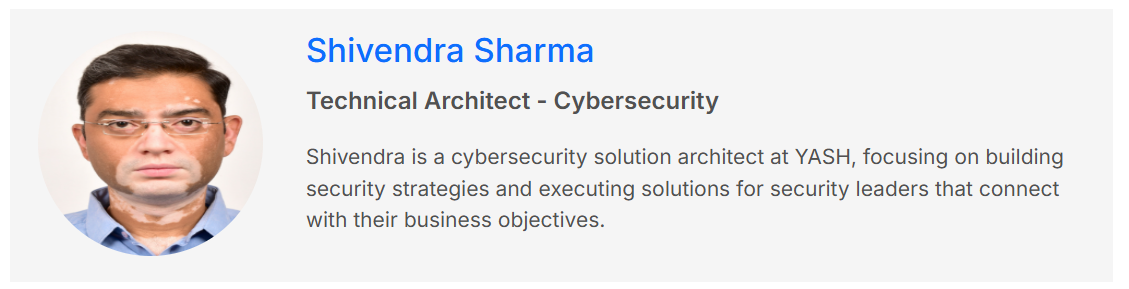
“I’ve watched organizations with perfect prevention controls get breached and recover in 48 hours because they prioritized resilience. And I’ve seen others with cutting-edge detection tools take six weeks to recover because they never tested their backups. Resilience is your insurance policy—and like all insurance, you need it before the disaster strikes, not after”,
said by Shivendra Sharma (Backup & Disaster Recovery Expert) at YASH Technologies.
Want to explore more insights from Shivendra? Check out his other blogs https://www.yash.com/blog_author/shivendra-sharma/
Priority #7: Patch Faster – Zero-Days Are Being Weaponized
The Reality
Exploitation as an initial attack vector is rising sharply. Ransomware groups and nation-state actors routinely weaponize vulnerabilities within hours of public disclosure—sometimes even before patches are available. Exploit kits containing ready-made attack tools are traded openly on criminal forums, lowering the barrier to entry.
The window between vulnerability disclosure and mass exploitation has collapsed. What once took weeks now happens in days or hours. Organizations that patch slowly are essentially leaving doors wide open with signs saying “vulnerable systems inside.”
Why Speed Matters
Modern vulnerability management isn’t about perfection—it’s about velocity. Attackers don’t target your hardest systems; they target your slowest. The organization that patches critical vulnerabilities in days survives. The one that takes weeks becomes a statistic.
Legacy patch management approaches—monthly patch cycles, extensive testing periods, change approval delays—no longer align with the threat landscape. Waiting weeks to patch a critical vulnerability that’s being actively exploited is a losing strategy.
What To Do (By Organization Size)
Small Organizations (5-50 employees)
- Enable automatic updates where possible and create a basic asset inventory. Prioritize patches for internet-facing systems and establish simple SLAs (critical within 7 days, high-risk within 30 days). Subscribe to vendor security bulletins and use patch management tools or managed services.
Mid-Sized Organizations (50-500 employees)
- Deploy automated vulnerability scanning with risk-based patch prioritization using threat intelligence. Establish emergency patch procedures for zero-days, create tiered patch windows, track compliance with clear ownership, and use virtual patching or WAFs as temporary mitigations when needed.
Enterprise Organizations (500+ employees)
- Implement continuous vulnerability assessment with real-time asset discovery and deploy automated patch orchestration with testing pipelines. Establish aggressive SLAs (critical in 48-72 hours, high-risk in 15 days), create dedicated vulnerability response teams, use threat intelligence feeds for prioritization, implement CMDB with dependency mapping, deploy SOAR for accelerated validation, and conduct regular penetration testing.
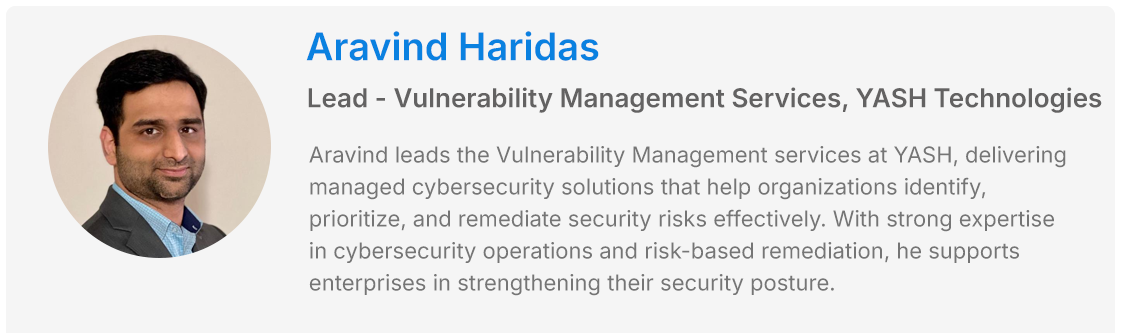
“Speed kills—but in vulnerability management, speed saves lives. We’ve shifted our clients from ‘patch Tuesday’ mentality to continuous vulnerability response. The organizations that treat patching as an emergency response capability rather than a monthly maintenance task are the ones staying ahead of ransomware groups. Every hour of delay is an hour attackers can exploit you”,
said by Aravind Haridas
Priority #8: Invest in People – Tech Alone Won’t Save You
The Truth
Humans drive the vast majority of security breaches. Phishing, social engineering, misconfiguration, and simple mistakes account for more incidents than sophisticated technical exploits. Yet most organizations treat security awareness as a checkbox compliance exercise—annual training that employees endure and immediately forget.
The cybersecurity skills gap persists and is widening. Organizations struggle to hire qualified security professionals while existing teams face burnout from alert fatigue and constant firefighting. Meanwhile, every employee needs baseline security knowledge, but few receive effective, engaging training.
Why This Matters More Than Ever
Technology improves constantly, yet human behavior remains the weakest link. As technical controls strengthen, attackers increasingly target people because it’s easier than breaking through firewalls and endpoint protection. Your multi-million-dollar security infrastructure fails the moment someone hands over their password to a convincing phishing email.
Security culture isn’t built through policies and mandates—it’s cultivated through education, empowerment, and positive reinforcement. Organizations with strong security cultures treat every employee as part of the security team rather than as potential liabilities.
What To Do (By Organization Size)
Small Organizations (5-50 employees)
- Conduct monthly security awareness moments and quarterly phishing simulations with immediate feedback. Make security part of onboarding, create clear policies in plain language, celebrate security wins, and provide fundamentals training on password hygiene and phishing recognition.
Mid-Sized Organizations (50-500 employees)
- Implement continuous security awareness with microlearning (5-10 minute modules) and monthly realistic phishing simulations. Create security champions networks, provide role-based training, offer security career development paths and certifications, measure culture through surveys and behavior metrics, and establish mentoring programs.
Enterprise Organizations (500+ employees)
- Build comprehensive security culture programs with dedicated resources and adaptive training based on individual performance. Create simulation programs beyond phishing (USB drops, vishing, social engineering), establish security education for leadership, develop internal security academies or university partnerships, implement meaningful security metrics measuring behavior change, create cross-functional security councils, offer competitive compensation and professional development, and build purple team programs for realistic threat scenarios.
“I tell every client the same thing: your employees are either your strongest defense or your biggest vulnerability—you get to choose which through how you invest in them. We’ve seen organizations transform their security posture not by buying new tools, but by creating cultures where employees feel empowered and responsible. When security becomes part of your DNA, not a policy document, everything changes”,
said by Shivendra Sharma (Principal Consultant) at YASH Technologies.
Want to explore more insights from Shivendra? Check out his other blogs https://www.yash.com/blog_author/shivendra-sharma/
Priority #9: Defend Against AI-Powered Social Engineering
The Shift
Artificial intelligence has fundamentally changed the social engineering landscape. Generative AI can now create convincing phishing emails in any language, clone voices for vishing attacks, generate deepfake videos, and craft personalized lures by scraping social media—all at massive scale with minimal effort.
Traditional security awareness training taught employees to look for typos and grammatical errors in phishing emails. Those tells have vanished. AI-generated attacks are grammatically perfect, contextually relevant, and increasingly difficult to distinguish from legitimate communications.
Help desks and IT support teams have become favorite targets. Attackers use AI-generated voices that mimic executives to request password resets or system access. The technology required costs less than $100 and requires no technical expertise.
Why This Is Critical
Your people remain your last line of defense and your greatest vulnerability. As technical controls improve, attackers increasingly target the human element. AI has made these attacks dramatically more effective while reducing the skill level required to launch them.
The speed and scale of AI-powered attacks overwhelm traditional defenses. What once required days of reconnaissance and manual effort can now be automated, personalized, and deployed against thousands of targets simultaneously.
What To Do (By Organization Size)
Small Organizations (5-50 employees)
- Conduct quarterly phishing simulations with realistic scenarios. Train on current AI-powered attack techniques, establish callback verification for sensitive requests (password resets, wire transfers), create easy reporting mechanisms, and share real-world attack examples.
Mid-Sized Organizations (50-500 employees)
- Deploy continuous security awareness with short, regular sessions and monthly phishing simulations (email, SMS, voice). Create security champions programs, establish out-of-band verification for high-risk transactions, provide specialized help desk training, and use AI detection for anomalous communications.
Enterprise Organizations (500+ employees)
- Deploy advanced email security with AI-powered behavioral analysis and implement real-time coaching. Create role-based training for specific risks, establish threat intelligence monitoring for credential leaks, deploy deepfake detection capabilities, build purple team approaches combining awareness with technical controls, and conduct adversarial simulations including vishing and deepfake scenarios.
“The game has changed completely. We’re now training employees to verify identity through multiple channels, not just spot bad grammar. AI has democratized sophisticated attacks—what used to require nation-state resources is now available to any criminal with a laptop. Our awareness programs now include deepfake detection and voice verification protocols because those threats are already here”,
Said by Vijaya Sagar
Want to explore more insights from Vijaya? Check out his other blogs https://www.yash.com/blog_author/vijaya-sagar-talasila/

Priority #10: Protect Your Identities – Your New Perimeter
The Threat
The perimeter has dissolved. Your employees, contractors, and partners access systems from everywhere—coffee shops, home offices, airports. Traditional firewalls can’t protect what they can’t see. Identity has become the frontline, and attackers know it.
Identity attacks are surging at an unprecedented rate. Most aren’t sophisticated—password spraying, credential stuffing, and simple phishing campaigns dominate. Yet they’re devastatingly effective. Valid account abuse has become the leading entry point for breaches, with “breakout time” measured in seconds, not hours.
Why It Happens
Modern infostealers delivered through phishing campaigns operate silently in the background, harvesting passwords, session cookies, and authentication tokens long before legacy security tools can react. By the time you detect the breach, attackers have already moved laterally through your network, escalating privileges and accessing crown-jewel data.
The shift to remote work and cloud services has multiplied attack surfaces. Every employee is now a potential entry point, and every credential is a key to your kingdom.
What To Do (By Organization Size)
Small Organizations (5-50 employees)
- Enforce MFA everywhere (email, admin, financial systems) and deploy a password manager to eliminate weak credentials. Enable credential monitoring for breach alerts and conduct quarterly access reviews.
Mid-Sized Organizations (50-500 employees)
- Add conditional access policies and SSO for centralized authentication. Implement privileged access management (PAM) for admin accounts, establish identity governance with automated access reviews and RBAC, and monitor for anomalous authentication patterns.
Enterprise Organizations (500+ employees)
- Advance toward Zero Trust with continuous verification. Deploy identity threat detection and response (ITDR), implement phishing-resistant MFA (FIDO2/WebAuthn), use identity analytics with behavior baselines, and establish a dedicated identity SOC function.
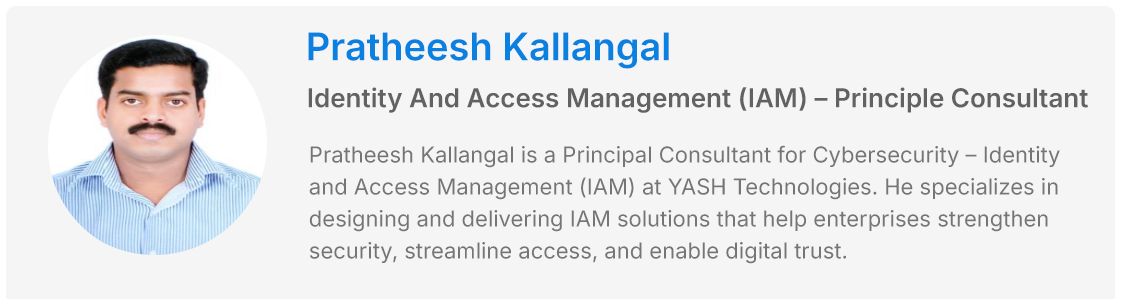
“Identity attacks are the #1 entry point we see across our clients. The shift from perimeter security to identity-first thinking isn’t optional anymore—it’s survival. Organizations that master IAM early gain a defensive advantage that compounds over time. We’re seeing clients who implemented strong identity controls two years ago now weathering attacks that are crippling their competitors”,
said by Pratheesh
Want to explore more insights from Pratheesh? Check out his other blogs https://www.yash.com/blog_author/pratheesh-kallangal/
Your Next Steps: A Practical Roadmap
Starting Out:
- Implement MFA across all critical systems
- Establish automated backup procedures
- Create basic asset inventory
- Launch phishing awareness training
With Basics Covered:
- Deploy endpoint detection and response (EDR)
- Implement continuous vulnerability scanning
- Establish vendor security standards
- Conduct tabletop incident response exercises
Advanced Maturity:
- Deploy AI-powered threat detection
- Architect Zero Trust security model
- Begin quantum cryptography readiness
- Establish threat intelligence programs
A Final Word from the Field
I’ve spent my career helping organizations navigate security transformations across every industry and maturity level. The organizations that thrive aren’t those with the biggest budgets—they’re the ones that act decisively, invest strategically, and treat security as a business enabler rather than a cost center.
Our team of portfolio experts—from identity and access management to AI security to vendor risk—stands ready to help you translate these priorities into action. We’ve walked this path with hundreds of organizations, and we know where the pitfalls lie and how to avoid them.
The threats are real. The solutions are accessible. The choice is yours.
Will you act before the breach—or after?

Senthilvel Kumar
Vice President – Cyber Security Services
Senthil is a cyber security Practice Head and VP at YASH offering advisory on cyber security solutions to CxO's, CISO, Board Level Executives for building a robust security modernization programme covering on-prem and Cloud.
More From Author.
Related Posts.
The Future of Security Operations Is Decision Intelligence-Augmented
Senthilvel Kumar

The Microsoft Security Shift CISOs Can’t Ignore
Mahipal Kirupanithy Senthilvel Kumar Shivaram Jeyasekaran

Your SOC Is Using AI. But Who Is Securing the AI Layer?
Shivaram Jeyasekaran

AI vs AI: Why Traditional SOCs Are Losing the 2026 Threat Race
Senthilvel Kumar Vikash Kumar

Mythos Moves in Hours. Your MTTD Starts Too Late
Shivendra Sharma


The Hidden AI Risk in Your Cloud: Why CSPM Is Now a Board-Level Priority
Mahipal Kirupanithy

How AI-Powered EDR Stops Modern Attacks in Real Time
Mahipal Kirupanithy Vikash Kumar