

For years, BizTalk Server quietly powered some of the most critical integration landscapes in enterprises—moving orders, synchronizing systems, and keeping B2B traffic flowing without fanfare. It was dependable, mature, and deeply embedded in core operations.
But the integration world it was built for no longer exists. With Microsoft confirming that BizTalk Server 2020 is the final release, the message is clear: BizTalk is entering a sunset phase, and integration strategies must evolve with it.
Support doesn’t disappear overnight—mainstream support runs until 2028 and extended support until 2030. But there will be no new features, no innovation, and no roadmap for the future. That changes the conversation entirely. What was once a stable platform is now a finite asset.
For organizations still running mission-critical workloads on BizTalk, this is no longer just an IT maintenance issue; it has become a critical business concern.
| Milestone | Date | Significance |
|---|---|---|
| Mainstream Support End | April 11, 2028 | No further functional updates or new features will be added. |
| Extended Support End | April 9, 2030 | The final cut-off for security patches. |
| The “Hard” Deadline | April 10, 2030 | The product is officially unsupported. |
Cloud-Native Integration Is No Longer Optional
Microsoft’s integration investments have decisively moved to Azure. Instead of a monolithic integration server, the future is composable, cloud-native services delivered collectively through Azure Integration Services (AIS).
Services such as Logic Apps, Service Bus, Event Grid, and API Management are not “BizTalk replacements” in the traditional sense. They represent a fundamentally different operating model:
- Integration that scales automatically, not through capacity planning
- Consumption-based pricing instead of fixed infrastructure costs
- Built-in resilience, security, and compliance aligned with modern cloud standards
Most importantly, Azure-native integration achieves what BizTalk never could: event-driven architectures, real-time analytics, AI-assisted workflows, and faster innovation cycles.
Migrating is not about recreating BizTalk in the cloud. It’s about repositioning integration as a digital accelerator rather than a backend constraint.
Modernization Doesn’t Mean Starting from Scratch
One of the biggest myths around BizTalk migration is that years of work must be discarded. In practice, that’s rarely true.
Schemas, maps, business rules, and integration logic often translate well into Azure-native patterns. With the proper tooling and migration approach, large portions of existing assets can be reused or adapted—reducing risk, cost, and disruption.
The real work lies not in rewriting everything, but in intentionally re-architecting, deciding where cloud-native design improves flexibility and where proven logic should be preserved. Done correctly, modernization becomes predictable rather than overwhelming.
Early Movers Gain More Than Technical Benefits
Organizations that delay migration often frame the decision as “why now?” The better question is “what do we gain by moving sooner?”
Early adopters typically see:
- Faster rollout of new integrations and partner connections
- Lower operational overhead as infrastructure management fades into the background
- Better observability, resilience, and fault isolation
- Direct access to Azure’s growing ecosystem of automation and AI capabilities
Meanwhile, staying on BizTalk for too long increases exposure to legacy risks, including shrinking skill pools, rising maintenance costs, and architectural rigidity that hinders business growth. Integration agility increasingly translates to competitive agility.
A Phased Approach Beats a Big-Bang Migration
Successful BizTalk migrations are rarely rushed—and they are never accidental.
A practical roadmap usually unfolds in stages:
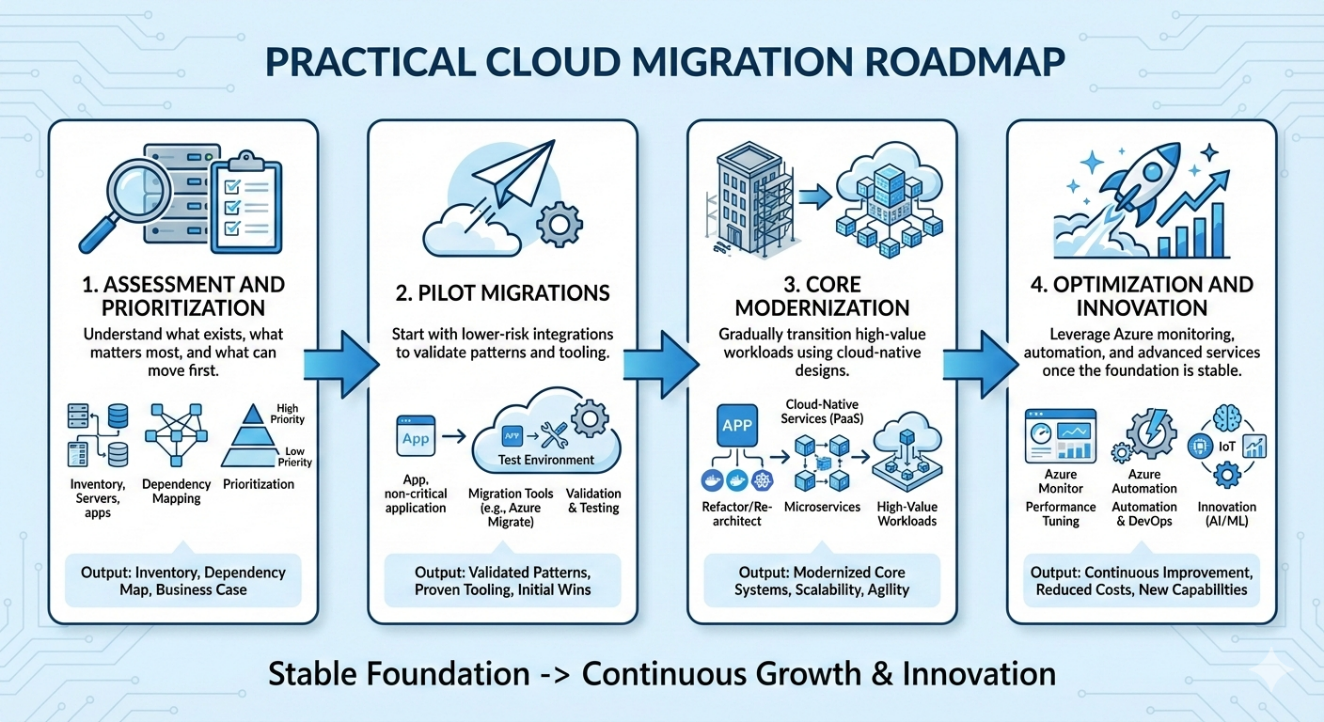
This journey may span multiple quarters, but starting early creates room for learning, adjustment, and value realization, without last-minute pressure as support deadlines approach.
This Is a Strategic Inflection Point, Not a Maintenance Task
Microsoft’s BizTalk lifecycle announcement marks more than the end of a product line. It signals a shift in how integration platforms are expected to support modern enterprises.
- BizTalk has fulfilled its role
- Azure Integration Services define the future
- The window for low-risk, well-planned migration is limited
Organizations that act now reduce long-term risk, modernize on their own terms, and position integration as a foundation for growth—not as a source of technical debt.
Seamless BizTalk-to-Azure Migration with YASH
At YASH Technologies, we help enterprises move beyond “end-of-support anxiety” and toward confident, outcome-driven modernization. Our teams bring deep experience across BizTalk Server (2013, 2016, and 2020) and Azure Integration Services, combining platform expertise with pragmatic migration strategies. We focus on:
- Preserving business-critical logic
- Designing resilient, cloud-native integration architectures
- Minimizing disruption while enabling future innovation
With a proven track record in complex integration transformations, YASH partners with organizations to develop realistic, secure, and business-aligned migration roadmaps that drive effective outcomes.
If BizTalk remains at the heart of your integration landscape, now is the ideal time to initiate the conversation. Contact us at info@yash.com

Rishi Gupta
Microsoft Sr. Solutions Architect
Rishi is a highly skilled and experienced Microsoft Sr. Solutions Architect with 18+ years of experience, specializing in Microsoft technologies with a focus on Azure application development, digital experience, M365, and Copilot services. He is passionate about helping organizations modernize applications and embrace AI-powered productivity tools to unlock real business value. He has worked in multiple domains like Manufacturing, healthcare, retail, and finance. As part of Microsoft Services as Yash, he is responsible for digital transformation, migration & modernization, and leading customers in their cloud journey.
More From Author.


Related Posts.


Unlock Data Editing Magic: Translytical Task Flows in Power BI
Lalit Goyal Prashant Atri






Unified Financial Data Platform: Empowering Modern Finance with Trust, Speed, and Scale
Phani Parashuram Srinivas Bhoopathi



Microsoft API Services: The Engine Powering Digital Transformation
Shiva Pratap Singh