


When Ransomware Reprices the Deal: Cyber Risk in Modern M&A
Publish Date: February 9, 2026Cyber risk is no longer an IT-side concern in M&A. It has increasingly become a pricing variable, one that can quietly shift enterprise value by hundreds of millions when surfaced late in the deal process.

The New Blind Spot in Valuation
Traditional acquisitions focused on physical assets: factories, fleets, and supply infrastructure. Modern deals, however, are built around digital ecosystems, cloud environments, proprietary algorithms, data platforms, and always-on operations.
Yet valuation models often fail to reflect the true resilience (or fragility) of these digital assets. When cyber due diligence is reduced to a late-stage checklist or simplified into red–yellow–green dashboards, deal teams are left without actionable financial clarity. A “medium risk” label cannot be translated into a defensible valuation adjustment or incorporated meaningfully into discounted cash flow modeling.
A $350M Market Signal
The Verizon – Yahoo acquisition remains a widely cited example. After signing, Verizon discovered previously undisclosed historic breaches at Yahoo, resulting in a price reduction of approximately $350 million.
That adjustment was not simply a reaction to a security incident; it reflected the market assigning a concrete dollar value to unmanaged cyber exposure and its downstream impact on brand trust, customer retention, regulatory risk, and future cash flows.
FAIR: Converting Cyber Findings into Deal Math
The FAIR model (Factor Analysis of Information Risk) provides a structured approach for quantifying financial exposure from security issues. Instead of relying on qualitative risk categories, FAIR breaks cyber risk into two core drivers:
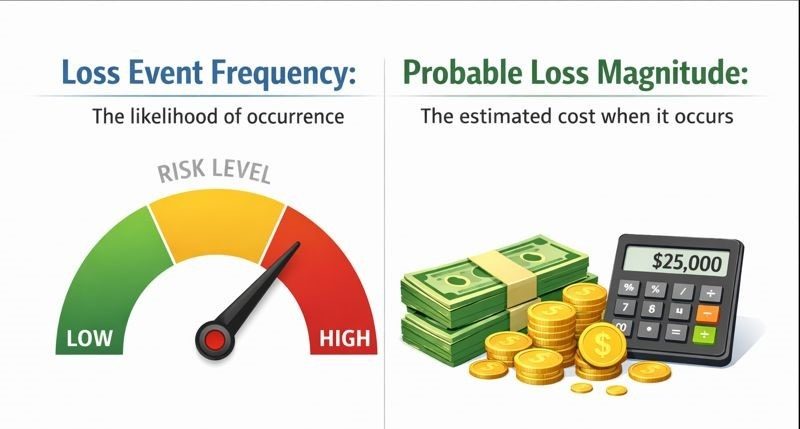
This enables outputs such as Annualized Loss Expectancy and Cyber Value at Risk, for example:
“Expected annual cyber loss of $6M, with a 90th percentile downside of $20M,”
rather than a generic “high risk” designation.
Once quantified, cyber risk is directly tied to deal mechanisms: pricing adjustments, cyber-specific escrows, insurance structuring, post-close integration priorities, and even potential WACC implications when systemic cyber fragility increases volatility in future cash flows.
Quantification at Deal Speed
Comprehensive risk modeling can be resource-intensive, while M&A timelines often move in compressed 2–4-week cycles. As a result, many organizations apply a Rough Order of Magnitude (ROM) approach, focusing on a limited number of “crown jewel” scenarios such as:
- ransomware disrupting operations
- large-scale data breach exposure
- intellectual property theft
These scenarios can be modelled quickly using industry loss benchmarks, outside-in security posture data, and assessments of control maturity. The objective is not precision, but a defensible loss range that can materially influence term sheets and valuation discussions.
Why This Matters for Dealmakers?
For acquirers, FAIR shifts cyber from a compliance checkbox to a capital-protection tool, enabling risk-adjusted valuations, smarter escrow decisions, more precise integration roadmaps, and stronger governance narratives at the board level.
For sellers, upfront quantification can reduce uncertainty, prevent disruptive repricing events, and demonstrate that security investments contribute directly to enterprise value.
The whole framework, example calculations, and guidance on applying FAIR outputs to price, escrow, and WACC adjustments are explored in the whitepaper:
Capital Preservation in the Digital Age: A Quantitative Framework for Integrating Cyber Risk into M&A Valuation [Download now]

Shivaram Jeyasekaran
Director – Cybersecurity Services, YASH Technologies
A distinguished cybersecurity leader with over 23 years of experience transforming enterprise security landscapes across global organizations. He is recognized for architecting and scaling robust cybersecurity programs that align with business objectives while maintaining cutting-edge defense capabilities. Shivaram has spearheaded numerous large-scale cybersecurity consulting engagements in his illustrious career, helping organizations navigate complex security challenges while balancing innovation with risk management. His approach combines strategic vision with practical implementation, ensuring organizations stay resilient in the face of evolving cyber threats.

Ankush Arora
Delivery Manager
Ankush Arora is a Client partner at YASH Technologies and an MBA candidate at UIUC specializing in M&A. He helps organizations align their IT strategy with complex merger integrations.
More From Author.
Related Posts.


The Hidden AI Risk in Your Cloud: Why CSPM Is Now a Board-Level Priority
Mahipal Kirupanithy

How AI-Powered EDR Stops Modern Attacks in Real Time
Mahipal Kirupanithy



From Annual Audits to Always-On Assurance: How AI Is Redefining SOC & ISO Compliance
Mahipal Kirupanithy Shivaram Jeyasekaran

Why Third-Party Risk Can No Longer Be Manual: Building an AI-Driven TPRM Program
Mahipal Kirupanithy Shivaram Jeyasekaran

The AWS Security Arsenal: 7 Services Every Cloud Leader Should Master
Mahipal Kirupanithy Shivaram Jeyasekaran

Stop Collecting Security Tools. Start Managing Cyber Risk.
Kaisar Chishti Shivaram Jeyasekaran Val Coucke

Microsoft Sentinel Data Lake: A Game-Changer for Security Operations
Kaisar Chishti Shivaram Jeyasekaran Val Coucke

AI Governance: Board-Level Oversight for Emerging Technology
Shivaram Jeyasekaran

Security Budgeting: Making the Business Case for 2026
Shivaram Jeyasekaran