
Understanding SOC Maturity in the Age of AI: A Framework for Measuring Security Operations Effectiveness
Publish Date: December 30, 2025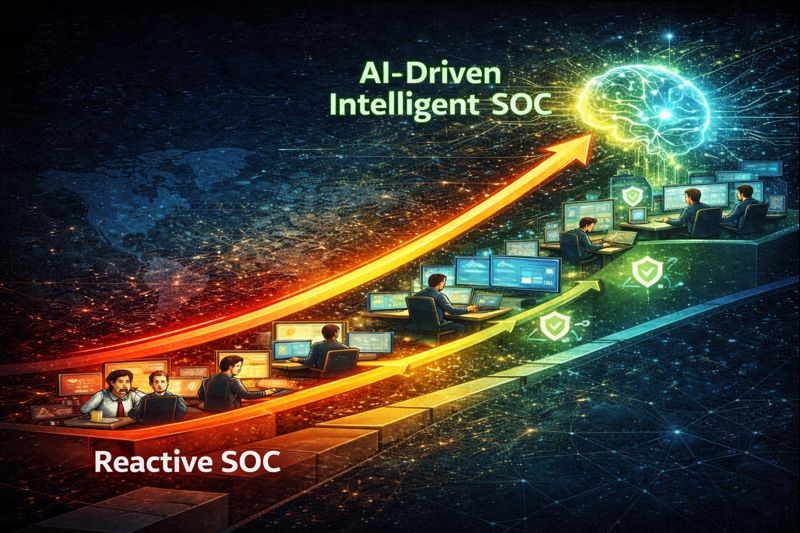
Introduction
Not all Security Operations Centers (SOCs) are created equal. While some organizations harness cutting-edge automation and AI-powered analytics for proactive defense, others still struggle with alert fatigue, manual triage, and fragmented visibility.
Understanding where your SOC stands on the maturity spectrum is essential for making informed decisions about investments, priorities, and strategic direction. Today, AI has emerged as both a technological accelerator and a differentiator—reshaping how SOCs detect, respond to, and prevent threats.
SOC maturity isn’t just about having the latest tools or the largest team—it’s about how intelligently and efficiently you use technology, data, and AI-driven insights to improve your security posture. This blog explores the SOC maturity model, enhanced through AI’s growing influence, and how to assess your organization’s current state.
What is SOC Maturity?
SOC maturity reflects the sophistication, efficiency, and intelligence of your security operations. A mature SOC doesn’t simply react to incidents—it anticipates them. Through AI-infused analytics, automation, and continuous learning, mature SOCs identify patterns invisible to human analysts, automate repetitive tasks, enhance decision-making speed, and align operations tightly with business goals.
The evolution from a basic SOC to an adaptive, AI-empowered operation is a journey—each stage building on lessons from the previous one, with intelligence, automation, and adaptability as the core drivers.
The Five Levels of SOC Maturity
Level 1: Initial / Ad Hoc
- Characteristics: Reactive approach, manual processes, limited logging, siloed tools, no formal incident response.
- Challenges: High false positives, slow detection, poor visibility, lack of metrics, compliance struggles.
- Success: Knowing when something bad has happened—even if response is delayed.
Level 2: Developing
- Characteristics: Basic SIEM, documented response procedures, dedicated team, initial automation and AI-assisted alert correlation.
- Challenges: Alert overload, inconsistent playbook use, limited tool integration.
- Success: Detect common threats within hours and follow documented processes with early support from AI analytics.
Level 3: Defined
- Characteristics: Consistent processes, tuned SIEM, integrated tools, proactive vulnerability management, early-stage AI-driven anomaly detection, 24/7 monitoring.
- Challenges: Dependence on manual analysis, limited automated tuning, tool sprawl.
- Success: Detect most threats within minutes to hours, respond consistently, show measurable posture improvements.
Level 4: Managed
- Characteristics: Data-driven decisions, advanced AI analytics, SOAR automation, predictive threat hunting, and comprehensive tool integration.
- Challenges: Balancing automation with analyst expertise, managing complexity, attracting AI-proficient talent.
- Success: Detect sophisticated threats within minutes, respond automatically, and continuously improve through AI feedback loops.
Level 5: Optimizing
- Characteristics: Continuous innovation, deep AI/ML integration, contextual threat intelligence sharing, dynamic decision-making, and full DevSecOps alignment.
- Challenges: Maintaining advantage, balancing agility with control, avoiding complacency.
- Success: Prevent most attacks before impact, predict emerging threats, and embed AI-driven security intelligence as a core business enabler.
Key Dimensions of AI-Enabled SOC Maturity
- People & Organization: Blending human expertise with AI-augmented analysis and training.
- Process & Governance: Embedding AI into playbooks, workflows, and continuous improvement cycles.
- Technology & Tools: Using SIEM, EDR/XDR, SOAR, and AI-driven correlation engines for adaptive visibility.
- Threat Intelligence: Operationalizing and contextualizing feeds through AI-based enrichment.
- Detection & Analytics: Leveraging machine learning to fine-tune use cases and minimize false positives.
- Response & Remediation: Using autonomous AI response frameworks to reduce MTTD and MTTR.
How to Assess AI-Enabled SOC Maturity
- Form an Assessment Team: Include SOC, IT, leadership, and external expertise with AI capability.
- Gather Documentation: Review incident response plans, metrics, and automation workflows.
- Interview Stakeholders: Analysts, managers, and leadership to evaluate process and AI adoption readiness.
- Score Each Dimension: Use a structured framework that factors in AI maturity.
- Identify Gaps & Priorities: Align technology and skill investments with business and compliance needs.
- Develop a Roadmap: Define phased AI adoption milestones with measurable security outcomes.
- Measure & Iterate: Reassess maturity regularly to track improvements driven by analytics and automation.
Common Pitfalls
- Over-reliance on tools without AI training or process integration.
- Skipping foundational levels before AI integration.
- Ignoring continuous skills development for analysts in AI and automation.
- Tracking metrics without leveraging them for AI-based improvements.
- Treating assessment as a one-time activity instead of an evolving intelligence process.
Realistic Timelines (with AI Considerations)
- Level 1 → 2: 6–12 months — foundational alignment and basic automation.
- Level 2 → 3: 12–18 months — initial AI-driven detection.
- Level 3 → 4: 18–24 months — integrated analytics, adaptive automation.
- Level 4 → 5: 2–3+ years — full AI operationalization and predictive defense.
The Business Case for AI-Driven SOC Maturity
- Reduced Breach Impact: Intelligent detection shortens dwell time.
- Lower Costs: AI-driven automation reduces incident handling overhead.
- Compliance Confidence: Automated reporting simplifies audits.
- Business Enablement: AI-supported security scales with digital transformation.
- Talent Retention: AI offloads repetitive tasks, allowing analysts to focus on strategic work.
- Insurance Benefits: Demonstrated AI maturity can reduce cyber insurance premiums.

Vijaya Sagar Talasila
Solution Architect
Solution Architect focused on cloud, microservices, and enterprise security. I design scalable, secure systems across SOC, SIEM, and vulnerability management—bridging strategy and execution to deliver resilient architectures that enable growth.