


The Smart Testing Triangle: How Impact Analysis, Test Management, and Automation Work Together to De-Risk ERP Change
Publish Date: August 14, 2026Continuous releases of SAP S/4HANA, QAD, or Salesforce will always encounter the same limitation during upgrades or migrations: the pace of change outpaces quality assurance testing. This means that the QA team in enterprises has traditionally worked with three separate silos – test management being done through Excel sheets, impact analysis only after the code review, and automation being done separately as script libraries, which need to be updated every time there are changes to the interfaces. Changes in one lead to changes in the others, leading to a reactive process.
To bridge the gap, impact analysis, test management, and automation must be considered as a whole. This is the philosophy of the so-called Smart Testing Triangle in SAP and Salesforce testing, and the framework is based on the Panaya platform used by YASH Technologies for SAP, QAD, and Salesforce testing.
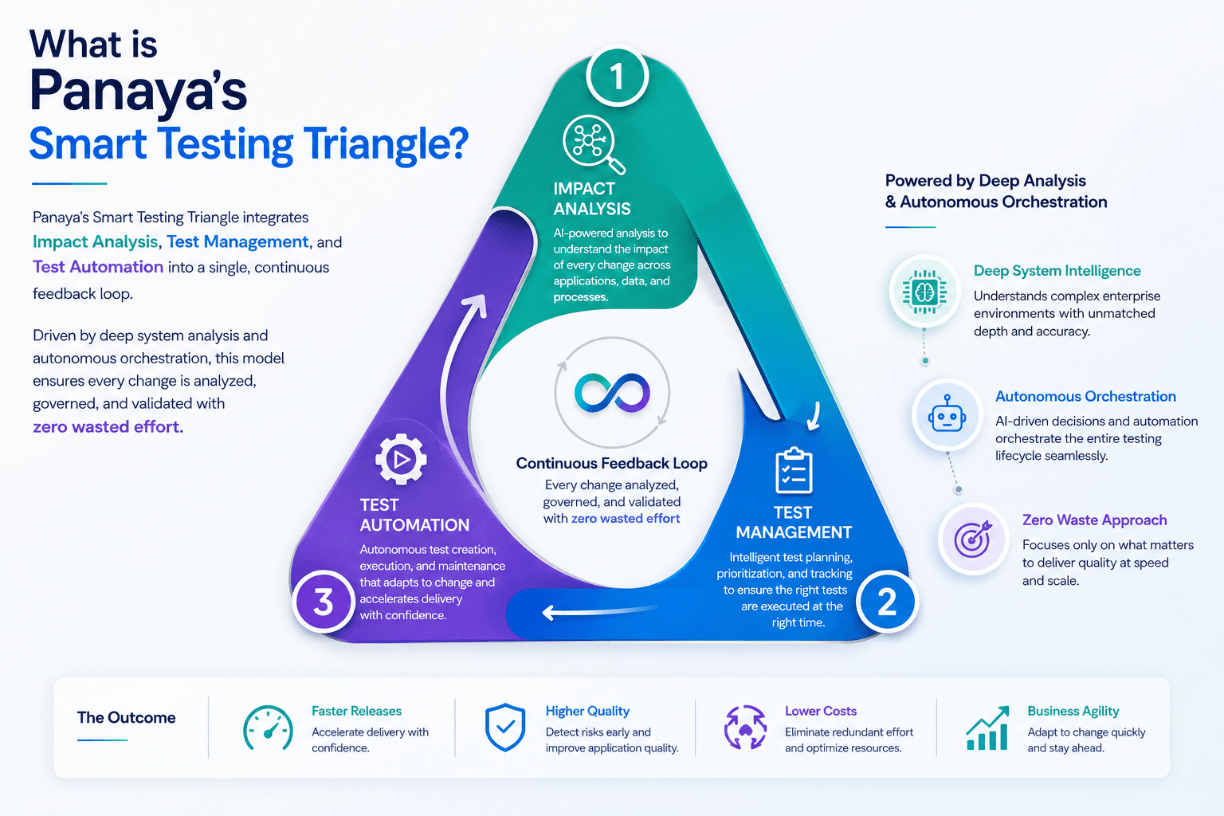
Pillar 1: Impact Analysis (Panaya Change Intelligence)
Traditional regression testing involves blanket execution: running large, unprioritized test suites whenever a patch, an upgrade, or a customization becomes ready for production, requiring weeks of testing effort without showing where in the business there is any risk.
Impact Analysis, backed by Panaya Change Intelligence, is the game-changer here. It performs static code and transport validation of ABAP objects, SAP Notes, S/4HANA upgrades, or Salesforce Apex/Flow before they reach production, and then links the changes to the impacted business processes, such as order-to-cash, procure-to-pay, record-to-report, etc. Changes are risk-categorized to help QA teams avoid redundant testing.
Pillar 2: Test Management (Panaya Test Orchestration)
Impact data is useful when it leads to actions. Rather than letting QA leads compile a test suite based on a change log, Panaya Test Orchestration takes the results from the impact analysis phase and automatically produces a risk-prioritized test plan and assigns the test tasks to respective teams.
This makes life easier for companies that use hybrid landscapes with Salesforce, SAP S/4HANA, and Workday by enabling them to prepare all their releases from a single dashboard. Another challenge for these companies is that they must always keep track of audits, which can be done easily through execution traces and screenshot captures.
Pillar 3: Automation (Panaya Autonomous Testing)
Maintenance is the area where automation is most vulnerable. Script-driven systems are highly fragile: changing the ID of a Fiori element or any aspect of the interface will cause numerous tests to fail, and QA specialists spend an overwhelming amount of time fixing broken tests rather than adding new ones.
Panaya’s self-running test suite solves this problem with self-healing scripts that employ AI algorithms for visual and contextual recognition and automatically adapt to interface changes. Combining self-healing scripts with a low-code/no-code approach allows business analysts and domain experts to write and run automated tests without a specialized scripting team.
How the Triangle Operates in Practice
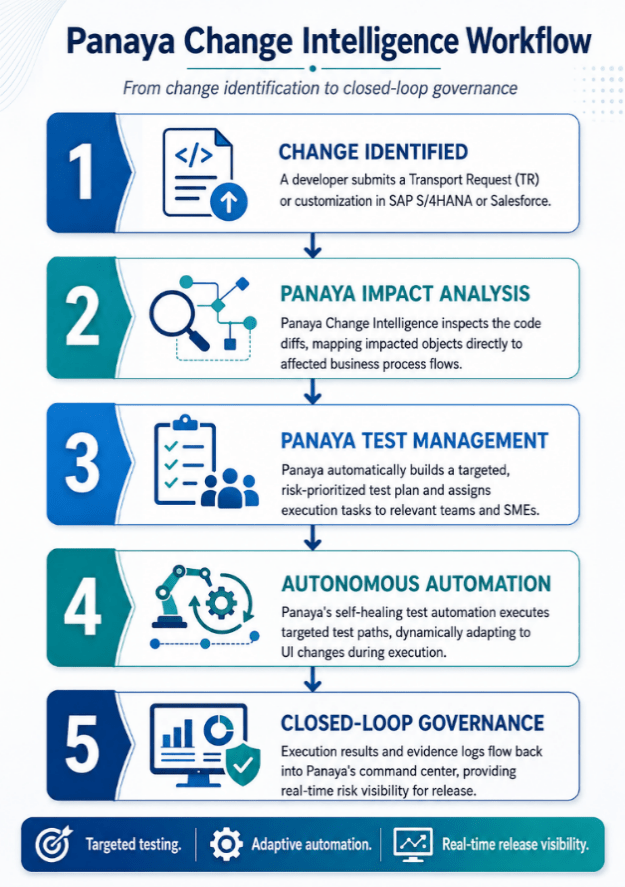
According to Panaya, the scope of testing will decrease by up to 85 percent and script maintenance effort by up to 90 percent when the three pillars are integrated, compared to their standalone operation. This data, provided by vendors, depends on the complexity of the landscape and ongoing changes, but it still confirms the trends revealed by enterprise IT departments.
Impact Comparison Between Traditional Testing and Panaya Smart Testing Triangle
| Metric | Traditional Enterprise QA | Panaya Smart Testing Triangle |
|---|---|---|
| Testing Scope | Full-suite execution without prioritization | Risk-based AI scope (top 15-20% of high-impact paths) |
| Release Velocity | Monthly/quarterly schedule | Weekly or continuous on-demand release |
| Script Maintenance | Up to 50% of QA resources are devoted to fixing scripts | Maintenance is minimized through the self-healing AI engine |
| Defect Triage | Time wasted tracing the root cause of an issue | Failure in test steps traced directly to transport/object |
| Audit Compliance | Manual creation of log files and screenshots | Automated traceability of evidence |
Placed side by side, the difference becomes not one big figure but rather five small ones, each addressing its own particular obstacle to releasing the product:
As mentioned above, these are the ranges offered by Panaya. Look at this as a pointer to the direction you should take when confirming the numbers in your SAP, QAD, or Salesforce environment.
The Strategic Case for Unifying QA
But beyond the scope of individual releases, the connection among these three disciplines is a cost-and-risk equation. Companies making continuous updates to their SAP S/4HANA systems, migrating to the cloud, or updating multiple systems incur costs due to the repeated effort required for each release: scoping, fixing scripts, and gathering evidence. Bringing impact analysis, test management, and automation together eliminates redundancy, reduces testing costs, enables early risk identification in the change cycle, and provides a defensible basis for the release owner’s sign-off.
The Strategic Advantage for Enterprise IT
Use Impact Analysis, Test Management, and Automation as a unified approach, and you will see results in three different areas:
- Migration to SAP S/4HANA and Cloud Faster: reduce risks associated with continuous SAP development and custom ABAP development.
- Lower cost of testing: save on manual testing and redundant execution by using smart scope selection.
- Improve release quality: find out high-risk defects before going into production without postponing release deadlines.
Why YASH
Implementation of the Smart Testing Triangle goes beyond licensing the platform. It demands a partner with sufficient understanding of the SAP, QAD, and Salesforce ecosystems to perform impact analysis, establish compliance-driven governance, and create automation coverage aligned with how a particular organization operates. YASH Technologies offers this unique blend of experience in SAP/QAD deliveries, knowledge of AMS practices within regulated industries, and hands-on Panaya implementation experience gained through enterprise transformation projects, equipping organizations with both the platform know-how and the enterprise perspective needed to implement the framework. Please get in touch with us at info@yash.com for more information.

More From Author.
Related Posts.


Why Unused SAP Data Costs More Than You Think
Bhavani Sankar Rajasekharuni

How to Carve Out Your SAP System Efficiently Using Archiving
Yellaiah Gattaiah Devasani


Why SAP Archiving Projects Fail Before They Start
Yellaiah Gattaiah Devasani



Predictive Maintenance Is Only as Good as the System Behind It
Firdosh Kotwal Hari Mantravadi



SAP GROW Fast: Launch SAP Cloud ERP within 90 Days
Jacinto Arauz Jai Prakash Nethala