


Cutting Script Maintenance, Raising Coverage: The Smart Factory Approach to SAP Testing
Publish Date: November 13, 2026SAP testing should serve as an enterprise change confidence builder and a business process risk mitigator. Instead, it often places an immense burden on testing resources and diverts valuable time from critical test activities. Some testing teams spend as much as 45% of their time maintaining test automation, leaving minimal time for critical test activities.
Traditional script-based testing is not designed to keep pace with the rapid changes in SAP environments and transformation programs. The answer is not to develop more scripts or write more automation. An intelligent approach is to combine risk-based test coverage, reusable test components, and Artificial Intelligence (AI) for test maintenance.
This article explains how enterprises can transition from a traditional Script Factory to a Smart Factory. The emphasis shifts from fixing tests to assuring business outcomes. The article draws on research from YASH Technologies and Tricentis to support its central thesis. This blog is a distilled version of what our teams highlighted at our recent webinar, From Script Factory to Smart Factory.
The Script Factory has hit its ceiling.
Traditionally, test automation has focused on rapid test case generation. This model largely held up until the nature of change in the SAP environment became continuous. SAPinsider research finds 65% of companies cite integration testing as the most impacted activity due to S/4HANA.
The real issue is structural. SAP automation scripts are human-authored decision trees and do not truly represent the end-to-end business processes. That is why Script Factories scale with headcount, not tooling.
Cutting maintenance: build once, heal safely, reuse everywhere
- Modules, not scripts. Model-driven automation of Tricentis Tosca eliminates the brittleness and duplication inherent in scripts and provides a library of shared modules. Fix one module and all tests using it get the fix. Tricentis Agentic Test Automation now locates matching modules and merges them to minimize the library size.
- Self-healing where it is proven. Object identification and self-healing locators based on AI accommodate UI changes. Self-healing is the most advanced and least risky form of agentic capability; it’s where we start with YASH.
- Healing you can audit. Every self-heal isn’t necessarily the correct one. YASH not only identifies false self-heals but also monitors for defect leakage and maintenance costs.
Raising coverage: test what changed, not everything
The coverage that truly counts in SAP enterprise testing is based on business risks, not the number of tests.
With Tricentis LiveCompare, each transport is mapped to the business processes it impacts. With risk-based scoping, those impacted business processes are prioritized, ensuring the regression focuses on the process flows that can be broken. In a 2026 Forrester Total Economic Impact study, customers reduced their test scope by 84%. AI-assisted test design will close the remaining gaps and generate tests based on user stories.
The Smart Factory by the numbers
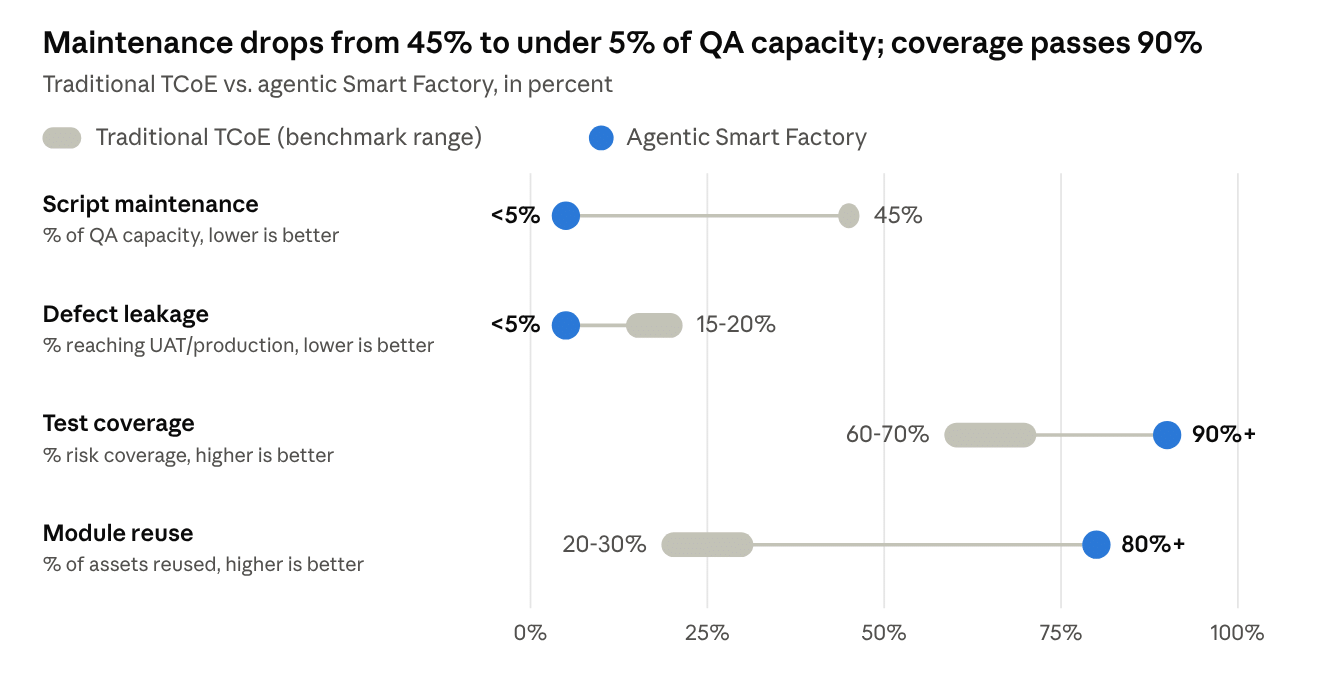
YASH engagement benchmarks · traditional TCoE vs. agentic Smart Factory
The two goals reinforce each other: hours freed from maintenance are reinvested in risk coverage.
Proof in practice: 2,500 legacy scripts to a modular TCoE
A global manufacturer that has been a YASH client since 2018 fell prey to the traditional trap of having thousands of scripts spread across numerous sunset tools. For every SAP release, they would have to perform extensive repairs. YASH facilitated a phased approach to migrate them to a Tosca-led TCoE, beginning with an assessment of the inventory and a reusable module framework. A pilot and a wave-by-wave scale-out and tuning followed this.
Beyond trivial conversion scripts, no reliable converters exist. Therefore, YASH took the approach to treat the migration as a model rebuild rather than a code port. The investment is upfront, and the return is the reusability of the modules.
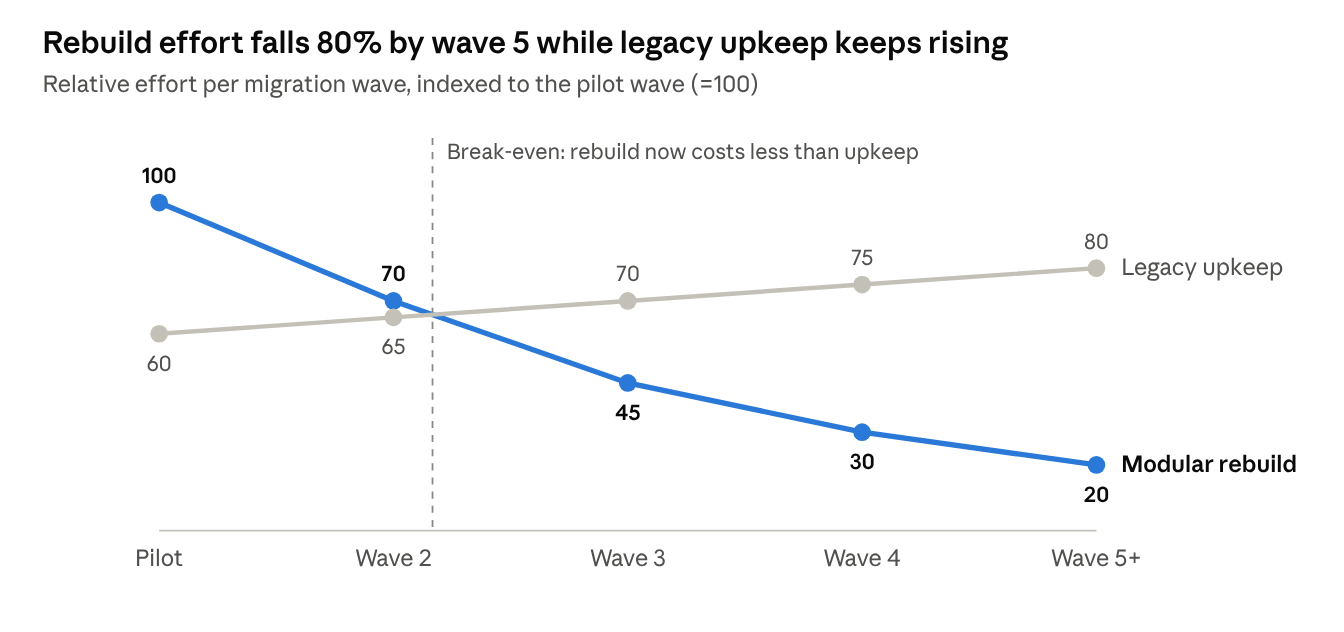
YASH engagement data, anonymized global manufacturer · indexed effort by migration wave
The results: 2,500+ legacy scripts converted, 1,000+ new scenarios automated across SAP, web and APIs, 90% regression coverage simulating 140+ business roles, and 30% shorter cycle times through CI pipelines.
Agentic AI testing, with guardrails
Ambition is not the bottleneck; trust is. In the Tricentis 2026 Quality Transformation Report, trust in AI agents making release decisions fell from 48% to 34%, and only 35% of organizations feel ready to govern agents at scale.
YASH treats that as a sequencing problem, not a reason to wait:
- Assess current automation and mature reuse, governance, and reporting before stacking on AI.
- Embrace modular design, then implement self-healing and AI-assisted test design within risk flows.
- Extend to agentic prioritization and triage, once AI decisions are governed, with decision logs audited like any controlled artifact.
Key takeaways for SAP Testing leaders
- Agentic AI is delivering value today in natural-language test generation, test asset discovery, test case explanation, self-healing, test result insights, and AI ecosystem integration through the Tricentis MCP server.
- Human governance is in the loop for validated flows in GxP and SAP environments.
- This is an operating model change, not just a tooling upgrade, spanning people, process, technology, data, and governance.
- Start with the Stabilize phase and then with the Augment and Orchestrate phases. Don’t skip governance.
From fixing tests to assuring the business
The hardest parts are rarely the tools: data readiness, integration complexity, workforce transformation, and proving measurable value. YASH’s SAP testing practice, built across S/4HANA transformations, rollouts, and divestitures, pairs with Tricentis, a Leader in The Forrester Wave: Autonomous Testing Platforms, Q4 2025, to enable a safe, measurable shift.
Your SAP Releases Are Speeding Up. Is Your Testing Keeping Pace?
YASH has helped enterprises transform thousands of fragile scripts into a testing approach that protects the business. Let’s explore what your team could gain.
Book your complimentary SAP Testing Assessment. In one focused session, YASH’s SAP testing experts will help you identify where maintenance effort is going, where coverage gaps exist, and the fastest, lowest-risk path to a Smart Factory.
Book Your Assessment
Watch the On-Demand Webinar: From Script Factory to Smart Factory

More From Author.
Related Posts.








Why Unused SAP Data Costs More Than You Think
Bhavani Sankar Rajasekharuni

How to Carve Out Your SAP System Efficiently Using Archiving
Yellaiah Gattaiah Devasani


Why SAP Archiving Projects Fail Before They Start
Yellaiah Gattaiah Devasani