


Stop Collecting Security Tools. Start Managing Cyber Risk.
Publish Date: February 4, 2026We have a problem in cybersecurity, and it’s not what you think.
Most organizations are drowning in security tools. On an average organisation uses 30+ different security products. Firewalls, antivirus software, intrusion detection systems, vulnerability scanners, endpoint protection, SIEM platforms and the list goes on.
But here’s the uncomfortable truth: more tools don’t equal better security.
The tool collection trap
I’ve seen it countless times. A new threat emerges, and the immediate response is: “We need a tool for that.” Someone proposes a solution, budgets get approved, and another product gets added to the stack.
Before long, your security team is spending more time managing tools than managing actual risk.
Think about it:
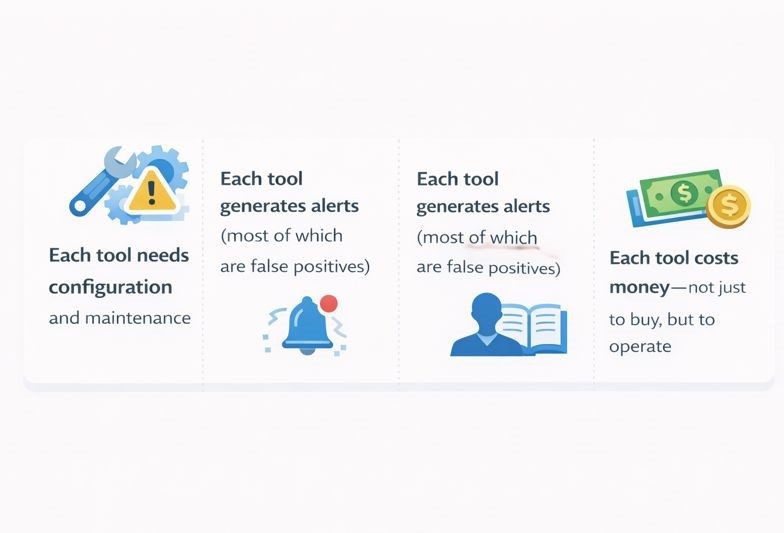
Meanwhile, the tools often don’t talk to each other. You end up with silos of information, gaps in coverage, and a security team that’s exhausted from tool overload.
What actually matters: Understanding your Risk
Here’s what we should be asking instead: What are we actually trying to protect, and from what? Security isn’t about having every tool under the sun. It’s about understanding and managing risk in a way that makes sense for your business.
This means:
Knowing your critical assets. What data, systems, and processes would hurt your business most if compromised? Not everything is equally important.
Understanding real threats. What are the actual attack vectors relevant to your industry and organization? A healthcare company faces different threats than a retail business.
Measuring what matters. Instead of counting how many alerts you processed, ask: Are we reducing the likelihood and impact of incidents that would harm our business?
Making informed decisions. Sometimes the right answer is accepting a risk. Sometimes it’s changing a process. Sometimes-yes,it’s buying a tool. But the tool is a means to an end, not the end itself.
The Shift to Risk Management
Managing cyber risk means taking a business-first approach:
Start with business context. Talk to the people running different parts of your organization. Understand what keeps them up at night. What would disrupt revenue? What would damage customer trust?
Prioritize ruthlessly. You can’t protect everything equally. Focus your resources where the risk is highest and the impact would be most severe.
Integrate, don’t accumulate. Before adding a new tool, ask: Can an existing tool do this? Can we consolidate? How will this fit with what we already have?
Communicate in business terms. Stop talking about vulnerabilities and patches. Start talking about business risk, potential impact, and informed trade-offs.
Moving Forward
If you’re buried in security tools, here’s where to start:
Take inventory. List every security tool you have. For each one, document: What risk does this address? Who uses it? When did we last use it effectively?
Look for overlap. You’ll likely find three tools doing variations of the same thing. Consolidate.
Measure outcomes, not activity. Stop tracking how many alerts you cleared. Start tracking: Are we seeing fewer successful attacks? Are we detecting and responding faster when incidents occur?
Build a risk register. Document your actual business risks, not just technical vulnerabilities. Update it regularly with stakeholders from across the business.
The Bottom Line
Security tools are important. But they’re not the strategy, they’re just tools in service of the strategy. The strategy is understanding and managing cyber risk in a way that protects your business while enabling it to operate and grow. So before you sign off on the next shiny security product, ask yourself: Are we collecting tools, or are we managing risk?The answer will determine whether your security program is effective—or just expensive.

Shivaram Jeyasekaran
Director – Cybersecurity Services, YASH Technologies
A distinguished cybersecurity leader with over 23 years of experience transforming enterprise security landscapes across global organizations. He is recognized for architecting and scaling robust cybersecurity programs that align with business objectives while maintaining cutting-edge defense capabilities. Shivaram has spearheaded numerous large-scale cybersecurity consulting engagements in his illustrious career, helping organizations navigate complex security challenges while balancing innovation with risk management. His approach combines strategic vision with practical implementation, ensuring organizations stay resilient in the face of evolving cyber threats.


More From Author.
Related Posts.


The Hidden AI Risk in Your Cloud: Why CSPM Is Now a Board-Level Priority
Mahipal Kirupanithy

How AI-Powered EDR Stops Modern Attacks in Real Time
Mahipal Kirupanithy



From Annual Audits to Always-On Assurance: How AI Is Redefining SOC & ISO Compliance
Mahipal Kirupanithy Shivaram Jeyasekaran

Why Third-Party Risk Can No Longer Be Manual: Building an AI-Driven TPRM Program
Mahipal Kirupanithy Shivaram Jeyasekaran

When Ransomware Reprices the Deal: Cyber Risk in Modern M&A
Ankush Arora Shivaram Jeyasekaran

The AWS Security Arsenal: 7 Services Every Cloud Leader Should Master
Mahipal Kirupanithy Shivaram Jeyasekaran

Microsoft Sentinel Data Lake: A Game-Changer for Security Operations
Kaisar Chishti Shivaram Jeyasekaran Val Coucke
AI Governance: Board-Level Oversight for Emerging Technology
Shivaram Jeyasekaran

Security Budgeting: Making the Business Case for 2026
Shivaram Jeyasekaran