

Securing AI/ML Models: Adversarial Attacks and Defenses
Publish Date: January 15, 2026The Importance of Strengthening AI Model Security (And Steps to Safeguard Them)
AI and machine learning have become the backbone of modern business operations, from fraud detection systems to autonomous vehicles. But here’s the unsettling reality: 41% of enterprises reported some form of AI security incident by late 2024, ranging from data poisoning to model theft. If you’re deploying AI models in production, you need to understand the threats they face and how to defend against them.
What are Adversarial attacks?
Think of adversarial attacks as clever tricks designed to fool your AI models. Unlike traditional cyberattacks that target code or networks, these attacks exploit how AI systems learn and make decisions. The scary part? In September 2025, the first documented large-scale cyberattack executed by agentic AI occurred, where AI systems performed 80-90% of the attack work with minimal human intervention.
Let me break down the main types of attacks in simple terms:
1 Evasion Attacks: The Master of Disguise
Imagine an AI system that’s supposed to catch spam emails. An evasion attack would slightly tweak a spam email so that it looks legitimate to the AI, even though a human would still recognize it as spam. These attacks happen when someone manipulates the input data during the prediction phase to trick your model.
Real-world example: In 2024, a Chevrolet automotive chatbot was tricked by prompt injection into offering a $76,000 car for $1.
2 Data Poisoning: Corrupting from the Inside
This is where attackers sneak bad data into your training dataset. It’s like poisoning a recipe by swapping sugar for salt. Gartner noted nearly 30% of AI organizations had experienced data poisoning attacks by 2023. The model learns wrong patterns and makes flawed decisions later, sometimes only when specific triggers appear.

3 Model Extraction: Stealing Your Intelligence
Attackers can recreate your proprietary AI model by repeatedly querying it and studying its responses. In late 2024, OpenAI identified evidence that a Chinese AI startup, DeepSeek, had used its GPT-3/4 API outputs for model distillation without authorization, forcing them to revoke DeepSeek’s API access in December 2024.
4 Prompt Injection: Hijacking AI Conversations
For systems like chatbots, attackers can craft special prompts that make the AI ignore its safety guidelines and do things it shouldn’t. Prompt injection has been called the “SQL injection” of the AI era.
5 Model Inversion: Extracting Sensitive Data
This attack reconstructs private training data from the model’s outputs. If your model was trained on medical records or personal images, attackers could potentially recover that sensitive information.
Why AI Systems Are Different (And More Vulnerable)
Traditional cybersecurity focused on patching software bugs and hardening infrastructure. But AI introduces new challenges. A model that works perfectly today might fail tomorrow if the input data changes slightly or if someone discovers how to manipulate it. The problem is that AI systems learn from data, and if someone controls that data or understands the learning process, they can manipulate the entire system’s behavior.
Building Your Defense Strategy: Practical Steps
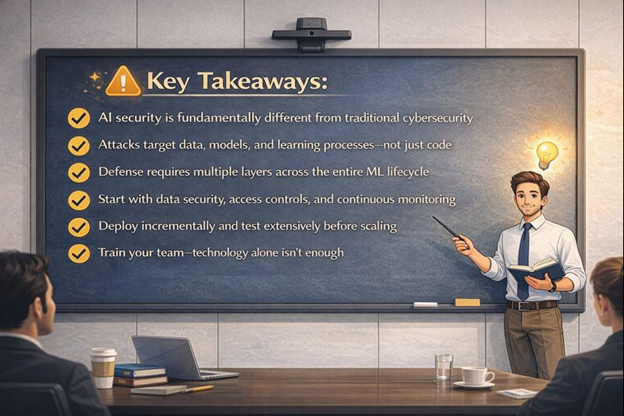
Based on the latest industry research, here’s how to protect your AI models without getting overwhelmed by complexity:
Layer 1: Secure Your Data
Your AI is only as good as the data it learns from. Start here:
- Validate everything: Set up automated checks to reject suspicious or out-of-range data before it enters your training pipeline
- Track data provenance: Know where every piece of training data came from and maintain a signed audit trail
- Regular audits: Continuously monitor your datasets for anomalies or corruption
- Use differential privacy: When handling sensitive information, apply techniques that prevent individual records from being reconstructed
Layer 2: Harden the Training Process
The NIST AI RMF recommends instrumenting build scripts to produce attestations: signed hashes of datasets, container images, and hyperparameter files.
- Treat your training pipeline like critical production code
- Use signed, immutable records for all training artifacts
- Implement strict version control for models and datasets
- Conduct adversarial testing before deployment
Layer 3: Control Access
AI models must be protected using strict access controls, including least privilege and zero trust principles.
- Give users and systems only the minimum access they need
- Apply strong authentication for every model, dataset, and API
- Continuously verify all interactions with AI models
- Treat each AI agent like a user account with its own identity and permissions
Layer 4: Monitor Continuously
You can’t defend what you can’t see. Set up comprehensive monitoring:
- Track unusual patterns in model behavior or performance drops
- Monitor for unexpected spikes in API requests
- Set up alerts for deviations from normal decision-making patterns
- Log every AI-initiated action for audit trails
Layer 5: Test Like an Attacker
The best defense is knowing how attackers think:
- Conduct regular red-teaming exercises
- Simulate adversarial attacks in controlled environments
- Test your models against known attack techniques
- Update defenses based on what you learn
Layer 6: Deploy Smart
Organizations should implement AI incrementally, deploying AI in non-critical systems first, then expanding as security controls mature.
- Start with low-risk applications
- Use sandboxing and isolation for AI systems
- Implement guardrails that define acceptable AI behaviors
- Have a rollback plan if something goes wrong
Layer 7: Train Your Team
Technology alone won’t save you. Human error remains one of the biggest cybersecurity vulnerabilities, making continuous AI security training essential for 2025.
- Educate everyone who interacts with AI systems about risks
- Train teams to recognize data manipulation attempts
- Create clear policies for AI usage
- Establish an AI governance board
The Reality Check: No Perfect Solution
Here’s the truth: there’s no foolproof defense against all adversarial attacks. The field is evolving rapidly, with new attacks and defenses emerging constantly. But that doesn’t mean you should give up. A multi-layered approach significantly raises the bar for attackers and protects against the most common threats.
What’s Next?
93% of security leaders are bracing for daily AI attacks in 2025, so the time to act is now. The organizations that win in the AI era won’t necessarily be those with the most sophisticated models—they’ll be the ones who can deploy AI safely and securely.
The AI revolution is here, but it comes with new responsibilities. By understanding adversarial threats and implementing robust defenses, you can harness AI’s power while protecting your organization from emerging risks.

Shivaram Jeyasekaran
Director – Cybersecurity Services, YASH Technologies
A distinguished cybersecurity leader with over 23 years of experience transforming enterprise security landscapes across global organizations. He is recognized for architecting and scaling robust cybersecurity programs that align with business objectives while maintaining cutting-edge defense capabilities. Shivaram has spearheaded numerous large-scale cybersecurity consulting engagements in his illustrious career, helping organizations navigate complex security challenges while balancing innovation with risk management. His approach combines strategic vision with practical implementation, ensuring organizations stay resilient in the face of evolving cyber threats.
More From Author.
Related Posts.



From Annual Audits to Always-On Assurance: How AI Is Redefining SOC & ISO Compliance
Mahipal Kirupanithy Shivaram Jeyasekaran

Why Third-Party Risk Can No Longer Be Manual: Building an AI-Driven TPRM Program
Mahipal Kirupanithy Shivaram Jeyasekaran

When Ransomware Reprices the Deal: Cyber Risk in Modern M&A
Ankush Arora Shivaram Jeyasekaran

The AWS Security Arsenal: 7 Services Every Cloud Leader Should Master
Mahipal Kirupanithy Shivaram Jeyasekaran
Stop Collecting Security Tools. Start Managing Cyber Risk.
Kaisar Chishti Shivaram Jeyasekaran Val Coucke

Microsoft Sentinel Data Lake: A Game-Changer for Security Operations
Kaisar Chishti Shivaram Jeyasekaran Val Coucke

AI Governance: Board-Level Oversight for Emerging Technology
Shivaram Jeyasekaran

Security Budgeting: Making the Business Case for 2026
Shivaram Jeyasekaran


Digital Risk Assessment: Protecting Value in Mergers & Acquisitions
Shivaram Jeyasekaran