

Leader’s Guide to AI Governance: Mastering NIST and ISO 42001 Standards
Publish Date: December 25, 2025As artificial intelligence becomes the backbone of modern business operations, leaders are asking the right question: “How do we harness AI’s power while managing its risks?” The answer lies in robust AI governance, and two frameworks are leading the charge – NIST’s AI Risk Management Framework and ISO 42001.
Why AI Governance Matters Now More Than Ever
Every day, businesses deploy AI systems that make decisions affecting customers, employees, and operations. From hiring algorithms to customer service chatbots, these systems can amplify both opportunities and risks at unprecedented scale. Without proper governance, companies face regulatory penalties, reputational damage, and operational failures that can cost millions.
The statistics are sobering: 85% of AI projects fail to deliver expected business value, often due to poor governance and risk management. Smart leaders recognize that AI governance isn’t a technical afterthought—it’s a business imperative.
Understanding the NIST AI Risk Management Framework
The National Institute of Standards and Technology (NIST) released its AI Risk Management Framework in 2023, providing a practical roadmap for managing AI risks. Think of it as your GPS for navigating AI implementation safely.
The Four Core Functions
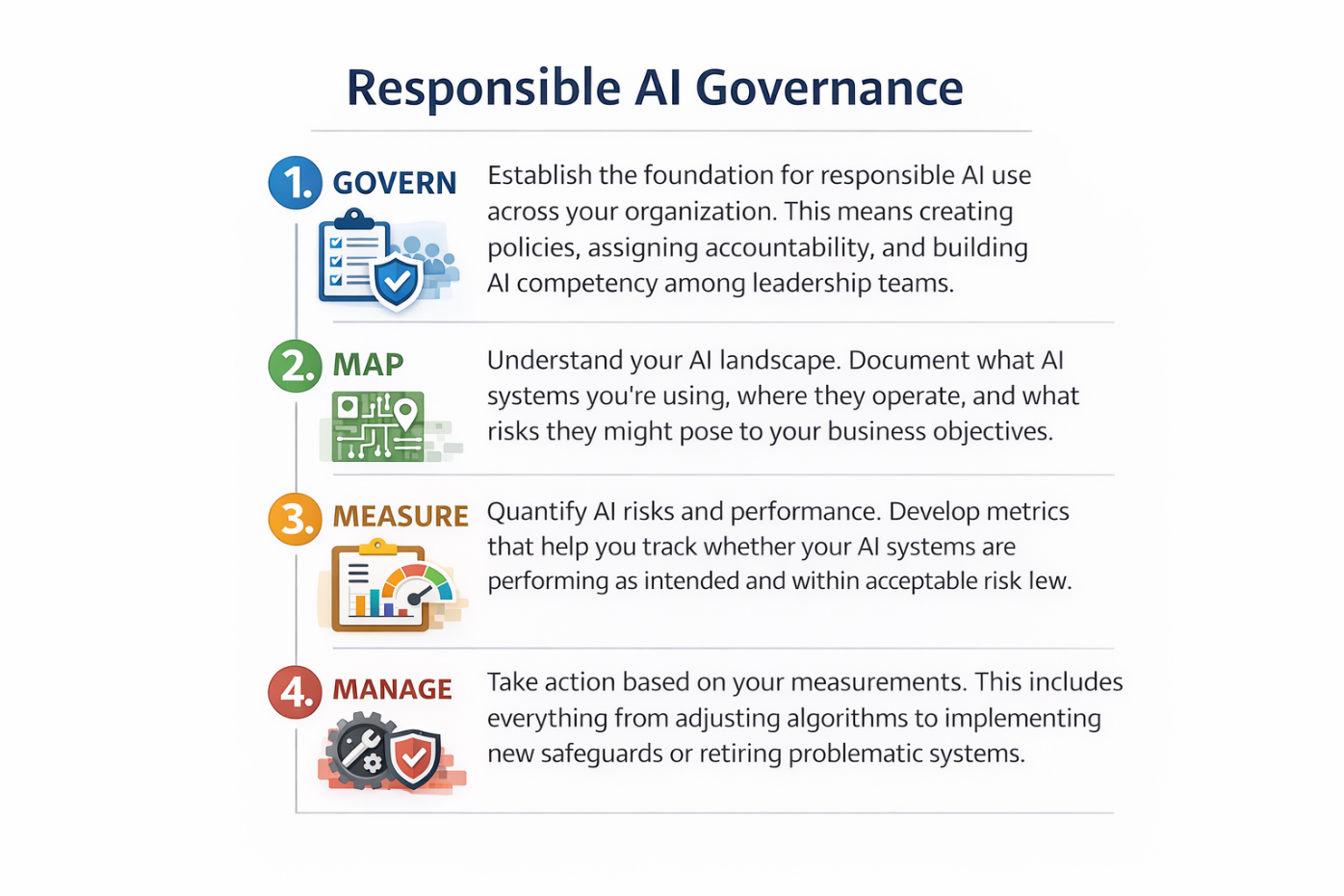
The beauty of NIST’s approach lies in its flexibility. Whether you’re a startup using basic automation or an enterprise deploying complex machine learning models, these functions scale to your needs.
ISO 42001: The International Gold Standard
While NIST provides the framework, ISO 42001 offers the certification path. Released in late 2023, this international standard establishes requirements for AI management systems that organizations can actually implement and get certified against.
Key Components of ISO 42001
Risk-Based Approach: Like other ISO standards, 42001 requires organizations to identify, assess, and manage AI-related risks systematically. This isn’t about eliminating all risks -it’s about understanding and controlling them.
Stakeholder Engagement: The standard emphasizes involving all relevant parties, from technical teams to end users, in AI governance decisions. This collaborative approach helps identify blind spots that technical teams might miss.
Continuous Improvement: AI systems aren’t “set and forget” solutions. ISO 42001 requires ongoing monitoring, evaluation, and improvement of AI systems throughout their lifecycle.
Documentation and Transparency: The standard mandates clear documentation of AI decision-making processes, making it easier to audit, explain, and improve your AI systems.
Practical Steps for Implementation
Implementing these standards doesn’t require a complete organizational overhaul. Here’s how smart leaders can start:
Start Small, Think Big
Begin with a pilot program focusing on your most critical AI applications. Map out their risks, establish baseline measurements, and implement basic governance controls. Use this experience to build templates and processes that can scale across your organization.
Build Cross-Functional Teams
AI governance isn’t just an IT responsibility. Create teams that include representatives from legal, compliance, operations, and business units. These diverse perspectives help identify risks and opportunities that purely technical teams might overlook.
Invest in Education
Your governance framework is only as strong as the people implementing it. Invest in AI literacy programs for leadership and key stakeholders. Understanding AI basics helps leaders make better governance decisions and ask the right questions.
Establish Clear Accountability
Assign specific roles and responsibilities for AI governance. Who decides when an AI system poses too much risk? Who monitors performance metrics? Who responds when something goes wrong? Clear accountability prevents governance gaps.
The Business Case for AI Governance
Implementing these standards isn’t just about compliance—it’s about competitive advantage. Organizations with strong AI governance report several benefits:
Reduced Time to Market: Clear governance processes help teams make faster decisions about AI deployments, reducing analysis paralysis.
Improved Stakeholder Trust: Customers, partners, and regulators have more confidence in organizations that can demonstrate responsible AI use.
Better Risk Management: Systematic approaches to AI risk help prevent costly failures and protect business reputation.
Enhanced Innovation: Paradoxically, good governance frameworks often accelerate innovation by providing clear guidelines for acceptable experimentation.
Common Implementation Pitfalls to Avoid
Even well-intentioned governance efforts can stumble. Here are the most common mistakes smart leaders avoid:
Over-Engineering: Don’t create governance processes that are more complex than your AI systems. Start simple and add sophistication as your AI maturity grows.
Ignoring Culture: Technical frameworks fail without cultural buy-in. Invest time in explaining why AI governance matters and how it supports business objectives.
Static Approaches: AI technology evolves rapidly. Build governance frameworks that can adapt to new AI capabilities and emerging risks.
Siloed Implementation: AI governance works best when integrated with existing risk management, quality assurance, and compliance processes rather than operating in isolation.
Looking Ahead: The Future of AI Governance
AI governance is evolving as rapidly as AI technology itself. Regulatory requirements are tightening globally, with the EU’s AI Act leading the charge and other jurisdictions following suit. Organizations that establish strong governance practices now will be better positioned for future regulatory requirements.
The convergence of NIST and ISO 42001 creates a powerful combination: NIST provides the conceptual framework while ISO 42001 offers the implementation pathway and certification credibility. Together, they give organizations a comprehensive approach to AI governance that balances innovation with responsibility.
Taking Action
The question isn’t whether your organization needs AI governance-it’s how quickly you can implement it effectively. Start by conducting an AI inventory across your organization. What AI systems are you currently using? What new implementations are planned? What risks do these systems pose to your business objectives?
From there, use the NIST framework to map your current state and identify governance gaps. Consider pursuing ISO 42001 certification as a way to demonstrate your commitment to responsible AI use to stakeholders and customers.
Remember, AI governance isn’t about slowing down innovation—it’s about innovating responsibly. In an increasingly AI-driven world, the organizations that master this balance will be the ones that thrive.
The future belongs to leaders who can harness AI’s transformative power while managing its inherent risks. NIST and ISO 42001 provide the roadmap. The journey starts with your next decision.

Shivaram Jeyasekaran
Director – Cybersecurity Services, YASH Technologies
A distinguished cybersecurity leader with over 23 years of experience transforming enterprise security landscapes across global organizations. He is recognized for architecting and scaling robust cybersecurity programs that align with business objectives while maintaining cutting-edge defense capabilities. Shivaram has spearheaded numerous large-scale cybersecurity consulting engagements in his illustrious career, helping organizations navigate complex security challenges while balancing innovation with risk management. His approach combines strategic vision with practical implementation, ensuring organizations stay resilient in the face of evolving cyber threats.
More From Author.
Related Posts.



From Annual Audits to Always-On Assurance: How AI Is Redefining SOC & ISO Compliance
Mahipal Kirupanithy Shivaram Jeyasekaran

Why Third-Party Risk Can No Longer Be Manual: Building an AI-Driven TPRM Program
Mahipal Kirupanithy Shivaram Jeyasekaran

When Ransomware Reprices the Deal: Cyber Risk in Modern M&A
Ankush Arora Shivaram Jeyasekaran

The AWS Security Arsenal: 7 Services Every Cloud Leader Should Master
Mahipal Kirupanithy Shivaram Jeyasekaran
Stop Collecting Security Tools. Start Managing Cyber Risk.
Kaisar Chishti Shivaram Jeyasekaran Val Coucke

Microsoft Sentinel Data Lake: A Game-Changer for Security Operations
Kaisar Chishti Shivaram Jeyasekaran Val Coucke

AI Governance: Board-Level Oversight for Emerging Technology
Shivaram Jeyasekaran

Security Budgeting: Making the Business Case for 2026
Shivaram Jeyasekaran


Securing AI/ML Models: Adversarial Attacks and Defenses
Shivaram Jeyasekaran