
Industry-Specific AMS Transformation: Tailoring AI for Healthcare
Publish Date: November 3, 2026An application outage is a setback in most sectors. In healthcare? It’s a crisis. Somewhere in the system, a nurse is left waiting for a non-loading lab result. A pharmacist is unable to verify a prescription. There is an unread scan. This is the reality healthcare organizations face with their applications. This reality alters how Application Management Services operate.
First, what do we mean by AMS?
Application Management Services (AMS) refers to the day-to-day management, support, care, and development of an organization’s application portfolio, typically provided by a specialized partner. This includes the management of incidents and problems, as well as all levels of enhancement, performance, and connectivity frameworks. When AMS is done right, systems become stable. When AMS is done even better, it not only improves stability but also allows internal IT teams to focus on what drives better care delivery.
What changes are occurring in the healthcare IT sector?
Five major changes are occurring in healthcare, one of which is a significant disruption.
- Change of operating model: Healthcare IT is shifting left, moving the resolution of incidents to be closer to the source via self-service, automation, and first-line support. In the absence of a clinician calling the help desk, the system is altered to be proactively monitored. Automation is the primary focus. Management is no longer concerned with the sheer quantity of closed help desk interventions, but with the availability of clinical systems and the resolution of incidents.
- Cloud Adoption- The shift to hybrid environments for EHRs, Imaging, and telehealth platforms is adding new dimensions to support conversations, including cost and resilience.
- Compliance- For most industries, a compliance list exists with market standards, but in healthcare it is more of a constant presence. With every change you make, every access, and every data flow, there must be rigorous controls and evidence.
- Customer Experience- There is a growing need for hospitals to match financial institutions in their digital services because patients expect seamless, connected, and on-time digital services more than ever, and clinicians need tools that serve them without added obstruction.
Sitting atop all of this is AI. Each of the aforementioned “disruptors” raises the bar for AMS. Unlike the others, AI changes the game entirely. The forces of automation, AI, and advanced monitoring springing up with the others also fit the framework of healthcare, and in this case AMS, for its most important aspect, excellence in patient-centered care.
A Deep Dive into Healthcare and Life Sciences
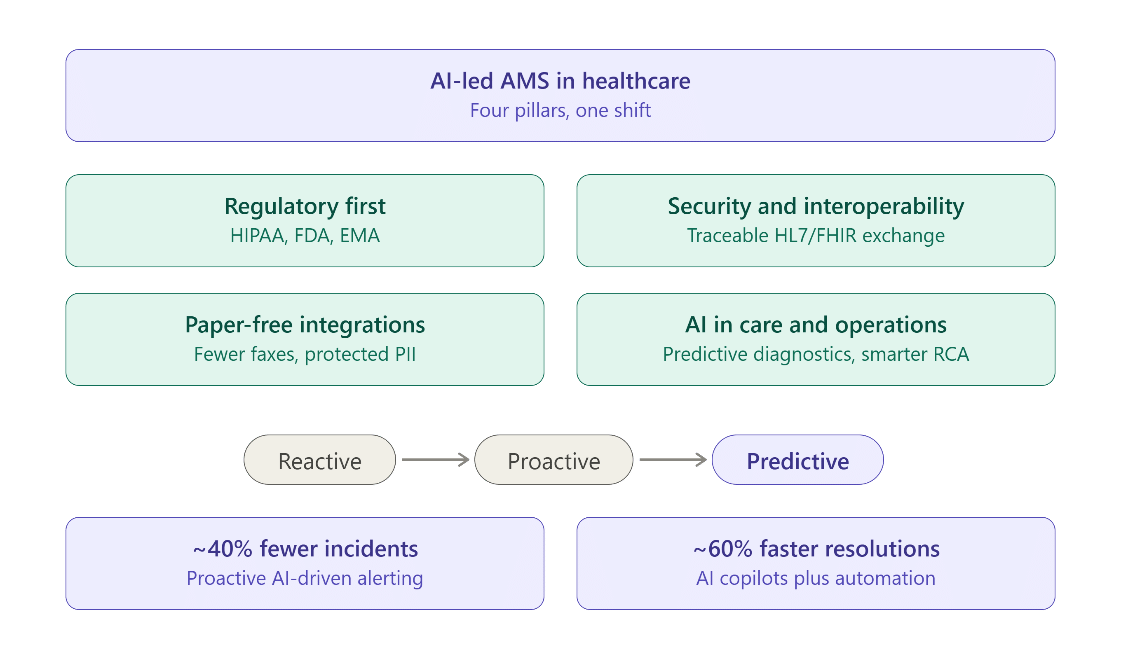
Customer care in healthcare and life sciences is all about regulation. In the US, AMS teams need a thorough understanding of the dense networks that include HIPAA, the FDA, and EMA (for life sciences), as well as their global counterparts. Two main priorities are data security and interoperability. Patient data must be easily accessible across all EHRs, labs, pharmacies, and payers, typically across various standards (for example, HL7 and FHIR), and every access must be recorded in a comprehensive audit log.
Well-designed integrations will likely perform two important functions simultaneously. For integration with electronic health records that replaces fax machines, printouts, and manually shared files, patient information confidentiality is less threatened. Minimizing the use of paper and printouts is less a convenience and more a strategy for better confidentiality.
And let’s not forget the other technology, AI, that this industry is starting to implement in several ways. Advanced AI technology in the industry will be able to implement predictive diagnostics that flag risks in patient information before symptoms escalate, and advanced root-cause detection that traces backward from the presented symptoms to determine the underlying diagnosis.
There is a nice symmetry to the same AI logic and technology that will be applied to the Operations Systems. AI-driven Operations Systems will correlate the “symptoms” of an Application Estate, such as log cut anomalies, query and interface timeouts, to determine a root cause before a clinician has to intervene.
Where is this going?
We are starting to see the impact of Generative AI on many healthcare Operations, such as creating summaries of incident histories and root-cause analyses, assembling evidence-compliance checklists, and presenting virtual agents that can prescribe solutions rather than deflect them, all because they know the user and the state of the System.
The greatest impact will likely come from Agentic AI combined with cloud-native systems. The use of agents that independently detect, diagnose, remediate, document, and escalate only the truly novel cases will cause significant disruption to the AMS business model. In this case, Agent usage will deliver significant business outcomes by increasing clinical uptime, improving KEY Performance Indicators, and increasing value, all while reducing staffing and ticket volume.
This is an example of patient-centric AMS. At YASH Technologies, AI-led AMS allows healthcare organizations to shift focus from reactive support to intelligent, proactive operations. AMS offerings such as intelligent ticketing, proactive self-healing, virtual agents, intelligent knowledge management, and continuous performance optimization help YASH minimize interruptions, improve response times, and increase the resilience of healthcare-critical applications.
To learn more, reach out to us at info@yash.com. Our forthcoming post will address the BFSI sector, where compliance is intrinsic to operations.

More From Author.
Related Posts.

Embedding AI in AMS Governance: Smarter Dashboards for CIOs and Business Leaders
Gopala Krishna Lakkoju
Why AI-Led AMS Is the Most Underutilized Lever in Manufacturing IT Strategy
Veera Venkata Naga Ravi Krishna Desaraju

From Managed Services to Autonomous Services: Building the Self-Healing Enterprise with AI
Veera Venkata Naga Ravi Krishna Desaraju
The Future of AMS Contracts: AI-Powered, Outcome-Based Service Models
Veera Venkata Naga Ravi Krishna Desaraju

Enhancing Security in AMS with Intelligent Monitoring Solutions
Veera Venkata Naga Ravi Krishna Desaraju

Redefining AMS Talent: How AI Elevates Human Roles in Managed Services
Veera Venkata Naga Ravi Krishna Desaraju


Elevating Application Maintenance Support through Intelligent AI Agents
Veera Venkata Naga Ravi Krishna Desaraju

SAP Application Management Services (AMS) trends we see dominating 2024
Varma Raju Pericherla

Streamlining Healthcare: The Essential Role of AMS in Modernizing Patient Care
Veera Venkata Naga Ravi Krishna Desaraju

Generative AI in the context of AMS
Veera Venkata Naga Ravi Krishna Desaraju

How Application Managed Services (AMS) empowers the Manufacturing Industry to drive excellent business outcomes
Veera Venkata Naga Ravi Krishna Desaraju