
From Managed Services to Autonomous Services: Building the Self-Healing Enterprise with AI
Publish Date: April 21, 2026For years, managed services have been the safety net of modern IT. When something breaks, a ticket gets raised. When performance dips, an engineer investigates the issue to determine the cause. When capacity runs out, teams scramble to scale. It’s reliable, proven—and increasingly insufficient.
Because today’s enterprise doesn’t just run IT, it runs on IT.
As systems grow more distributed, cloud-native, and API-driven, the sheer volume of alerts, incidents, and changes is outpacing human response. Meanwhile, customers expect always-on experiences, regulators demand auditability, and business leaders want speed without risk. The result? IT operations teams are pulled into an endless cycle: monitor → react → recover → repeat.
The next evolution is already taking shape: Autonomous Services—AI-led operations that detect issues early, resolve them automatically, and continuously improve. This is the foundation of a self-healing enterprise.
At YASH Technologies, we see this shift not as an IT trend but as a strategic transformation in which enterprises move from managing systems to engineering resilience.
The Managed Services Ceiling: Why Reactive Doesn’t Scale
Managed services brought standardization, SLAs, and operational stability. But their operating model is inherently reactive:
- Incidents are addressed after impact
- Root cause analysis happens after downtime
- Knowledge remains scattered across runbooks, tools, and tribal memory
- Automation is often scripted, siloed, and fragile
Even with strong teams, the “human-in-the-loop” model becomes a bottleneck. MTTR improves marginally, but incident volumes rise. More tools are added, but visibility remains fragmented. And critical expertise becomes concentrated in a few individuals, creating risk at scale.
The enterprise needs a different approach: IT operations that behave like an intelligent immune system—constantly sensing, learning, and responding without waiting for escalation.
Autonomous Services: A New Operating Model
Autonomous Services aren’t “managed services with a chatbot.” They represent a step change in how IT operates.
Think of the shift like this:
Managed Services optimize how fast humans can fix problems.
Autonomous Services reduce the need for human intervention.
At the core is AI-driven operational intelligence, enabling systems to:
- Predict issues before they occur
- Diagnose root causes faster than manual triage
- Resolve incidents through closed-loop automation
- Learn from outcomes and improve continuously
In other words, the service becomes self-healing not because it never fails, but because it can recover intelligently, at machine speed.
What Makes an Enterprise Self-Healing?
A self-healing enterprise is built on four capabilities, working together:
1) Observability That Understands Context
Traditional monitoring tells you what happened.
AI-powered observability tells you why it happened and what will happen next.
Instead of isolated alerts, the enterprise gains correlated insights across logs, metrics, traces, events, and even business signals (like checkout failures or order drops). This contextual understanding is essential for reducing noise and focusing on what truly matters.
2) Intelligent Incident Management
AI can now assist across the incident lifecycle:
- Auto-triage incidents based on patterns and past resolutions
- Recommend response actions based on similar historical cases
- Summarize incident context for faster decision-making
- Generate timelines and post-incident reports automatically
The biggest win here isn’t just speed—it’s consistency. The response becomes repeatable, measurable, and less dependent on who is on-call.
3) Closed-Loop Automation (the “Self-Heal” Engine)
Automation is not new. But autonomous services make automation adaptive.
A self-healing workflow can:
- Detect degradation (not just failure)
- Trigger corrective actions (restart, scale, reroute, rollback)
- Validate remediation success
- Escalate only if automation fails or risk thresholds are exceeded
This is where enterprises transition from “runbooks” to AI-orchestrated remediation—with guardrails in place to ensure security, compliance, and minimal business impact.
4) Continuous Learning and Optimization
Every incident, change, and fix becomes a piece of data. Over time, AI models learn:
- Which patterns lead to outages
- Which fixes work best under certain conditions
- Which systems are risk hotspots
- Which changes are likely to fail
This transforms operations into a living system—improving reliability and reducing disruptions as it evolves.
The Real Value: Resilience, Speed, and Trust
Autonomous Services deliver benefits that go beyond IT metrics:
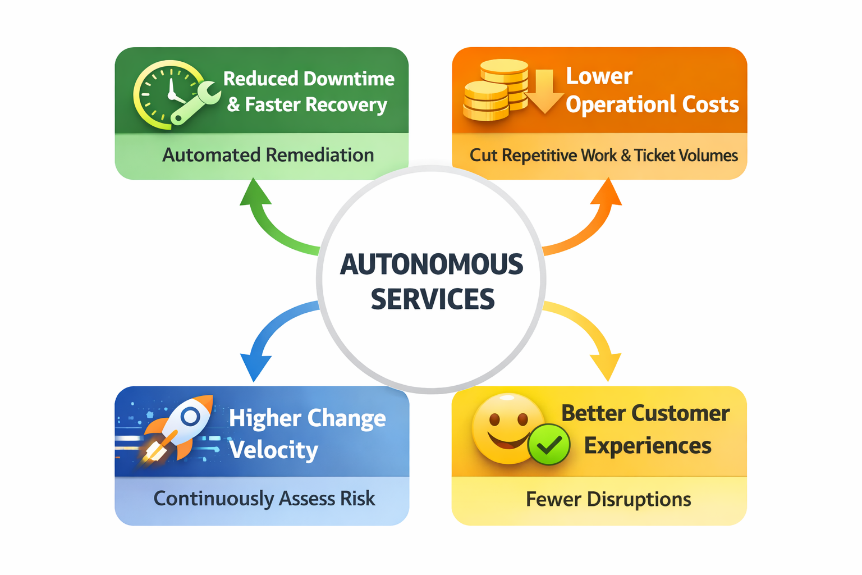
Image generated using AI tools for illustrative purposes.
However, perhaps the most strategic outcome is that Autonomous Services foster operational trust.
When leaders trust IT’s resilience, innovation accelerates. Releases move faster. Teams experiment more. The enterprise becomes bolder.
How YASH Helps Enterprises Make the Shift
The transition to Autonomous Services isn’t a “rip and replace.” It’s a maturity journey.
At YASH Technologies, we help organizations move step-by-step:
- Assess operational maturity and identify automation opportunities with measurable ROI
- Modernize observability to build a unified operational view
- Implement AI-assisted ITSM and AIOps for triage, correlation, and decision support
- Design closed-loop remediation with governance, security, and fail-safe controls
- Create a learning operations model, where every incident improves future response
This is not simply about implementing tools but about building a self-healing enterprise architecture that aligns people, processes, and platforms. So, let us help you accelerate the shift—safely and strategically. Could you write to us at info@yash.com?

More From Author.
Related Posts.

Embedding AI in AMS Governance: Smarter Dashboards for CIOs and Business Leaders
Gopala Krishna Lakkoju
Why AI-Led AMS Is the Most Underutilized Lever in Manufacturing IT Strategy
Veera Venkata Naga Ravi Krishna Desaraju
The Future of AMS Contracts: AI-Powered, Outcome-Based Service Models
Veera Venkata Naga Ravi Krishna Desaraju
Enhancing Security in AMS with Intelligent Monitoring Solutions
Veera Venkata Naga Ravi Krishna Desaraju

Redefining AMS Talent: How AI Elevates Human Roles in Managed Services
Veera Venkata Naga Ravi Krishna Desaraju


Elevating Application Maintenance Support through Intelligent AI Agents
Veera Venkata Naga Ravi Krishna Desaraju

SAP Application Management Services (AMS) trends we see dominating 2024
Varma Raju Pericherla

Streamlining Healthcare: The Essential Role of AMS in Modernizing Patient Care
Veera Venkata Naga Ravi Krishna Desaraju

Generative AI in the context of AMS
Veera Venkata Naga Ravi Krishna Desaraju

How Application Managed Services (AMS) empowers the Manufacturing Industry to drive excellent business outcomes
Veera Venkata Naga Ravi Krishna Desaraju

Service Integration and Management: A Key Catalyst for Optimal Application Management Efficiency
Veera Venkata Naga Ravi Krishna Desaraju