

Beyond Compliance: How ISO/IEC 42001 and YASH’s Governance Framework Build Trustworthy AI
Publish Date: November 6, 2025The Rise of AI — and the Urgent Need for Trust
Artificial Intelligence has evolved from an experimental frontier to the operational backbone of global enterprises—powering predictive analytics, fraud detection, customer engagement, and industrial automation.
But as AI begins making business-critical decisions, trust becomes the new benchmark of success.
For CISOs, CIOs, and board members, the question is no longer “Should we use AI?”—it’s “Can we govern AI responsibly, transparently, and securely?”
That’s where ISO/IEC 42001, the world’s first international AI Management System (AIMS) standard, enters the picture.
Understanding ISO/IEC 42001
Published in 2023, ISO 42001 provides a structured, auditable framework to manage AI design, development, deployment, and continual improvement.
Much like ISO 27001 did for information security, ISO 42001 institutionalizes accountability and trust in AI.
It defines how organizations should manage:

ISO 42001 bridges data science, ethics, and compliance—embedding trust directly into the AI lifecycle.
Why It Matters to Boards and Business Leaders
AI risks—bias, model drift, data leakage, and adversarial manipulation—can no longer be handled by technical teams alone.
They demand enterprise-wide governance and board-level visibility.
Adopting ISO 42001 enables organizations to:
- Demonstrate accountability to regulators and customers
- Integrate AI risk management into enterprise GRC
- Strengthen brand reputation through transparent assurance
- Gain a competitive edge via independent, auditable trust
This is not a compliance checkbox—it’s about building long-term confidence in AI systems that customers, regulators, and partners can rely on.
Technology: The Missing Link in AI Governance
Implementing ISO 42001 can be complex—requiring evidence management, control mapping, risk analytics, and cross-team collaboration.
Technology platforms turn this from a static framework into a living, measurable system of trust.
At YASH Technologies, our Cybersecurity GRC Practice leverages Thoropass, ServiceNow GRC, and custom audit-management platforms to:
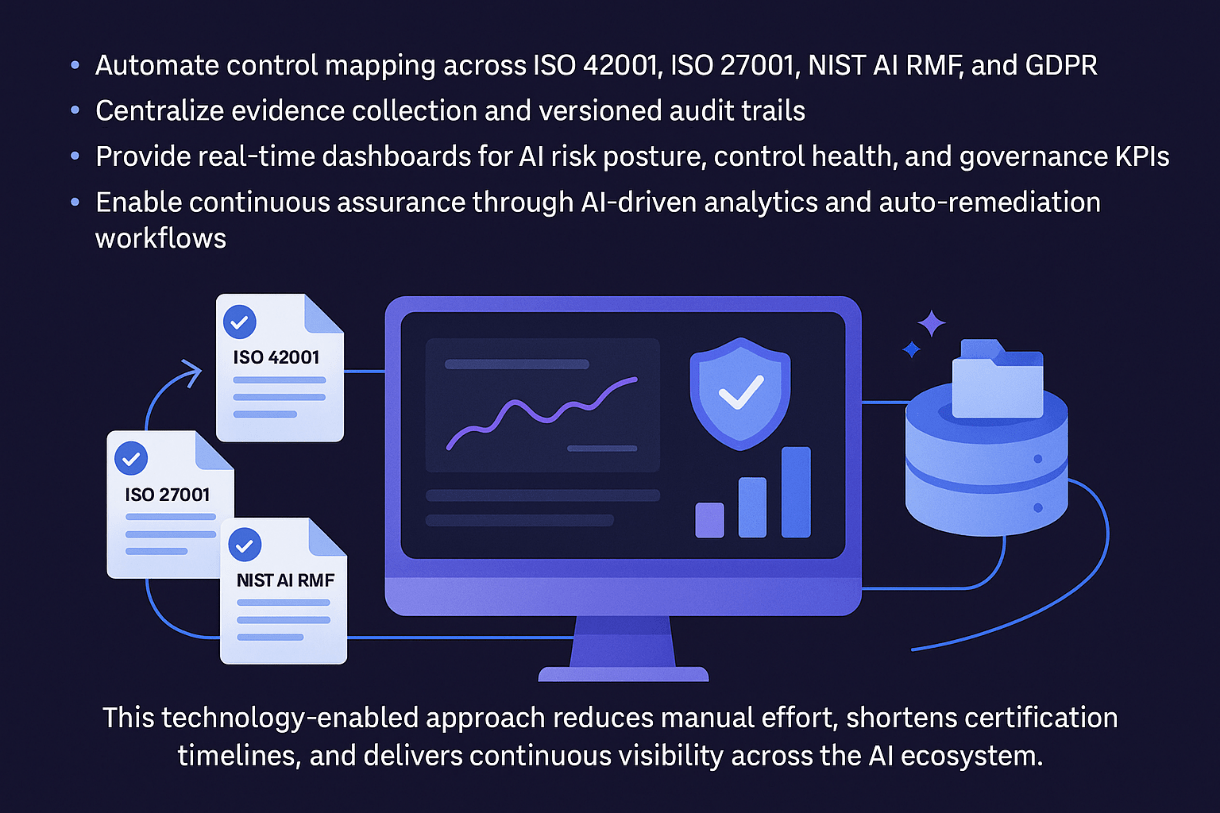
How Platforms Bring ISO 42001 to Life
| Pillar | What It Means in Practice | How Technology Helps |
|---|---|---|
| AI Governance & Accountability | Define oversight structures, ethics committees, and RACI models. | Workflow automation for approvals, accountability tracking, and reporting. |
| AI Risk Management | Identify, assess, and treat AI-specific risks (bias, model drift). | Centralized risk registers, automated scoring, and analytics dashboards. |
| Transparency & Explainability | Ensure traceability and interpretability of AI decisions. | Evidence repositories linking model documentation to audit trails. |
| Security & Privacy by Design | Embed data protection and security controls into AI lifecycle. | Continuous control monitoring mapped to ISO 27001 & GDPR standards. |
| Continuous Improvement | Review AI systems periodically for drift or bias. | Automated alerts, compliance KPIs, and dashboard-driven insights. |
Certification as a Trust Multiplier
Achieving ISO 42001 certification signals that your organization’s AI systems are ethical, accountable, and resilient.
Business benefits include:
- Alignment with regulations (EU AI Act, NIST AI RMF, GDPR)
- Reduced audit fatigue via unified control management
- Synergy with existing ISO 27001 & SOC 2 programs
- Enhanced stakeholder confidence through transparent governance reporting
With integrated audit platforms like Thoropass, certification becomes a continuous value cycle, not a one-time milestone.
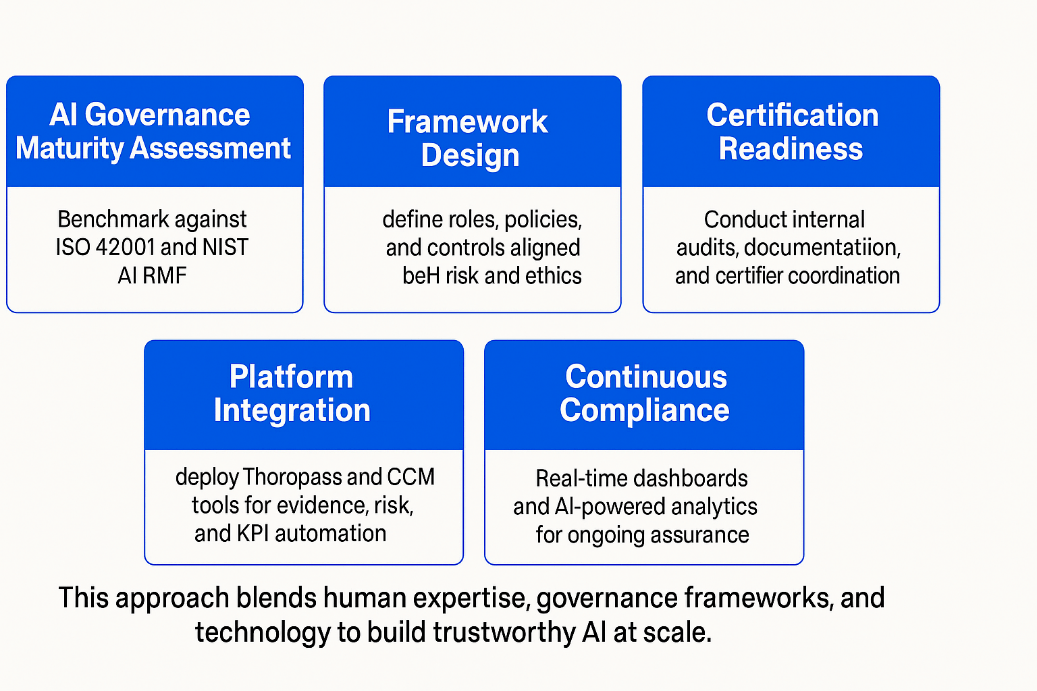
The YASH Approach to AI Governance & Certification Readiness
YASH Cybersecurity GRC Practice accelerates ISO 42001 readiness through a five-phase methodology:
The Road Ahead: Governance as a Business Enabler
In the coming years, AI governance will move from an ethical aspiration to a strategic business imperative.
ISO 42001 provides the scaffolding; platforms like Thoropass and YASH’s GRC ecosystem make it operational.
Organizations that act now will lead with:
- Responsible innovation that builds market trust
- Audit-ready compliance with minimal manual overhead
- Transparent AI decisioning aligned to global standards
At YASH Technologies, we help enterprises turn AI risk into resilience — embedding trust into the very fabric of digital transformation.
Conclusion
AI will define the next decade of business growth. But without structured governance, it can just as easily amplify risk.
ISO/IEC 42001, combined with YASH’s technology-driven governance platforms and methodology, enables enterprises to move from compliance to confidence — delivering secure, ethical, and auditable AI innovation.
Trustworthy AI isn’t built by accident — it’s engineered through governance, certification, and technology.

More From Author.
Related Posts.

The Future of Security Operations Is Decision Intelligence-Augmented
Senthilvel Kumar

The Microsoft Security Shift CISOs Can’t Ignore
Mahipal Kirupanithy Senthilvel Kumar Shivaram Jeyasekaran

Your SOC Is Using AI. But Who Is Securing the AI Layer?
Shivaram Jeyasekaran

AI vs AI: Why Traditional SOCs Are Losing the 2026 Threat Race
Senthilvel Kumar Vikash Kumar


Mythos Moves in Hours. Your MTTD Starts Too Late
Shivendra Sharma


The Hidden AI Risk in Your Cloud: Why CSPM Is Now a Board-Level Priority
Mahipal Kirupanithy

How AI-Powered EDR Stops Modern Attacks in Real Time
Mahipal Kirupanithy Vikash Kumar