

The cybersecurity landscape is transforming at rapid speed. AI tools that once seemed like science fiction are now sitting on every security team’s desk. But here’s the challenge: while AI promises to revolutionize how we defend against cyber threats, it also creates entirely new risks that CISOs must navigate.
If you’re a CISO wondering how to harness AI’s power while keeping your organization safe, you’re not alone. Let’s break down the practical steps you can take today.
AI in Cybersecurity: A Dual Perspective
Think of AI in cybersecurity like giving a security guard superhuman abilities. On one hand, AI can analyze millions of security events per second, spot patterns humans would miss, and respond to threats in milliseconds. On the other hand, that same powerful tool can be fooled, manipulated, or even turned against you if not properly managed.
Example: Security solutions can help analysts investigate incidents 22% faster. But if it’s trained on biased data or makes a wrong recommendation, your team might chase false leads while real threats slip through.
Governance: Building the Foundation
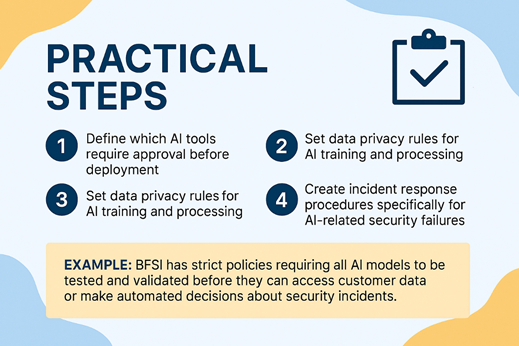
Establish Clear AI Policies
Start with the basics: create written policies that define how AI tools can and cannot be used in your security operations. It might seem like bureaucracy, but it’s your essential safety net
Create Cross-Functional AI Governance Teams
Don’t go alone. Form a team that includes security, legal, compliance, and business stakeholders. AI decisions affect everyone, so everyone should have a voice.
Key roles to include:
- Data privacy officers
- Risk management teams
- Business unit leaders who use AI tools
- External auditors or consultants for independent oversight
Oversight: Keeping AI on Track
Implement Continuous Monitoring
AI models aren’t “set it and forget it” tools. They need constant attention, just like any critical security system.
What to monitor:
- Model accuracy over time (are false positives increasing?)
- Data quality feeding into AI systems
- Decision patterns (is the AI showing unexpected bias?)
- Performance metrics compared to baseline human performance
Example: Security solutions like Darktrace continuously monitors its AI behavior and provides customers with explainable AI reports showing why certain decisions were made, allowing security teams to validate and adjust as needed.
Regular AI Audits and Testing
Schedule regular “health checks” for your AI systems, like how you conduct continuous penetration testing.
Testing should include:
- Adversarial testing (trying to fool the AI)
- Data poisoning scenarios
- Model drift analysis
- Bias detection across different types of security events
Human-in-the-Loop Validation
Never let AI make critical security decisions completely autonomously. Always maintain human oversight, especially for high-stakes actions like blocking network traffic or quarantining systems.
Practical implementation:
- Require human approval for actions above certain risk thresholds
- Implement escalation procedures when AI confidence levels are low
- Maintain audit trails of all AI-assisted decisions
Security: Protecting AI from Becoming a Liability
Secure AI Infrastructure
Your AI systems are high-value targets for attackers. Treat them with the same security rigor as your most critical assets.
Essential security measures:
- Encrypt AI model files and training data
- Implement strong access controls for AI systems
- Use secure development practices for AI applications
- Regular vulnerability scanning of AI infrastructure
Example: In 2023, researchers demonstrated how attackers could extract sensitive training data from AI models by crafting specific queries. This highlights why securing AI data pipelines is crucial.
Protect Against AI-Specific Threats
Traditional cybersecurity tools may miss AI-targeted attacks. You need specialized defenses.
Key threats to defend against:
- Model poisoning: Attackers corrupting training data to make AI behave maliciously
- Prompt injection: Tricking AI systems into ignoring security protocols
- Model extraction: Stealing your proprietary AI models
- Adversarial examples: Inputs designed to fool AI into wrong decisions
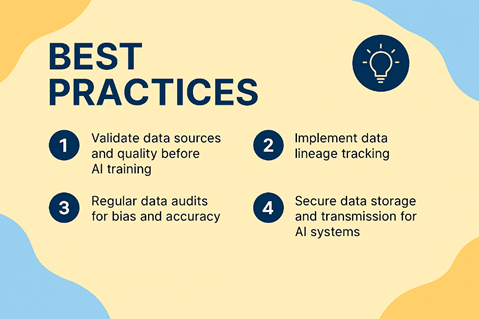
Data Governance for AI
The quality of your AI is only as good as the data feeding it. Poor data governance can turn your AI security tools into security liabilities.
Questions Every CISO Should Ask
As you implement AI governance, challenge your assumptions with these forward-thinking questions:
Strategic Questions
- How do we measure the ROI of AI security tools beyond just cost savings? Consider factors like analyst job satisfaction, threat detection quality, and business risk reduction.
- What happens when our AI security system conflicts with our human analysts’ judgment? Who has the final say, and how do we learn from these conflicts?
- How do we prepare for a future where attackers are using AI more sophisticatedly than we are? Are we building reactive or proactive defenses?
Technical Questions
- Can we create “AI tripwires” that detect when our models are being probed or attacked? This could provide early warning of AI-targeted attacks.
- How do we maintain AI effectiveness while ensuring complete transparency in decision-making? The balance between “black box” AI power and explainable decisions.
- What’s our plan for AI model versioning and rollback when updates go wrong? Just like software deployment, AI models need change management.
Organizational Questions
- How do we prevent “AI washing” where vendors claim AI capabilities without real substance? What technical validation should we require?
- Are we creating over-dependence on AI that could cripple our security operations if AI systems fail? How do we maintain manual capabilities as backup?
- How do we handle the ethical implications of AI making decisions that could impact employee privacy or access? What oversight mechanisms ensure fairness?
Building Your AI Governance Roadmap
Phase 1: Foundation (Months 1-3)
- Inventory current AI tools in use
- Establish basic AI governance policies
- Form cross-functional AI governance team
- Implement basic monitoring for existing AI tools
Phase 2: Expansion (Months 4-9)
- Deploy comprehensive AI monitoring and audit procedures
- Enhance security measures for AI infrastructure
- Begin regular AI security assessments
- Train security team on AI-specific threats and defenses
Phase 3: Optimization (Months 10-12)
- Implement advanced AI security measures
- Develop AI incident response procedures
- Create metrics and KPIs for AI governance effectiveness
- Begin planning for next-generation AI security challenges
The Conclusion
AI in cybersecurity isn’t optional anymore, it’s essential for staying competitive and secure. But like any powerful tool, it requires thoughtful governance, careful oversight, and robust security measures.
The CISO’s who succeed will be those who embrace AI while maintaining a healthy skepticism, who automate intelligently while preserving human judgment, and who move fast while building strong foundations.
Remember: you’re not just implementing technology; you’re reshaping how your organization thinks about security. Make sure you’re building something that will serve you well not just today, but as AI continues to evolve.
The future of cybersecurity is AI-powered, but it’s still human-governed. Make sure you’re ready for both sides of that equation.

Shivaram Jeyasekaran
Director – Cybersecurity Services, YASH Technologies
A distinguished cybersecurity leader with over 23 years of experience transforming enterprise security landscapes across global organizations. He is recognized for architecting and scaling robust cybersecurity programs that align with business objectives while maintaining cutting-edge defense capabilities. Shivaram has spearheaded numerous large-scale cybersecurity consulting engagements in his illustrious career, helping organizations navigate complex security challenges while balancing innovation with risk management. His approach combines strategic vision with practical implementation, ensuring organizations stay resilient in the face of evolving cyber threats.
More From Author.
Related Posts.



From Annual Audits to Always-On Assurance: How AI Is Redefining SOC & ISO Compliance
Mahipal Kirupanithy Shivaram Jeyasekaran

Why Third-Party Risk Can No Longer Be Manual: Building an AI-Driven TPRM Program
Mahipal Kirupanithy Shivaram Jeyasekaran

When Ransomware Reprices the Deal: Cyber Risk in Modern M&A
Ankush Arora Shivaram Jeyasekaran

The AWS Security Arsenal: 7 Services Every Cloud Leader Should Master
Mahipal Kirupanithy Shivaram Jeyasekaran
Stop Collecting Security Tools. Start Managing Cyber Risk.
Kaisar Chishti Shivaram Jeyasekaran Val Coucke

Microsoft Sentinel Data Lake: A Game-Changer for Security Operations
Kaisar Chishti Shivaram Jeyasekaran Val Coucke
AI Governance: Board-Level Oversight for Emerging Technology
Shivaram Jeyasekaran
Security Budgeting: Making the Business Case for 2026
Shivaram Jeyasekaran


Securing AI/ML Models: Adversarial Attacks and Defenses
Shivaram Jeyasekaran