


Digital Risk Assessment: Protecting Value in Mergers & Acquisitions
Publish Date: January 15, 2026When companies merge or acquire other businesses, they’re not just buying assets, customers, and talent, they’re also inheriting digital risks that could make or break the deal’s success. In today’s technology-driven world, overlooking digital vulnerabilities during M&A transactions can lead to massive financial losses, regulatory headaches, and damaged reputations.
Why Digital Risk Assessment Matters More Than Ever
Think about it: every modern business runs on technology. From customer databases to payment systems, from cloud storage to mobile apps, digital infrastructure is the backbone of operations. When you acquire a company, you’re essentially adopting their entire digital ecosystem, including any hidden problems lurking beneath the surface.
Recent high-profile breaches have shown us that cybersecurity incidents can wipe out billions in market value overnight. Imagine completing a major acquisition only to discover the target company has weak security protocols, outdated systems, or worse, an ongoing data breach that hasn’t been detected yet.
The Cost of Getting It Wrong
While most dealmakers obsess over revenue multiples and EBITDA margins, they’re missing a massive risk hiding in plain sight. Poor cybersecurity due diligence is quietly killing deals and destroying value at an alarming rate.
Here’s the reality: 67% of M&A failures can be traced back to inadequate cyber due diligence. That’s not a typo, it’s a wake-up call.
Why Traditional Due Diligence Falls Short
Most M&A teams treat cybersecurity like a checkbox exercise. They ask for compliance certificates, maybe run a basic vulnerability scan, and call it good. But here’s what they’re actually missing:
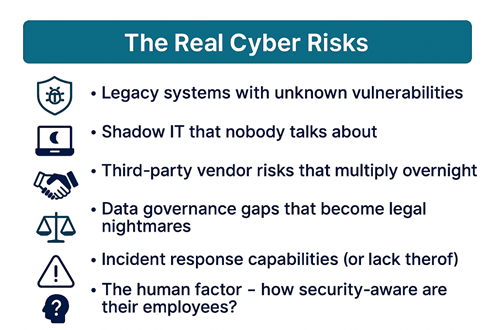
The True Cost of Getting It Wrong
When cyber due diligence fails, the consequences go way beyond embarrassing headlines:
Financial Impact:
- Average data breach costs have hit $4.45 million
- Regulatory fines that can reach hundreds of millions
- Customer churn that destroys the deal’s original value proposition
- Integration delays that burn cash and momentum
Operational Chaos:
- Systems that can’t be integrated due to security gaps
- Compliance issues that halt business operations
- Key IT people quit when they realize the mess they’re inheriting
- Companies that skip thorough digital risk assessments often face expensive surprises. Post-acquisition, they might discover they need to invest millions in security upgrades, face regulatory fines for compliance violations, or deal with customer trust issues following a data breach.
Best Practices for Digital Due Diligence
Start Early: Begin digital risk assessment during the initial due diligence phase, not as an afterthought. This gives you time to properly evaluate risks and factor them into your valuation and negotiation strategy.
Bring in the Experts: While financial and legal due diligence are standard, many companies still treat cybersecurity assessment as optional. Engage qualified cybersecurity professionals who understand both technology and business risks.
Look Beyond the Technical: Digital risk isn’t just about technology, it’s also about people and processes. Evaluate the target company’s security culture, employee training programs, and incident response procedures.
Plan for Integration: Consider how you’ll merge different technology systems and security protocols. Incompatible systems can create security gaps during the integration process.
Document Everything: Maintain detailed records of your digital risk assessment findings. This documentation will be valuable for integration planning and can help protect you legally if issues arise later.
Key Digital Risks to Evaluate
Cybersecurity Vulnerabilities: Start with the basics: How secure are their systems? Look for outdated software, weak password policies, lack of employee training, and poor access controls. A company with loose security practices is essentially a ticking time bomb.
Data Privacy Compliance: With regulations like GDPR, CCPA, and dozens of other privacy laws worldwide, non-compliance can result in hefty fines and legal troubles. Check if the target company properly handles customer data, has necessary consent mechanisms, and follows required data retention policies.
Technology Infrastructure: Examine their IT setup: Are systems outdated? Do they rely on legacy software that’s no longer supported? How about their cloud strategy—is it secure and scalable? Aging technology infrastructure often requires significant investment post-acquisition.
Third-Party Dependencies: Many companies rely heavily on external vendors for critical services. What happens if a key technology partner goes out of business or suffers a breach? Understanding these dependencies helps you assess potential disruption risks.
Intellectual Property Protection: Digital assets like proprietary software, algorithms, and databases are often a company’s most valuable assets. Ensure they’re properly protected, documented, and legally owned by the company you’re acquiring.
The Gist
Digital risk assessment shouldn’t be an afterthought in M&A transactions, it should be a core component of your due diligence process. The cost of a comprehensive digital risk evaluation is minimal compared to the potential losses from cyber incidents, regulatory violations, or technology failures post-acquisition.
In today’s digital economy, protecting value means protecting data, systems, and digital assets. Effective digital risk assessment is crucial for companies aiming to successfully acquire other businesses and avoid expensive surprises after a deal is finalized.
Remember: you’re not just buying a business, you’re inheriting its digital DNA. Make sure you know what you’re getting into before you sign on the dotted line.

Shivaram Jeyasekaran
Director – Cybersecurity Services, YASH Technologies
A distinguished cybersecurity leader with over 23 years of experience transforming enterprise security landscapes across global organizations. He is recognized for architecting and scaling robust cybersecurity programs that align with business objectives while maintaining cutting-edge defense capabilities. Shivaram has spearheaded numerous large-scale cybersecurity consulting engagements in his illustrious career, helping organizations navigate complex security challenges while balancing innovation with risk management. His approach combines strategic vision with practical implementation, ensuring organizations stay resilient in the face of evolving cyber threats.
More From Author.
Related Posts.



From Annual Audits to Always-On Assurance: How AI Is Redefining SOC & ISO Compliance
Mahipal Kirupanithy Shivaram Jeyasekaran

Why Third-Party Risk Can No Longer Be Manual: Building an AI-Driven TPRM Program
Mahipal Kirupanithy Shivaram Jeyasekaran

When Ransomware Reprices the Deal: Cyber Risk in Modern M&A
Ankush Arora Shivaram Jeyasekaran

The AWS Security Arsenal: 7 Services Every Cloud Leader Should Master
Mahipal Kirupanithy Shivaram Jeyasekaran
Stop Collecting Security Tools. Start Managing Cyber Risk.
Kaisar Chishti Shivaram Jeyasekaran Val Coucke

Microsoft Sentinel Data Lake: A Game-Changer for Security Operations
Kaisar Chishti Shivaram Jeyasekaran Val Coucke

AI Governance: Board-Level Oversight for Emerging Technology
Shivaram Jeyasekaran

Security Budgeting: Making the Business Case for 2026
Shivaram Jeyasekaran


Securing AI/ML Models: Adversarial Attacks and Defenses
Shivaram Jeyasekaran