
Everybody can see the assistant. It sits in the sidebar, pops up in the service desk, drafts the reply, summarizes the incident, and suggests the next action. The more important question sits elsewhere: has the work actually become better? That is where the productivity debate gets interesting.
| Visible Adoption vs Realized Value | ||
|---|---|---|
| ~80% using gen AI |
60%+ with no significant bottom-line impact |
Just 1 in 50 AI initiatives delivering transformative value. |
Gartner notes that organizations are entering 2026 with aggressive expectations for AI, even though only 1 in 50 AI initiatives delivers transformative value. McKinsey, from a different angle, reports that nearly 80% of companies are already using gen AI, yet more than 60% still see no significant bottom-line impact. The gap between visible adoption and measurable operating value is now too large to ignore.
The capability vs fluency gap
From where we sit in the cloud, infrastructure, digital workplace, and DevOps environments, that gap makes sense. AI assistants are being deployed faster than organizations are redesigning the work around them. Gartner’s estimates found that by the end of 2025, most enterprise applications will have embedded AI assistants.
| By 2026 | By 2027 | By 2029 |
|---|---|---|
| Up to 40% of enterprise applications are expected to include task-specific AI agents. | One-third of agentic AI implementations could combine multiple agents with different skills. | At least half of knowledge workers are expected to develop new skills to work with, govern, or create AI agents. |
That progression matters because an assistant is not the same thing as an agent, and an agent is not the same thing as an operating model. The same report even warns against “agentwashing,” where simple assistants get marketed as autonomous agents before they can actually execute complex end-to-end work.[1].
The deeper issue is capability. McKinsey’s article focuses on frontline-heavy sectors, but the lesson travels well into enterprise IT. When tools arrive before skills, productivity stalls. McKinsey found that almost half of US C-suite executives say AI deployment is moving too slowly, and the top reason they cite is talent skill gaps. McKinsey also points to a leadership blind spot on skills: leaders over-index on technical capabilities, while employees place greater value on socioemotional and practical capabilities.
This is why in AI-led environments, both matter. People need fluency with the tool, confidence in judgment, and the ability to act on AI output inside a real workflow.[2]. This is also why the future of employee productivity will not be decided by who bought an assistant first. It will be decided by who cleaned up the workflow around it.
Addressing the “Workslop” Drain With Harmonious Infrastructure
Gartner flags AI “workslop” as a major productivity drain: low-quality AI output that employees spend hours fixing. The cost is not only wasted time but also erosion of trust within the workforce.[3].
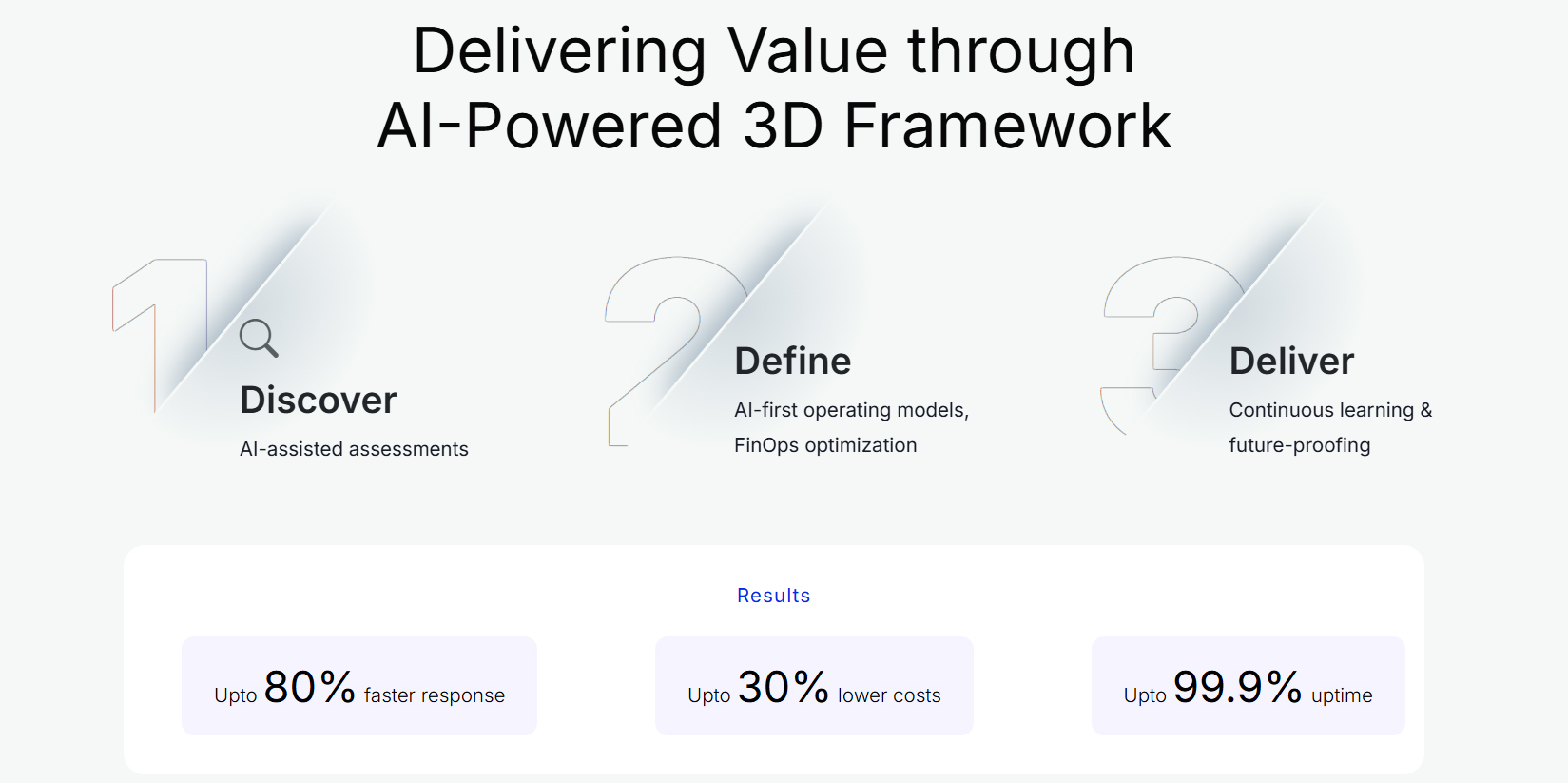
At YASH, our own cloud and infrastructure practice is built around a more grounded view of transformation. Our Infrastructure Management Services positioning is explicit: AI-led delivery must sit alongside operating-model design, FinOps discipline, automation-first execution, and continuous learning. The AI-powered 3D framework itself is telling in its sequence: discover through AI-assisted assessments, define through AI-first operating models and FinOps optimization, and deliver through continuous learning and future-proofing. (Learn about YASH’s FinOps offerings here)
That order reflects a practical truth from the field: productivity improves when AI is tied to process visibility, service architecture, governance, and adoption, rather than dropped into a fragmented environment and expected to rescue it.
The same pattern runs through YASH’s AMURAA® platform. It combines AIOps visibility, automation, orchestration, governance, DevOps accelerators, and conversational support. Components such as AMURAA® iAssist, iFix, iMonitor++, and iNotify show where assistants become most useful in operations: improving the user experience, reducing support costs, automating workflows, providing real-time visibility, and improving incident communication. For DWS and DevOps teams, this is the more credible picture of AI productivity. The assistant is most valuable when it has context, system visibility, and a defined role inside the operating chain. (Learn about YASH AMURAA here).
YASH’s AMURAA® platform helps enable the following fundamental shifts for enterprises’ IT teams:
| From | To |
|---|---|
| Lack of visibility of the IT value stream | Connecting, visualizing and measuring the value stream |
| Disparate pockets of automation | Accelerating end-to- end IT lifecycle automation by joining the dots |
| Adhoc IT improvement initiatives | Data-based decision making through integrated dashboards |
| Functional roles and silo’ed teams | Integrated friction-free teams mapping to a product IT operating model |
The business evidence is stronger when we look at outcomes rather than features. In YASH’s work with a global European bank, the problem was operational sprawl across 5,000+ applications, multiple monitoring systems, and an overloaded help desk. The response was to implement workflow automation through dedicated POD teams and a single, customized cockpit. The impact was concrete:
- a 40% increase in end-user satisfaction
- a 74% increase in password resets from a 31% baseline,
- direct service desk cost savings
That is what productive AI-adjacent automation looks like in the real enterprise: less friction, fewer manual hops, higher user confidence, cleaner operating rhythm (read the full case study here).
In another case, the YASH team, working with a global pharma leader, makes the same point from an infrastructure operations perspective. The client had data-center sprawl, multiple monitoring tools, outdated systems, backup failures, and patching delays. YASH brought inventory discipline, consolidated monitoring, automation, better patching, and service improvements. Over the first three years, the engagement delivered more than
- 20% productivity gains
- 45% lower maintenance and operational cost
- 70–80% fewer outages
- 90–95% time savings through auto-ticketing,
- 100 person-hours saved per month through specific Office 365 migration work.
These are the kinds of gains leaders should care about when discussing AI assistants and employee productivity. They are operational gains before they are branding statements (read the full study here).
A third example, involving a global security solutions leader migrating to Azure, shows what happens when cloud strategy, monitoring, documentation, automation, and managed services are aligned. Team YASH’s work led to:
- a 40% reduction in server footprint
- a 40% reduction in critical incidents
- 99% SLA adherence
- 30% faster time to market
- >€30K in monthly network operational savings, and
- >€1 million in annual cost savings.
Here again, the story is not about an assistant in isolation, but rather about a system that becomes easier to run, easier to trust, and easier for teams to act within (read the full case study here).
Productivity depends on the operating foundation beneath
So where does that leave AI assistants? In a much more useful place than the hype cycle suggests. They are neither a novelty nor a shortcut. They are the new interaction layer for enterprise work, and soon they will be joined by task-specific agents and multi-agent workflows.
But the companies that will pull durable productivity from them are the ones willing to do the slower work underneath: redesign processes, build skills, govern output quality, connect assistants to live operational context, and measure impact in resolution time, downtime, cost, throughput, and experience. The assistant may be the surface. Productivity is still earned in the operating model beneath it.[4].
[1] Gartner
[2] McKinsey
[3] (Gartner
[4] Gartner, Gartner, McKinsey

More From Author.



Related Posts.
The AI-Powered Enterprise: What’s Next for Business Automation?
Abhishek Pandey
AI-driven automation for resilient supply chains and superior customer experiences
Srikanth Pattabi Raman



Data and AI: Essential skills every Big data architect needs
Kumareswar Kandimalla

The power of Salesforce Einstein integrations
Mitesh Sharma

An introduction to Reinforcement Learning – Part 2
Rahul Budholiya

An introduction to Reinforcement Learning – Part 1
Rahul Budholiya