
The Future of AMS Contracts: AI-Powered, Outcome-Based Service Models
Publish Date: March 17, 2026Application Management Services (AMS) contracts have long been synonymous with ticket resolution, SLA adherence, and predictable maintenance. While these models ensured operational stability, they often limited innovation. As enterprises accelerate toward digital maturity, the paradigm shifts from effort-based delivery to intelligent, outcome-driven value creation. The future of AMS is no longer about maintaining systems; it’s about making them self-healing, self-optimizing, and business-aligned through AI and automation.
From Reactive Support to Predictive Intelligence
Traditional AMS models focus on resolving incidents after they occur. AI-powered AMS flips this equation. Predictive analytics now allows IT teams to anticipate issues before they impact users. For instance, AI-Ops platforms such as ServiceNow’s Predictive Intelligence or Dynatrace’s Davis AI analyze historical data, user behavior, and system logs to detect early anomalies and recommend fixes, often resolving 60–70% of issues automatically.
This transformation means enterprises no longer need large L1 support teams to triage tickets manually. Instead, AI-driven virtual agents and automated workflows handle repetitive tasks, freeing human experts to focus on optimization, transformation, and user experience enhancement. The result is a shift from reactive firefighting to proactive, intelligence-led management.
Outcome-Based Contracts: Aligning IT with Business KPIs
The future of AMS delivery centers hinges on the Outcome-Based Contract model, which represents a foundational shift from managing IT effort to co-creating business value. In this model, the vendor’s success is directly tied to the client’s success, moving beyond traditional Service Level Agreements (SLAs) to focus on business-aligned outcomes. This requires an integrated delivery model that is directly aligned with key business value streams.
Measuring Business Benefits: Monetary and Non-Monetary Angles
A futuristic AMS engagement model must prove its value through a balanced scorecard that captures both financial efficiency and strategic, non-monetary gains.
1. Monetary Benefits (Value Realization)
These metrics focus on the direct financial impact of the AMS partnership:
- Total Cost of Ownership (TCO) Optimization: TCO reduction remains a core goal, often achieved by eliminating redundancies, automating routine tasks, and streamlining workflows.
- Revenue Generation: Measuring the direct impact on the client’s top line, such as increased sales or new customer acquisition.
- Cost Predictability: Utilizing combined fixed-fee and flexible value-based components within the contract to ensure predictable cash flow and effective budget management.
2. Non-Monetary Benefits (Strategic & Organizational Value)
These metrics quantify the long-term, strategic value that enables business growth and innovation, rather than just cost-cutting:
- Operational Resilience and Stability: Measuring the improvement in reliability and resilience of applications, which reduces technical debt and enables business growth.
- Time-to-Market (TTM): Tracking the speed of new feature deployment or product/service launches, which is a key outcome of an agile, modernized AMS model.
- Focus on Innovation: Freeing up internal IT teams from routine, “keep-the-lights-on” tasks so they can be reallocated to strategic initiatives and product development.
- Risk Mitigation and Compliance: Ensuring applications are secure and compliant (e.g., HIPAA or GDPR) through regular audits and proactive threat detection.
Measuring User Experience Levels (UX/CX)
The shift from IT-centric to business-centric metrics is best captured by moving away from Service Level Agreements (SLAs), which measure only IT performance (e.g., uptime, ticket response time), toward Experience Level Agreements (XLAs). XLAs measure the actual impact of the service on the end-user, whether they are customers (Customer Experience, or CX) or employees (User Experience, or UX).
Key Metrics for Measuring Experience (XLAs):
- Availability: Moving from Percentage of System Uptime to Productivity Loss Index (How much time was lost by users due to the outage).
- Speed/Performance: Moving from Mean Time To Respond (MTTR) for a ticket to Application Response Time (Measured from the end-user device).
- Satisfaction: Implementing metrics like Net Promoter Score (NPS), Customer/User Satisfaction (CSAT/USAT), and Effort Scores.
- Value: Moving from Adherence to fixed scope/contract to the Adoption Rate of new features/modules.
By focusing on XLAs, modern AMS providers ensure their operations, powered by AI and automation, continuously deliver greater satisfaction and prioritize end-user needs.
Autonomous & Composable AMS: The Operating Model of the Future
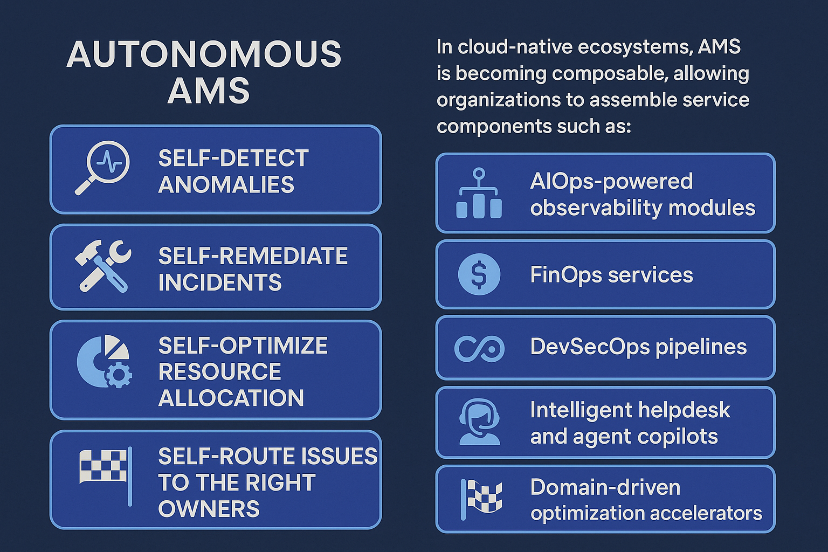
The next evolution is autonomous AMS, where AI and machine learning continuously learn from application behavior to perform auto-remediation, dynamic resource allocation, and smart incident routing. In cloud-native ecosystems, AMS models are becoming composable, enabling enterprises to assemble service components on demand—from DevSecOps pipelines to observability and FinOps modules.
For instance, hyperscalers such as Microsoft Azure and AWS already offer AI-enabled monitoring and remediation frameworks, enabling AMS partners to integrate cognitive capabilities at scale. According to one research, by 2027, over 50% of AMS contracts will include AI-driven automation as a core clause, emphasizing predictive maintenance, autonomous monitoring, and self-service enablement.
Shaping a Data-Driven Partnership Model
The integration of AI into AMS redefines the client-vendor dynamic. Providers now act as strategic co-innovators rather than mere service executors. This partnership thrives on shared data, transparent dashboards, and continuous improvement loops. Through AI-powered insights, clients gain visibility into not only IT metrics but also how applications drive business results, reducing time-to-market, enhancing CX, and cutting the total cost of ownership.
Forward-thinking AMS providers are embedding generative AI copilots into service delivery platforms to aid decision-making, root-cause analysis, and knowledge reuse. Such copilots can summarize incidents, generate code snippets, or recommend configuration changes, accelerating time to resolution and elevating the overall experience.
Why YASH Technologies Is Uniquely Positioned for the AMS of the Future
At YASH Technologies, we are architecting next-generation AMS through predictive intelligence, AI-led automation, value-based KPIs, and experience-driven service design.
Our AMS 4.0 Framework integrates:
- AIOps and Observability Platforms
- GenAI Copilots for Engineering and Service Operations
- Cloud-native automation accelerators
- Industry-specific optimization models
- Outcome- and experience-driven engagement structures
With deep competencies across SAP, Microsoft, AWS, ServiceNow, and industry-specific digital ecosystems, YASH partners with enterprises to build autonomous, insight-led AMS landscapes that deliver measurable business value — both monetary and experiential, as well as strategic.
In an era where uptime, agility, and digital experience shape competitive advantage, YASH ensures your applications don’t just run; they evolve, optimize, and adapt intelligently.
If your enterprise is ready to adopt the future AMS model, please get in touch with palm@yash.com to begin your journey.

More From Author.
Related Posts.

Embedding AI in AMS Governance: Smarter Dashboards for CIOs and Business Leaders
Gopala Krishna Lakkoju

Why AI-Led AMS Is the Most Underutilized Lever in Manufacturing IT Strategy
Veera Venkata Naga Ravi Krishna Desaraju

From Managed Services to Autonomous Services: Building the Self-Healing Enterprise with AI
Veera Venkata Naga Ravi Krishna Desaraju

Enhancing Security in AMS with Intelligent Monitoring Solutions
Veera Venkata Naga Ravi Krishna Desaraju

Redefining AMS Talent: How AI Elevates Human Roles in Managed Services
Veera Venkata Naga Ravi Krishna Desaraju


Elevating Application Maintenance Support through Intelligent AI Agents
Veera Venkata Naga Ravi Krishna Desaraju

SAP Application Management Services (AMS) trends we see dominating 2024
Varma Raju Pericherla

Streamlining Healthcare: The Essential Role of AMS in Modernizing Patient Care
Veera Venkata Naga Ravi Krishna Desaraju

Generative AI in the context of AMS
Veera Venkata Naga Ravi Krishna Desaraju

How Application Managed Services (AMS) empowers the Manufacturing Industry to drive excellent business outcomes
Veera Venkata Naga Ravi Krishna Desaraju

Service Integration and Management: A Key Catalyst for Optimal Application Management Efficiency
Veera Venkata Naga Ravi Krishna Desaraju