

Next-Gen Identity & Access Management: Leveraging AI for Stronger, Smarter Enterprises
Publish Date: January 20, 2026Enterprises are navigating a digital landscape defined by speed, scale, and interconnectivity. Cloud migration, data proliferation, and AI adoption are expanding digital perimeters faster than ever. Each new platform, API, device, or user introduces an identity that must be verified and protected. Managing this web of trust, securely and efficiently, has become an enterprise priority.
As organizations intensify automation and AI integration across business functions, identity has emerged as the foundation that binds people, processes, and intelligent systems together. Traditional IAM systems weren’t designed to handle this pace or complexity. Static controls and manual processes slow innovation and widen security gaps.
Next-Gen Identity & Access Management (IAM) helps enterprises turn this challenge into an opportunity, using AI, automation, and adaptive security to create intelligent trust frameworks that strengthen resilience while enabling digital growth.
Why Traditional IAM Falls Short
Enterprise realities have shifted:
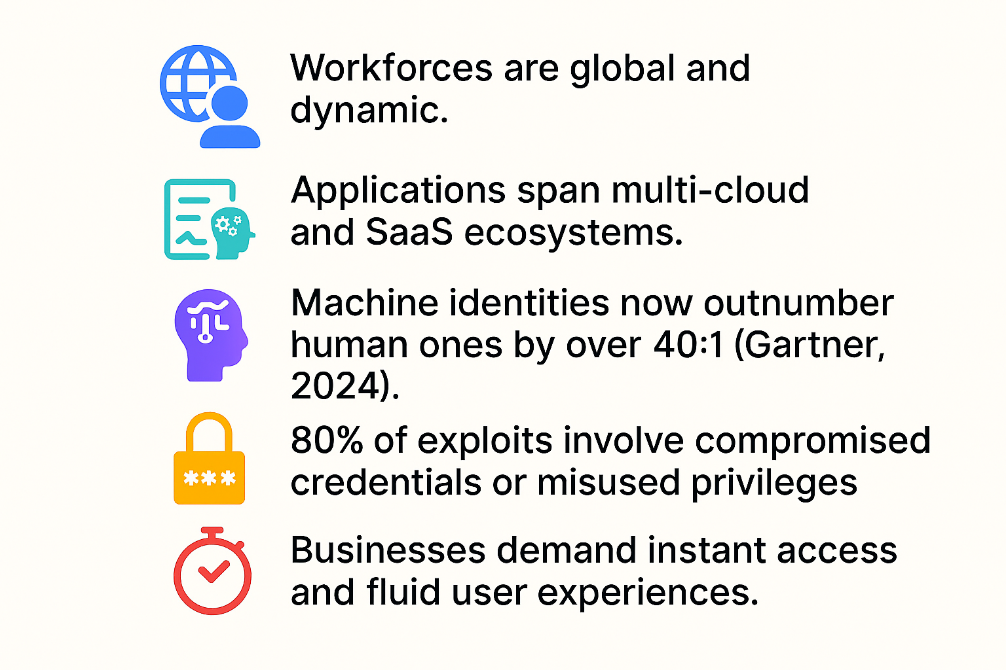
Legacy IAM, built for static network perimeters, cannot keep up. Its manual reviews, password-heavy authentication, and rigid rule sets are reactive, not intelligent. In contrast, AI-driven IAM continuously learns from context, understanding behaviors, detecting anomalies, and automating responses more quickly than human teams can.
What Defines Next-Gen IAM
Next-Gen IAM isn’t just about managing access; it’s about managing trust intelligently. By combining Zero Trust design, AI analytics, automation, and unified governance, enterprises can now prevent threats before they manifest and deliver secure, seamless access for humans and machines alike.
- Zero Trust Identity Architecture
Zero Trust principles eliminate the concept of implicit trust, every access attempt is continuously verified. Using AI-based real-time analytics, enterprises can now evaluate each login or access request in context:
- User behavior and historical patterns.
- Device posture and security signals.
- Geolocation and network risk factors.
AI brings predictive strength here, it identifies subtle deviations, flags suspicious access, and adjusts trust dynamically. This enables real-time, risk-aware decisions that balance both security and user convenience.
- AI-Driven Identity Intelligence
As identity data grows exponentially across hybrid environments, it’s beyond the scope of human monitoring alone. AI transforms this complexity into insight.
By ingesting and correlating identity, device, and application data, AI models can:
- Detect privilege misuse or credential anomalies.
- Predict high-risk access behaviors before they occur.
- Identify zombie or orphaned accounts for remediation.
- Recommend access adjustments to maintain least privilege.
A Forrester study shows that enterprises adopting AI in IAM saw a 40% reduction in identity-related security incidents and significantly faster compliance readiness. This evolution shifts identity governance from a point-in-time review to continuous intelligence.
- Intelligent Automation Across the Identity Lifecycle
AI and machine learning accelerate the identity lifecycle—from onboarding to exit. Intelligent automation ensures precision and policy consistency across every identity-related action:
- Instant provisioning when an employee joins.
- Role-based updates as responsibilities evolve.
- Automated deprovisioning upon departure.
This not only reduces human error and administrative effort by up to 60% (IDC, 2024), but also ensures access accuracy and compliance at enterprise scale. AI-powered automation gives enterprises a trust framework that adapts in real time.
- Unified Identity Fabric
Modern enterprises require harmony between security and experience. A unified identity fabric integrates Identity Governance (IGA), Access Management (AM), Privileged Access Management (PAM), and Customer IAM (CIAM) into one intelligent layer.
With AI-enhanced analytics, enterprises gain a comprehensive view of every identity, its behaviors, privileges, and associated risks. Unified policies ensure consistency, while automation enforces them seamlessly across hybrid environments.
Gartner predicts that by 2027, 60% of large enterprises will adopt unified, AI-supported identity platforms, replacing fragmented architectures with cohesive, data-driven systems.
- Passwordless and Adaptive Authentication
Static credentials remain a weak point, responsible for over 80% of breaches. Using AI-driven adaptive authentication, Next-Gen IAM continuously monitors behavioral signals to determine when additional verification is necessary.
Coupled with passwordless options, biometrics, passkeys, or hardware tokens, this creates frictionless experiences for users while reinforcing enterprise security posture.
How Next-Gen IAM Works in Practice
AI transforms Next-Gen IAM from a rules-based system into an intelligent trust ecosystem:
- Discover & Classify: AI continuously scans hybrid environments, cataloging all identities, human, machine, and service.
- Authenticate with Context: Machine learning models adjust authentication based on risk signals like device health or location.
- Authorize Dynamically: AI-driven engines grant, escalate, or revoke access in real time.
- Enforce Least Privilege: Algorithms detect and correct over-provisioned accounts automatically.
- Monitor & Respond: Anomaly detection models flag threats and trigger automated remediation without human input.
This transforms IAM into a living, adaptive system that learns from every interaction, reducing risk while optimizing operations.
Business Impact: Beyond Protection
AI-enabled IAM not only strengthens cybersecurity but also delivers measurable enterprise outcomes:
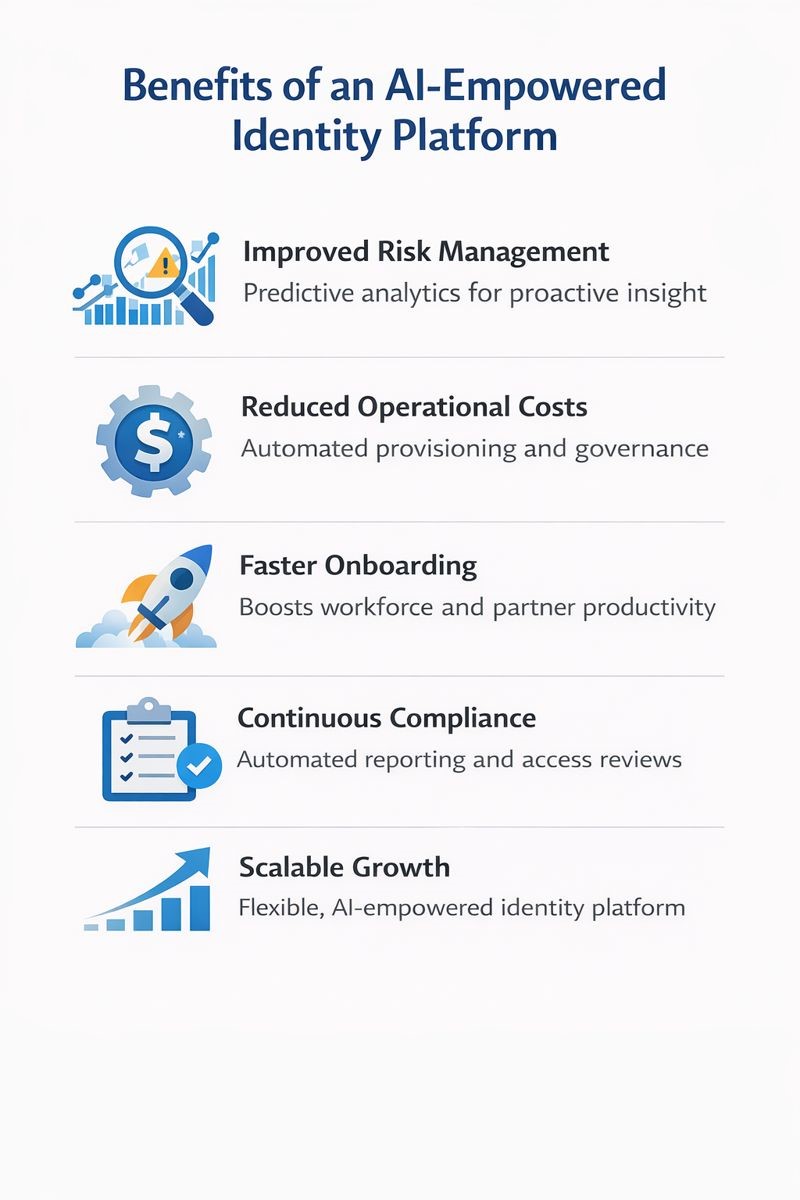
When identity becomes intelligent, it directly supports enterprise transformation, allowing CIOs and CISOs to simultaneously advance both security and business speed.
Looking Ahead: AI-Powered Trust Architectures
As enterprises operationalize AI across departments, their IAM foundations will evolve alongside. The next wave of transformation will feature:
- AI-native Identity Threat Detection & Response (ITDR) to predict and neutralize attacks.
- Autonomous governance models that enforce policies across hybrid ecosystems.
- Decentralized identity frameworks (DID) combining privacy, portability, and ownership.
- Real-time identity observability through AI’s predictive and prescriptive analytics.
Ultimately, AI is enabling identity systems that think, adapt, and defend autonomously, shifting IAM from static infrastructure to strategic intelligence.
Identity is now the intelligent fabric of enterprise trust.
By embedding AI, automation, and Zero Trust into identity management, organizations can secure every connection, empower every user, human or machine, and drive innovation with confidence. Click here to talk to our cybersecurity experts today, or write to us cybersecurity@yash.com

More From Author.
Related Posts.



From Annual Audits to Always-On Assurance: How AI Is Redefining SOC & ISO Compliance
Mahipal Kirupanithy Shivaram Jeyasekaran

Why Third-Party Risk Can No Longer Be Manual: Building an AI-Driven TPRM Program
Mahipal Kirupanithy Shivaram Jeyasekaran

When Ransomware Reprices the Deal: Cyber Risk in Modern M&A
Ankush Arora Shivaram Jeyasekaran

The AWS Security Arsenal: 7 Services Every Cloud Leader Should Master
Mahipal Kirupanithy Shivaram Jeyasekaran
Stop Collecting Security Tools. Start Managing Cyber Risk.
Kaisar Chishti Shivaram Jeyasekaran Val Coucke

Microsoft Sentinel Data Lake: A Game-Changer for Security Operations
Kaisar Chishti Shivaram Jeyasekaran Val Coucke
AI Governance: Board-Level Oversight for Emerging Technology
Shivaram Jeyasekaran

Security Budgeting: Making the Business Case for 2026
Shivaram Jeyasekaran

Securing AI/ML Models: Adversarial Attacks and Defenses
Shivaram Jeyasekaran

Digital Risk Assessment: Protecting Value in Mergers & Acquisitions
Shivaram Jeyasekaran