
From Data to Intelligence: How Fabric IQ Transforms Enterprise AI
Publish Date: April 21, 2026Every day, organizations invest in more data platforms, more analytics tools, and more sophisticated AI systems. Yet despite these investments, centralizing data effectively while lacking clarity on what data means is key for the future of AI investments.
Microsoft Fabric IQ is built to solve these challenges.
Imagine your organization has unified all its data in Microsoft Fabric and OneLake. Your infrastructure is state-of-the-art. Your dashboards are beautiful. But when you ask an AI agent to automate a business process, something goes wrong. The agent misinterprets a field. It applies a rule inconsistently. It can’t connect relationships between data scattered across systems.
Why? Because business meaning, the definitions, relationships, and rules that make data valuable, remain fragmented across emails, documentation, and institutional knowledge.
Fabric IQ is Microsoft’s answer to semantic fragmentation. At its core, it transforms raw data into business-aware intelligence by letting you define business entities (such as “Customer” or “Order”), their relationships, and business rules in a structured format called an Ontology.
The result? Everyone, humans and AI alike, operates from the same playbook.
Three Game-Changing Capabilities
A Shared Semantic Language
Fabric IQ creates a shared semantic language by defining business terms once in governed models, so they are understood consistently across all data and analytics experiences.
AI-Ready Context
AI agents grounded in Fabric IQ operate on explicit business meaning, relationships, and constraints, not fragile retrieval logic or prompt engineering tricks. This leads to consistent, explainable, and trustworthy outputs.
From Insights to Actions
Fabric IQ goes beyond answering questions. By embedding business rules directly into the semantic layer, it enables AI agents to trigger safe, auditable actions, alerts, workflows, and automated updates with confidence.
How It Works
Ontology Foundation
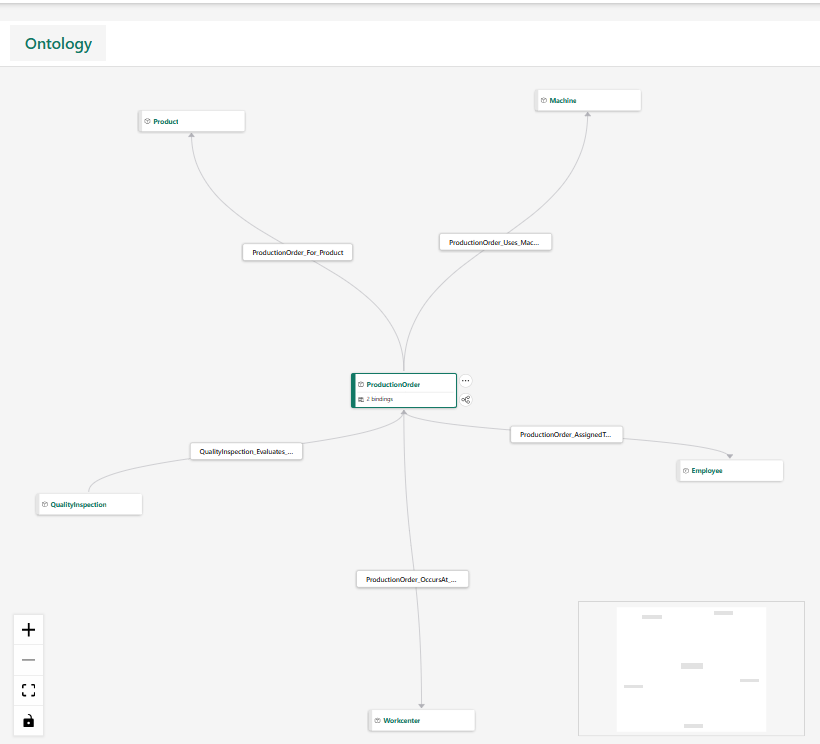
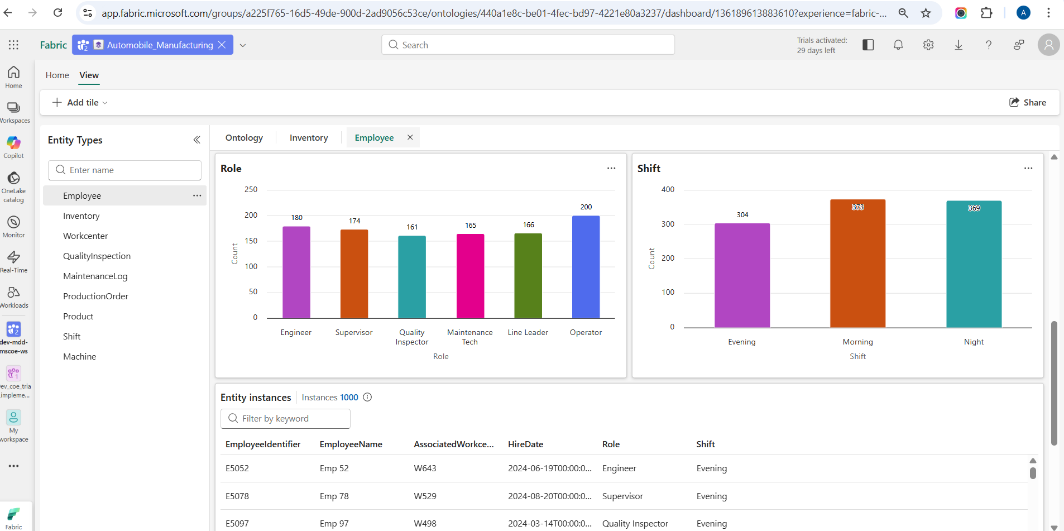
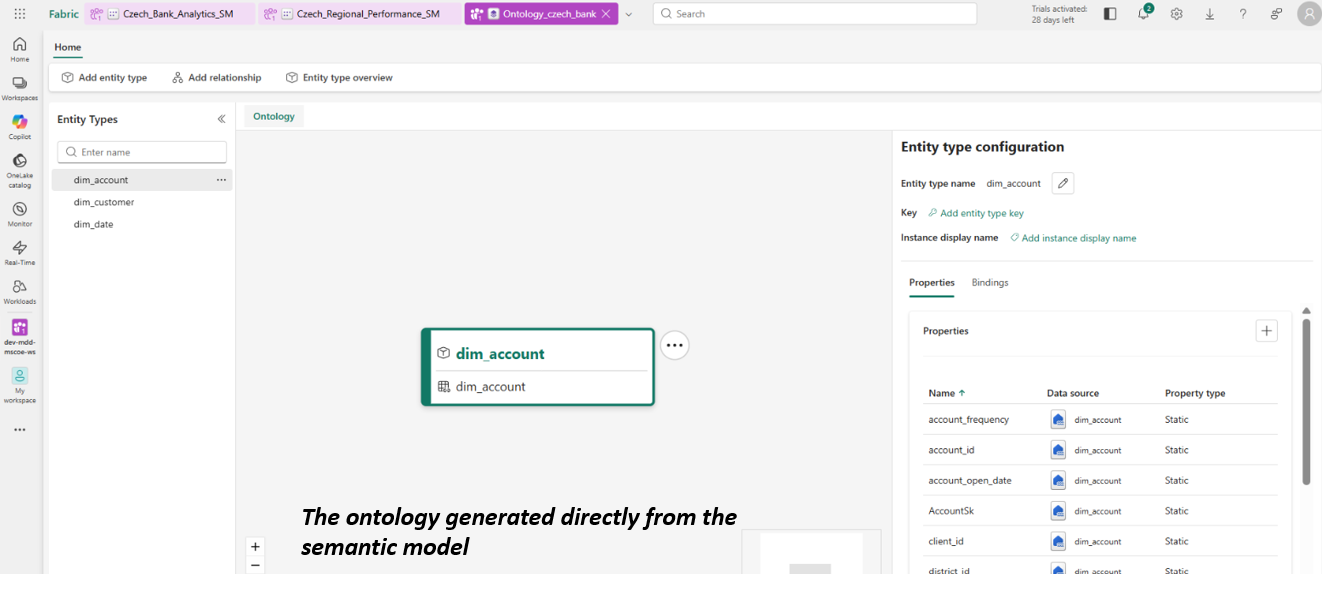
The Ontology is the semantic backbone of Fabric IQ. It transforms raw tables into rich business entities with clear lineage, governance policies, and relationships. Think of it as creating a universal dictionary for your business; every concept is defined once with its properties, relationships, and governing rules.
Fabric IQ makes this intuitive through visual modelling tools. You can see how different business concepts relate to each other in real time. The clever part? Your data doesn’t move. The ontology binds abstract business concepts directly to data that already lives in OneLake’s lakehouses, semantic models, and eventhouses, eliminating manual data stitching and complex integration logic.
Fabric Graph: Relationship-First Intelligence
Fabric IQ includes Fabric Graph, a managed graph layer for enterprise relationships. Your actual data stays in OneLake. Only relationships are stored in the graph. This gives you graph reasoning power without data duplication.
Run complex cross-domain queries, Order → Shipment → Sensor → Breach—using standard natural language, all without moving data around.
Core Features Powering Intelligence
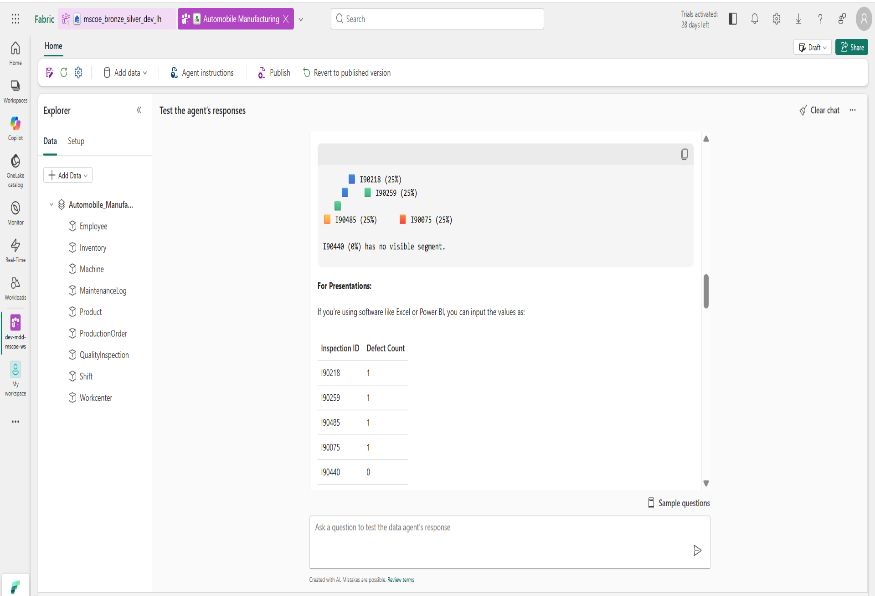
Data Agents (Conversational AI)
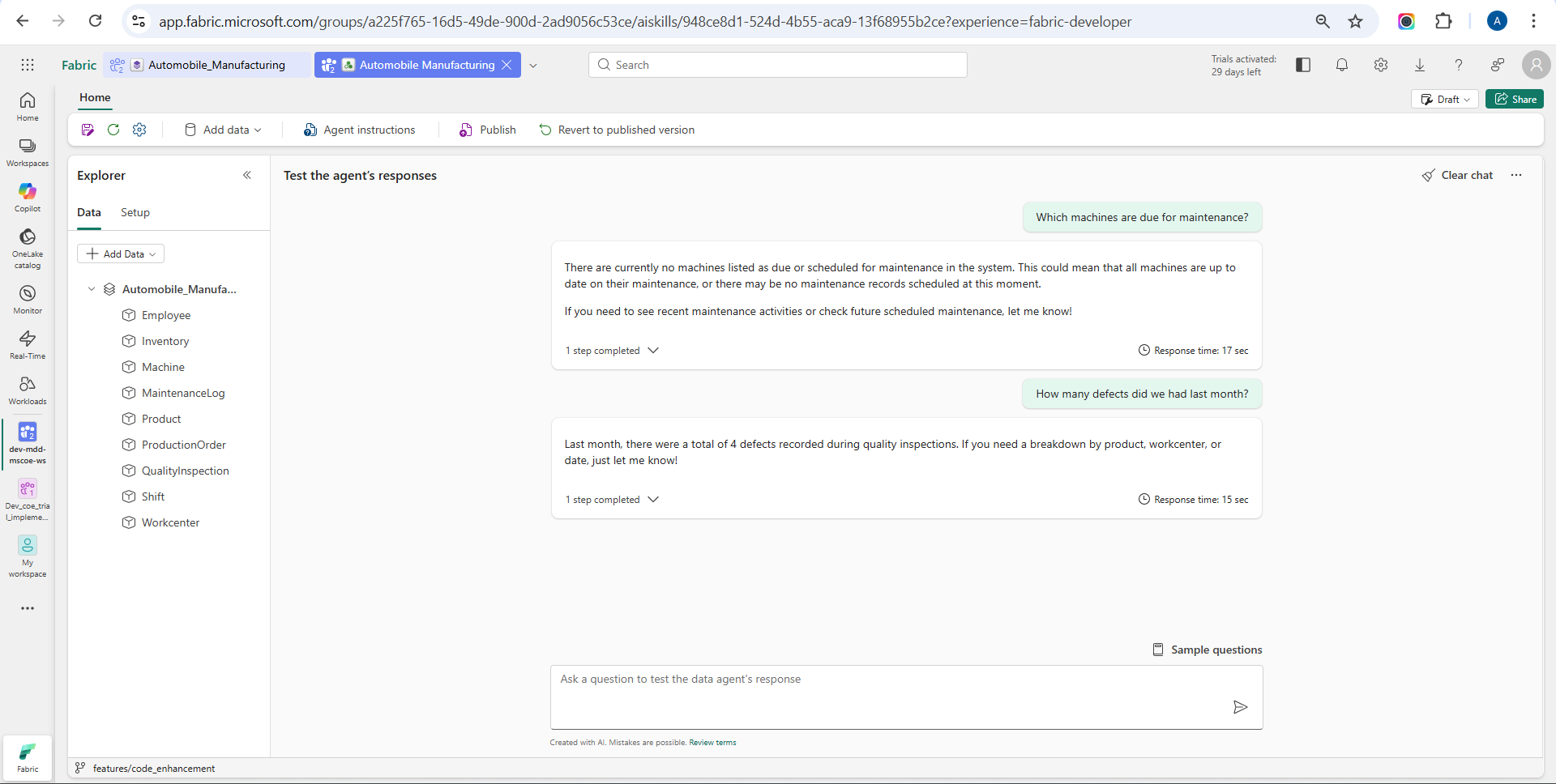
Ask complex business questions in plain language: “Which high-value customers haven’t ordered in 90 days?” Data Agents leverage the ontology to navigate your data and deliver answers without requiring SQL expertise.
Operations Agents
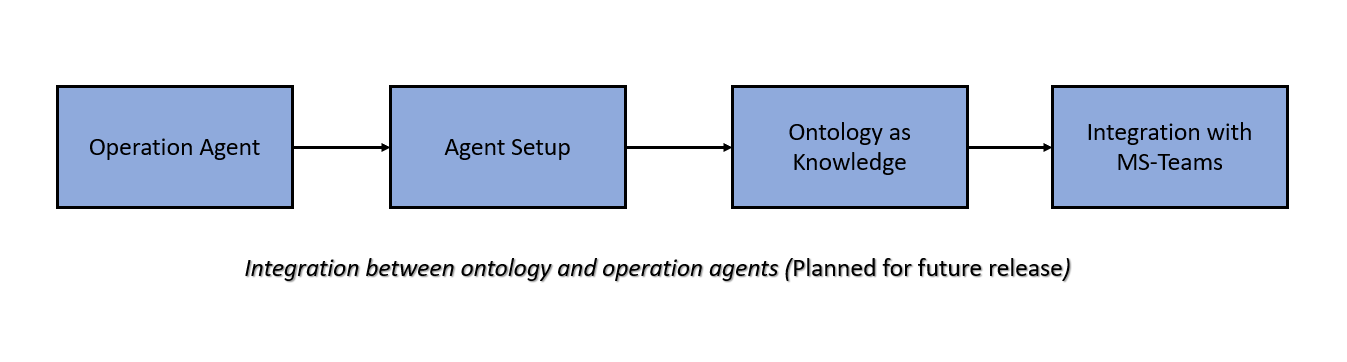
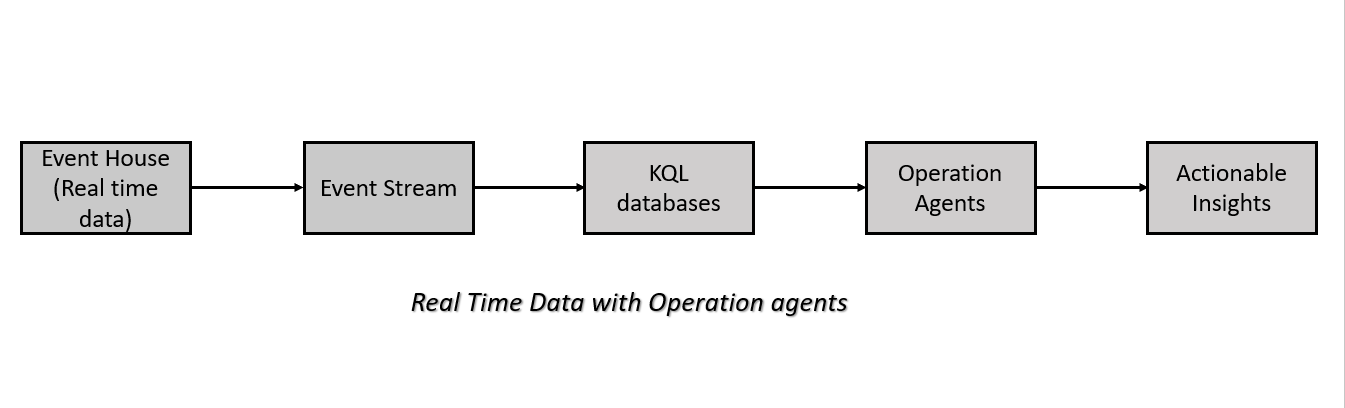
Go beyond questions to autonomous action. Operations Agents continuously monitor real-time data, reason over business rules and constraint violations, and automatically trigger actions like sending alerts or updating records, all governed by your ontology’s embedded business logic.
Graph Engine for Multi-Hop Reasoning
Analyze complex relationships across your entire enterprise. The graph engine enables deep reasoning across multiple data hops, from Customer to Order to Product to Supplier, uncovering insights nearly impossible with traditional relational models.
Business Rules & Actions
Define business logic directly in the ontology. Set constraints, validation rules, and executable actions that govern how AI agents reason and what they’re authorized to do.
Unified Lineage & Governance
Every definition, relationship, and change is tracked with full audit trails and version control. Trace how any insight was generated, ensure consistency, and reduce semantic drift over time.
Foundry IQ
Foundry IQ transforms enterprise data into strategic intelligence, seamlessly integrating with Data Agents to deliver advanced analytics and real-time insights powered by your ontology-driven architecture.
Real-World Benefits
Consistency Across the Enterprise
Every report, dashboard, AI agent, and application operates on the same foundation. Fewer errors. Less rework. Clearer collaboration.
Faster AI Development
Developers no longer spend weeks stitching together context from multiple systems. AI agents inherit business meaning, rules, and relationships automatically from the ontology. What used to take months now takes weeks.
Better Data Governance
Business rules embedded at the semantic layer catch data quality issues before they cascade into bad decisions. Governance becomes proactive, not reactive.
Explainable, Trustworthy AI
Because AI reasoning is grounded in explicit business semantics, you can audit how decisions were made. This builds trust, internally and with regulators.
Cross-Domain Insights at Scale
The graph engine enables interconnected analyses that would be difficult or impossible with traditional databases. Your data can reveal previously hidden stories.
Leverages Existing Investments
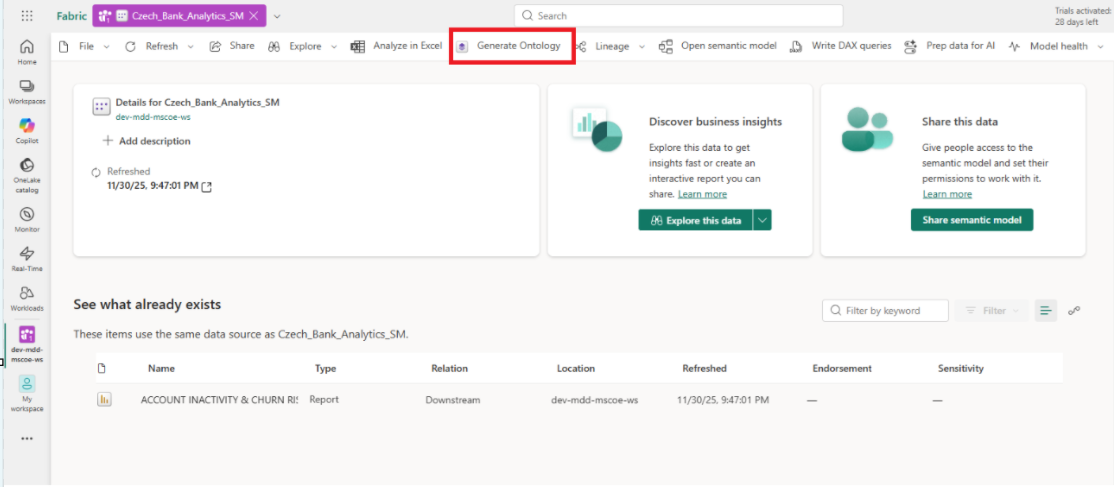
If you already have Power BI semantic models, Fabric IQ can elevate them into a richer ontology, protecting existing investments while unlocking new possibilities.
What This Means for Your Organization
With Fabric IQ, enterprises can build AI agents that genuinely understand business context, reduce time-to-production for analytics and AI projects, generate real-time decision-ready intelligence, democratize data access without sacrificing governance, and move from answering questions to automating operations.
In short, Fabric IQ transforms Fabric from a unified data platform into a context-aware intelligence platform. It’s the difference between having a library and having a librarian.
The organizations that modernize their data infrastructure today will be the ones making smarter decisions and outmaneuvering competitors tomorrow.
Why Yash!
Fabric IQ delivers the intelligence, and YASH ensures flawless execution. Real transformation needs more than technology; it needs a partner who understands enterprise complexity, governance, AI enablement, and long-term value creation.
YASH brings proven expertise in building secure data architectures, validated ELT pipelines, and knowledge graph–based ontology models, while fine-tuning AI agents with built-in governance and access control. With enterprise-grade AI/ML proficiency and full lifecycle delivery, we help organizations not just adopt technology but operationalize it, scale it, and continuously extract business value.
Our dedicated support and optimization ensure sustained performance, compliance, and adoption. With Fabric IQ and YASH, data fragmentation no longer slows innovation; enterprises gain a unified, AI-ready ecosystem to make faster, smarter decisions and stay ahead of the competition. The advantage lies in acting now, modernizing your data foundation, and transforming information into proactive intelligence that drives leadership.
The Path Forward
Adopting Fabric IQ isn’t just about deploying new technology; it’s about turning intelligence into action. That takes partners who understand enterprise complexity, governance, AI enablement, and the path to lasting optimization.
That’s where the experienced implementation partners make the difference. They bring the know-how to design secure data architectures, build validated pipelines, develop knowledge graph–based ontology models, and fine-tune AI agents with governance and access control at the core.
The real competitive edge doesn’t come from having more data or tools; it comes from being the enterprise that truly understands its data and can act on it faster, smarter, and with greater confidence than the rest.




Related Posts.

The AI-Ready ERP Checklist for CIOs and CFOs
Depesh Kumar


Unlock Data Editing Magic: Translytical Task Flows in Power BI
Lalit Goyal Prashant Atri







Unified Financial Data Platform: Empowering Modern Finance with Trust, Speed, and Scale
Phani Parashuram Srinivas Bhoopathi