

How manufacturers can maintain operations amid the loss of experienced personnel and the knowledge they hold
In almost all manufacturing plants from Erie to Allentown, one will find a similar complaint: orders are pouring in, the machines are there, yet there is no one to operate them.
Manufacturing is a key industry of Pennsylvania’s economy. The sector has over 560,000 employees (or about 9.5% of the state’s labor force) and contributes more than $116 billion annually to the economy. However, many plants struggle to hire and retain the qualified personnel. According to the Pennsylvania manufacturing analysis, 45% of companies were unable to pursue profitable deals due to lack of staff.
That is not a distant workforce forecast. It is revenue leaving the Commonwealth today.
Reasons for the Knowledge Gap to Persist
Retirement is the main component of the problem. Qualified machinists, maintenance technicians, quality control specialists, and even line managers retire and with them go many decades of knowledge that have never been recorded formally.
30 years of experience might manifest in a remark like “When the machine sounds like this, it means there is something wrong with the spindle bearing.” And when the employee retires, the knowledge goes away together.
Apart from that, the nature of work itself is changing: modern operators not only have to use the machines to manufacture goods but also should be able to analyze sensor readings, monitor digital dashboards, interact with automation systems, troubleshoot software-related issues etc. New advanced technologies not only introduce new tasks to employees but also introduce new skillsets needed by manufacturers.
Specialized courses provided by community colleges, apprenticeship programs, and other workforce development initiatives help people to acquire new skills. For instance, Pennsylvania’s WEDnetPA program offers qualified employers financial aid to train existing and new employees. Training, however, cannot make people learn decades of experience over night.
Pennsylvania cannot simply hire its way out of the problem. Manufacturing also requires an efficient mechanism to preserve and transfer knowledge.
Where AI Can Make a Practical Difference
There is always plenty of hype around the AI topic. Here, however, we are talking about the real benefits that artificial intelligence can bring to the production process.
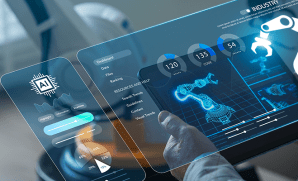
- Knowledge preservation. An intelligent knowledge assistant records decades of maintenance and repair history and makes it accessible for any technician in seconds.
- Predictive maintenance. Predictive maintenance helps to spot the issues weeks ahead, so lean team works in a scheduled manner instead of working in fire-extinguishing mode.
- Quality control. AI-enabled vision system inspects each and every product, making it possible for an inspector to focus on important decisions instead of repetitive checking.
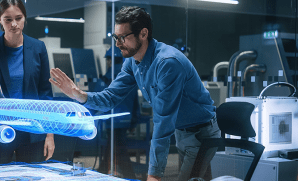
- Fast onboarding. Intelligent digital work instructions help new employees contribute in weeks, not years and make the job more attractive to tech-savvy employees.
- More done with less. Intelligent scheduling and supply chain management allow a few planners do the work that used to take an entire department to complete.
AI does not replace people, it augments their capabilities.
People First, Technology Second
The most successful manufacturers see AI as an enablement technology—one that enables their workers, rather than one that helps cut their numbers.
Consider a new operator facing a new problem. Rather than wait for the company’s most senior technician to get around to it, the operator can access a controlled knowledge base comprised of officially sanctioned documentation and plant history to determine possible causes, appropriate safety procedures, and what steps should be taken next to isolate the issue.
The human-in-the-loop principle is important. Government studies of the role of AI in operational settings underscore the value proposition of AI-enabled decision support and point out the dangers posed by autonomous solutions in situations where errors could result in negative consequences.
Current technologies can also make manufacturing careers more appealing to the next generation. Jobs combining hands-on work with modern data analytics, automation, and digital tools provide a direct connection between skilled trades and the skills sought by today’s young workers.
You can buy machines; you need to build capability. And AI can speed the building of organizational capability, provided the technology is implemented properly, with people, process, education, and governance in place to ensure its effectiveness.
Closing the Gap with YASH Technologies
Here’s where YASH Technologies helps manufacturers transform AI capabilities into real-world operating capabilities.
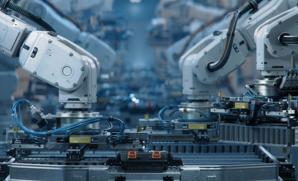
Based on our nearly 30 years of expertise in technology and digital transformation, YASH partners with manufacturing organizations on predictive intelligence, factory automation, digital manufacturing, quality management, operational analytics, and connected factories initiatives. Our manufacturing portfolio helps manufacturers increase visibility, make better decisions, perform proactive maintenance, and connect plant-floor information with enterprise-level processes.
We help manufacturers identify high-value use cases, lay down the data foundation, implement AI into their manufacturing processes, and deploy solutions in production mode. The aim isn’t technology in itself; it’s improvement in terms of downtime, quality, productivity, knowledge retention, and worker skill level.
Learn about how YASH Technologies can help your plant retain knowledge and make your workforce more productive and resilient. Reach out to us at info@yash.com.

More From Author.
Related Posts.
The Smart Factory Workforce: Getting Pennsylvania Ready for the Next Industrial Revolution
Gowthaman Sibi Kodairasu
The Advent of AI Copilots in Pennsylvania Manufacturing
Gowthaman Sibi Kodairasu