
Why Organizations Wait, and Why Waiting Eventually Costs More
Publish Date: October 12, 2026Most organizations don’t keep legacy systems out of neglect. They keep them because, for a long time, it’s the rational choice. Legacy platforms run the processes that keep the lights on — billing, payroll, order management, compliance reporting, core banking, claims processing & many more processes— and touching them feels riskier than living with their limitations.
That calculation holds until it doesn’t. Regulatory change, margin pressure, client expectations, or a merger can flip legacy systems from a “known, manageable cost” into the biggest risk on the balance sheet. Understanding both sides — why organizations rationally delay, and what tips the scale — is key to knowing when modernization stops being optional.
Why Organizations Rationally Stick with Legacy Systems
1. Risk and continuity outweigh efficiency gains
Legacy systems typically run an organization’s most critical, revenue-generating processes — billing and time tracking at a services firm, core transaction processing at a bank, inventory and supply chain systems at a manufacturer, etc. Any disruption can directly affect customer commitments, service-level agreements, and reputation.
The operating principle becomes don’t rock the boat. If a system is stable, compliant, and well understood, there’s little appetite to touch it without a clear, funded, business-critical reason.
2. High switching costs and hidden liabilities
Modernization projects are expensive, complex, and risky — data conversion, process redesign, retraining, integration across dozens of tools, and, for larger organizations, compliance across multiple jurisdictions.
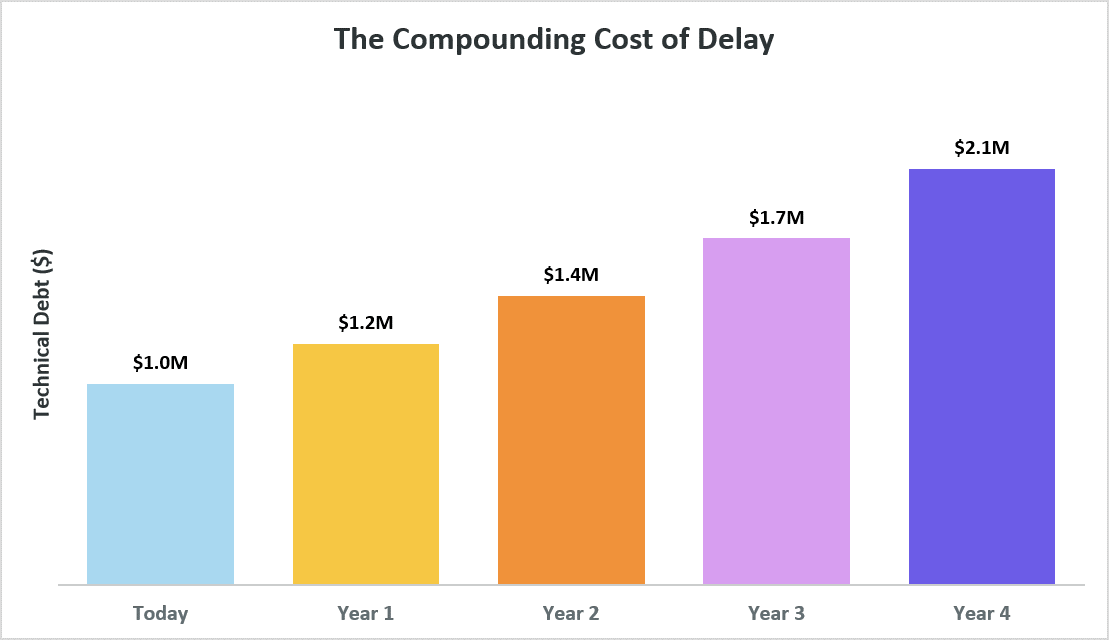
Meanwhile, technical debt compounds quietly. The longer a system stays in place, the more customizations and undocumented dependencies accumulate, making any future change harder and costlier. Legacy maintenance is a known, predictable cost; transformation is a large, uncertain investment with a payoff that plays out over years.
3. Organic and inorganic growth create a patchwork
Organic growth layers new tools on top of old ones. Mergers and acquisitions add entirely new stacks, processes, and data models on top of that. The result isn’t elegant, but it’s workable — held together by local fixes and manual reconciliation between systems. The natural response is to standardize only where the pain is most acute, and otherwise preserve existing investments rather than reopen every integration at once.
4. An efficiency-first lens can favor incremental fixes
When leadership focuses on operational efficiency, the instinct is often to optimize within current constraints — automating manual steps, adding robotic process automation (RPA) — rather than replacing the core system outright. This delivers near-term gains with far less risk than a full overhaul. It’s reasonable until broader business priorities shift and expose the limits of incremental fixes.
The Hidden Cost – Cost of Delay
Nearly half of organizations continue to operate legacy systems simply because they remain functional. However, the operational strain this creates is often felt acutely by engineering teams while remaining largely invisible to finance and leadership.
A compelling internal business case bridges this gap by quantifying the true cost across four key dimensions: ongoing maintenance labor, end-of-life vendor support risk, security exposure, and the AI-driven opportunities the current architecture prevents you from pursuing.
A structured diagnostic assessment is the most reliable way to surface these real numbers for your specific systems. Below is the illustrative example.
The Tipping Point: When Modernization Becomes the Safer Bet
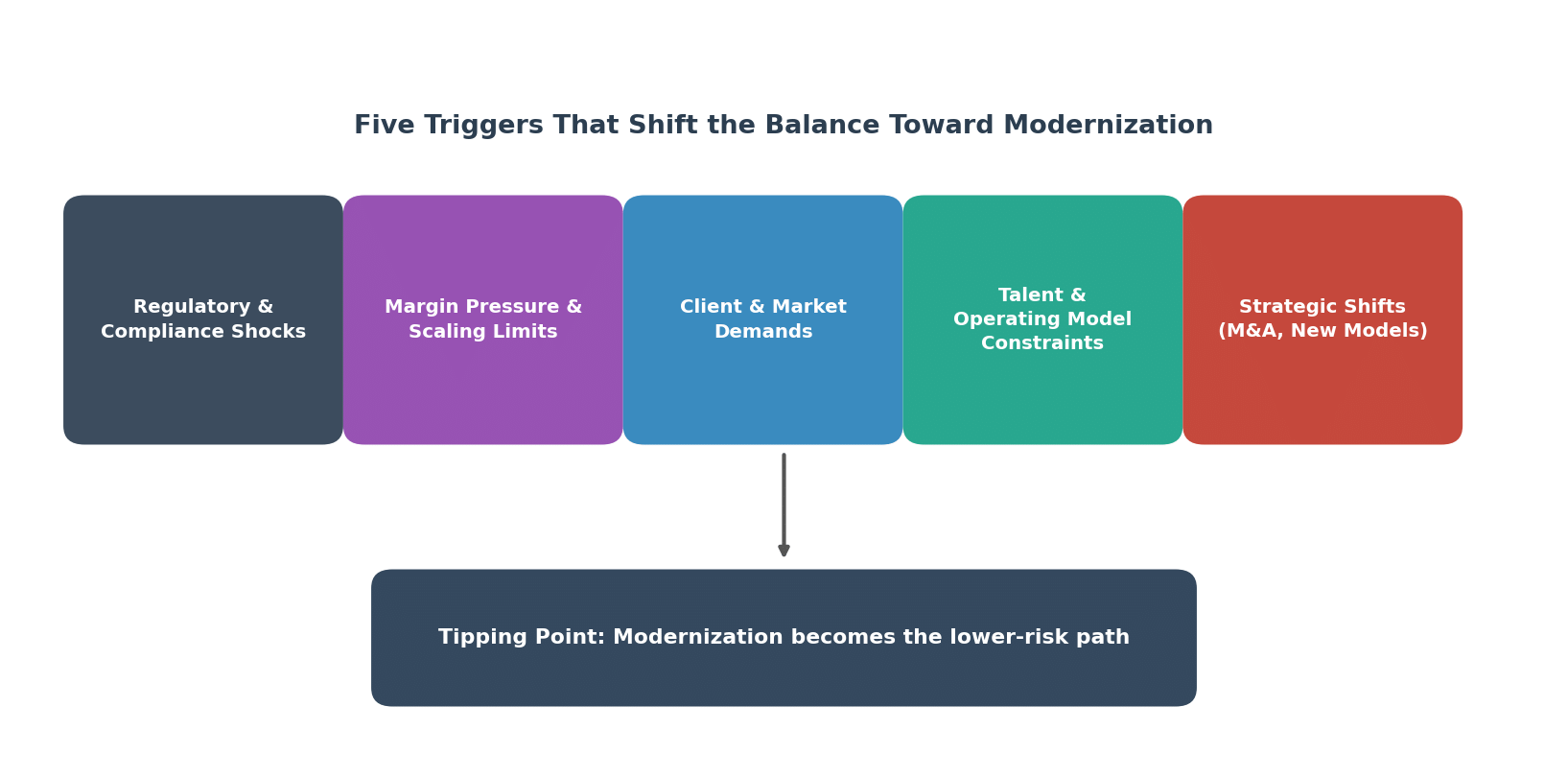
Despite all of the above, certain triggers change the cost-benefit equation entirely — to the point where not modernizing becomes the riskier path.
1. Regulatory and compliance shocks
New data privacy laws, financial control requirements, or industry-specific regulations can emerge that legacy systems cannot support without significant rework. Audit findings that explicitly cite system limitations as a control weakness are a strong signal that the risk calculus has flipped.
2. Margin pressure and scaling limitations
As an organization scales, legacy-specific inefficiencies — manual reconciliations, slow reporting, duplicate data entry — start to erode margins in a way that’s hard to ignore. Eventually, the business can’t expand into new markets or serve larger clients without disproportionate growth in headcount.
3. Client and market demands
Customers increasingly expect real-time visibility, self-service portals, and seamless digital experiences. When legacy systems can’t deliver this, the organization risks falling behind competitors who can.
4. Talent and operating model constraints
Maintaining legacy systems often depends on a shrinking pool of specialists with niche expertise who eventually retire or move on. Digitally native talent is reluctant to build a career on outdated platforms, making it harder to attract the people the organization needs.
5. Strategic shifts — new business models and M&A
Post-merger integration is one of the clearest tipping points: maintaining several parallel legacy stacks is rarely sustainable given the cost of consolidating onto a single rationalized platform. New business models, too, often can’t run on infrastructure designed for a different era.
What Modernization Actually Involves
Once the tipping point is reached, organizations typically combine several strategies rather than picking one:
- Refactoring — restructuring existing code to improve performance and maintainability without changing external behavior; often the fastest way to reduce technical debt.
- Cloud migration — moving workloads to the cloud for elasticity, lower capital expenditure, and better disaster recovery.
- Re-architecting — redesigning applications around modern patterns (microservices, APIs) for scalability and long-term flexibility.
- Replatforming or replacement — where the underlying platform has reached end of life, moving to a modern commercial or cloud-native solution.
The right mix depends on risk tolerance, the criticality of the systems, and how much runway exists before the trigger points above become unavoidable.
Benefits for Legacy Modernization
Legacy system modernization delivers measurable value across both financial and operational dimensions of an organization. It frees up significant IT budget by reducing the cost of maintaining outdated infrastructure, while simultaneously reducing security risk by eliminating unsupported, vulnerable systems. Beyond cost savings, modernized systems boost developer productivity and operational efficiency by replacing rigid, hard-to-maintain codebases with modern, scalable architectures. Together, these improvements accelerate digital transformation, enabling organizations to innovate faster and respond more effectively to changing business needs. Benefits can be tracked under the following categories:
- IT Budget Reallocation
- Security Risk Reduction
- Modernization Speed
- Cost Reduction
- Developer Productivity
Legacy System Modernization: Best Practices
The following practices distinguish successful modernization programs from those that stall.
- Begin with a discovery phase rather than jumping into code. Projects that bypass dependency mapping inevitably incur greater cost and delay later in the lifecycle.
- Establish clear ownership before project initiation. Determine in advance who is authorized to make trade-off decisions as the scope evolves. Ambiguous or diffuse ownership remains the leading organizational cause of project failure.
- Pursue modernization in phased waves. Decommission obsolete components first, and prioritize the remaining systems based on maintenance burden and business value. Avoid attempting a simultaneous, wholesale transition.
- Approach data migration as a deliverable – Establish acceptance criteria for completeness, accuracy, and performance before migration commences, as data-related failures are costly and difficult to reverse.
- Convert institutional knowledge into formal test cases. Document undocumented business logic through acceptance testing, validating it first against the legacy system and then against the new system to confirm no functionality has been lost.
- Evaluate progress by business outcomes, not by task completion. A statement such as “the authentication layer was migrated” reflects a milestone; a statement such as “authentication-related incidents decreased by 60%, and developer time spent on authentication issues fell from 12 hours to 2 hours per week” reflects a measurable business outcome.
- Incorporate rollback planning from the outset. Every phase of the initiative should include a rollback strategy that can be executed without disrupting production operations.
Conclusion: The Cost of Delay Is Rarely Neutral
It’s tempting to treat “wait and see” as a low-risk default. In reality, delay is not neutral — technical debt compounds, the gap between what the organization can deliver and what clients and regulators expect widens, and the people who can safely maintain the old system keep leaving. None of this shows up in a single budget cycle, which is exactly why it’s easy to underestimate until it surfaces as a compliance penalty, a lost client, or a stalled acquisition. The organizations that modernize well are the ones that recognize the trigger points early and act before the cost of standing still exceeds the cost of moving.
But modernizing systems one at a time isn’t enough — it needs to be paired with Application Portfolio Rationalization to decide what to retain, retire, or consolidate, and Value Tracking to confirm each investment delivers its promised outcomes. Anchoring both to the budget cycle turns modernization from a one-off project into a continuously governed program. The question worth asking isn’t only “what will modernization cost us?” It’s equally: “what is staying exactly as we are costing us — and for how much longer can we afford not to know?”


Related Posts.

Cybersecurity as a Deal Maker: Reframing Security Due Diligence as a Growth Enabler
Mori Beheshti Prateek Goyal Shreyaa

Post-Merger IT Integration: A Catalyst for Digital Transformation
Mori Beheshti Prateek Goyal Shreyaa

TSA as a Service in Divestiture Transactions: Strategic Implications and Frameworks for IT Service Providers
Mori Beheshti Prateek Goyal Shreyaa

The Hidden ROI of Phase 0: Measuring What Never Happened
Akansha P Parimit Lohani


The Compounding Dollar Value
Gaurav Kankani Parimit Lohani
Beyond the Happy Path: How Asking the Right Questions During Discovery De-risks Automation
A V Shree Anurag Sameer Patnaik

Adapting to Inflation: The Necessity of Continuous Scenario Planning for a Sustainable Business
Prateek Goyal Sameer Patnaik